Hi all. I’ve been tracking my food intake over the past week. I did this sporadically over the years when I was dieting (or trying to, that is). Now that I’ve been keeping a food log for a week, I’m getting an inkling of why I never kept my food log for any length of time: I’m not sure whether it’ll actually help me make healthier food choices.
That is, I’m pretty sure it won’t. Almost each day over the past week, the app I’m tracking my food intake in has been telling me that I consume more calories than I burn. It’s also telling me that I consume more fat and carbohydrates than I should and not enough protein. Yes, even on days when I eat meat and dairy. And I tend to choose low-fat dairy and the meal delivery service offers lean meats.
I’m not sure whether I want to continue logging my food intake, because on the one hand, yes, I want to be more conscious of what I shove into my mouth. On the other hand, I don’t want this to become an obsession, especially because it tends to lead to a pendulum effect. What I mean is I might like to know what I’m eating, but if the app keeps telling me it’s too much, I am probably going to decide to screw the entire thing after all and just start eating whatever the heck I want., I don’t want this to turn into another diet.
One thing that the app does help me with, is predict my weight gain or loss. Or at least, that’s what I hope it’ll do. For years, after all, I’ve been worrying that I experience unexplained weight loss. The reason is the fact that I quite easily maintain these days and even lost over 20kg over the years. I’m hoping that, if I do decide to follow through with MyFitnessPal, I’ll be able to see why I’m maintaining, losing or gaining. One worry that I never even thought of until I learned about protein though, is that I’m losing muscle mass.
Hi everyone on this late Friday evening. I’m joining #WeekendCoffeeShare again. It’s nearly 10:30PM as I start typing this post, so no more coffee for me. If you’d like something to drink though, feel free to grab a cup of your favorite beverage and let’s chat.
If we were having coffee, first I’d talk about the weather, like I usually do. It’s been cloudy and rainy most of the week with daytime temps around 20°C. It’s also still pretty warm indoors.
If we were having coffee, I’d share that I’m still meeting my movement goal on my Apple Watch so far each day. Did I share that I finally got a perfect month again in August?
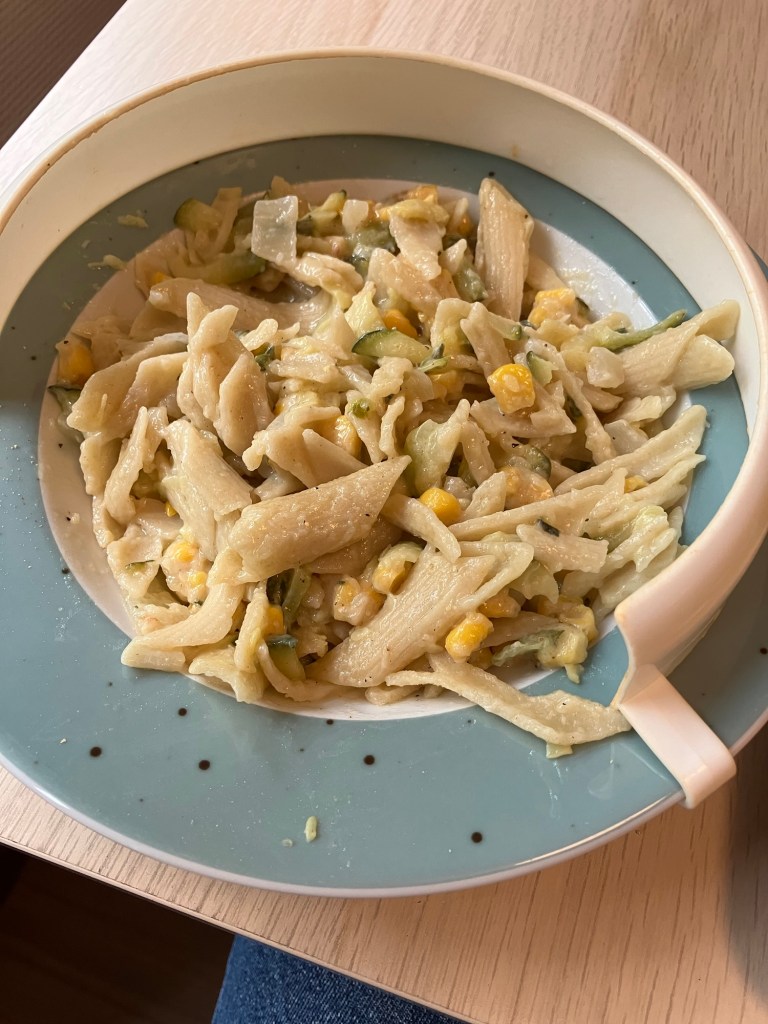
If we were having coffee, next I’d tell you that I’m still going strong with the culinary activities. On Wednesday, I cooked a creamy pasta dish. The recipe was supposed to be vegan with a plant-based Parmesan cheese alternative and coconut milk in it instead of cream and actual cheese. I got quite stressed early in the week, feeling guilty that I’d de-veganized the meal by choosing to get regular Parm. I’m not a vegan myself, but I once again twisted my best friend’s yapping about veganism to be a personal attack. It wasn’t, for clarity’s sake! In fact, when she found out I had cooked the dish for my fellow residents as well, she said she’d have discouraged me from using vegan Parm since it can be quite disappointing taste-wise to those who are used to consuming real cheese. She also made it clear that I don’t need to justify my lifestyle choices to her. I apologized for having misinterpreted her activism as a personal attack. By the way, the meal was good.
Pasta
If we were having coffee, then I’d tell you that I’ve been keeping a food log for the past few days in the MyFitnessPal app. I’m doing pretty well except that I’m finding it’s a struggle to get in enough protein on days that I’m not eating meat. I definitely need to research plant-based protein sources, since I’ve read on the Dutch Voedingscentrum (Food Center) site that it’s recommended to get 60% of your protein from plant-based sources. I’m also not getting in enough fiber or so the app says.
If we were having coffee, then I’d share that, today, we had French fries and a snack in honor of a fellow resident’s birthday. I’d also eaten an apfelstrüdel in the afternoon, so I exceeded my daily calorie goal by over 300.
I had originally planned to create crispy rice salad this weekend, but the shredded cabbage I got from the supermarket yesterday would’ve needed to be used by Sunday. I ate it today as a side with my fries and snack, because I wasn’t sure it’d retain its full freshness until I could create the rice salad. Now my best friend wants to come by on Sunday anyway, so I’m now not sure whether I’ll be making the crispy rice salad tomorrow or will be postponing it until next week.
Initially, we’d agree to see each other tomorrow, since I needed to get my hair cut. However, this morning I thought I had a cold so canceled the hairdresser appt. My best friend then asked to meet on Sunday because that’s what we usually do. It turned out I don’t really have a cold (though it might be on its way) after all. I do have pretty nasty bowel cramps from the fat in the fries plus the cabbage though. Still not getting enough fiber according to the fitness app.
If we were having coffee, I’d share that I’ve been feeling rather upset about the lack of apparent progress on the moving front. It’s not necessarily that I wish I could move sooner, but that I’m afraid the higher-ups are doing things behind my back that I have no say in and that this means they won’t care about where I’ll be moving.
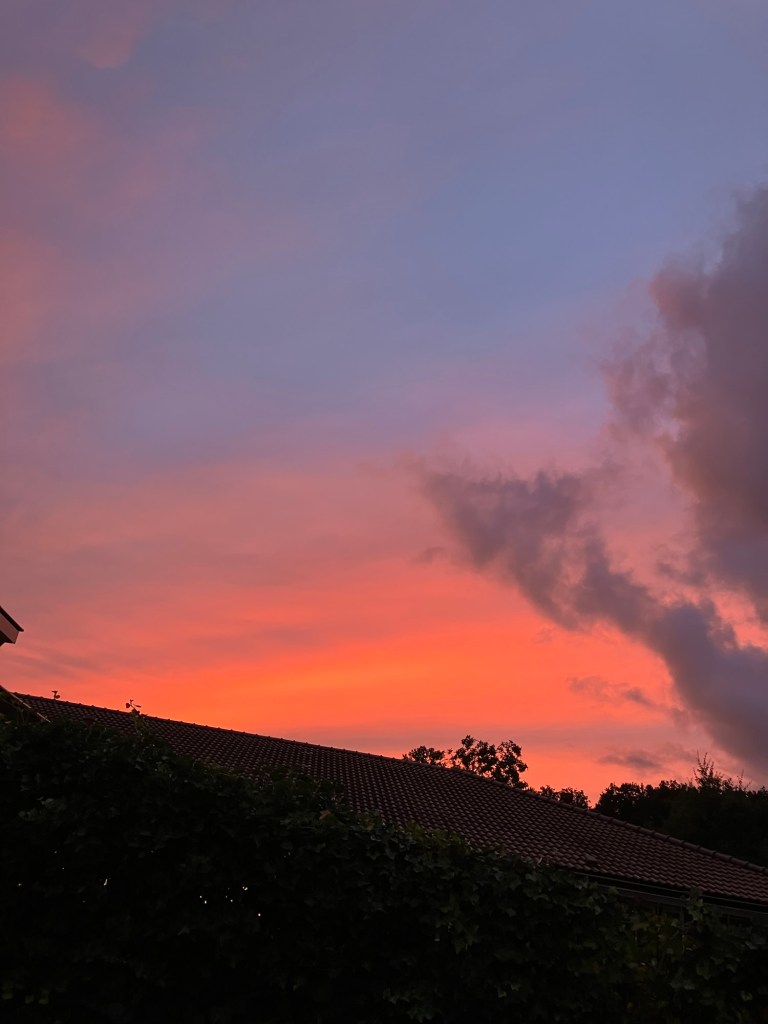
If we were having coffee, I’d end with a photo of this evening’s sky at sunset. It’s now past 11:30PM and I’m going off to bed, I think.
Hi everyone! It’s the final day of the month and this means it’s time for my monthly recap. August was a pretty good month in terms of my engaging in interesting and enjoyable activities. It was also a slow month, in that no progress has been made on the home-finding front. In fact, I only realized yesterday that it’s been literally a month since the client supporter contacted me.
I could of course blame the summer for the slow-going process. It’s true, in that my support coordinator and assigned staff were both off for the greater part of August and the behavior specialist is now off until mid-September. It isn’t good though. Because of this, I E-mailed both the client supporter and the client confidante on involuntary care today. After all, no formal progress doesn’t mean life doesn’t go on. I mean, back in my days of online forums, I’d always use some variation of the tagline “Time spent in institutions is not life experience deductable” as my signature. It’s true for the client, but too often the people in charge do not realize this.
It is, in this light, good that I was able to spend a significant amount of time on enjoyable activities. One of those has been cooking and baking. I originally wasn’t sure I wanted to spend over €300 on a food processor if I wasn’t going to be able to do cooking activities at my next home anymore. I obviously could’ve bought a cheaper model, but eventually decided to go for it and just get the model I wanted. I’m lucky in this respect that I’m relatively financially secure. And in case you’re wondering, it took some fiddling around with the whisk attachment, but eventually the cake I wanted to bake on Saturday was a success.
I haven’t heard anything about my Care and Force Act agreement (on when I can and can’t be restrained or secluded) since having had the meeting with the behavior specialist and client confidante three weeks ago. This honestly sucks big time, since even though I’ve only been restrained once during this time, there’s no guarantee that things won’t turn around for the worse again until I’ve actually gotten a proper agreement. And truthfully, even if or when I do, I doubt things will ever be okay here at this home.
That’s the sad realization I’ve come to this month: no matter how good my day is, I’ll always be waiting for the other shoe to drop. And I think this perpetual sense of apprehension isn’t altogether unfounded.
Hi everyone! I’m joining in with #WeekendCoffeeShare once again. It’s nearly 11PM, so I’m hoping I can finish this post before midnight. I don’t think I even want water anymore before going to bed, but if you’d like a cup of something to drink, feel free to and let’s chat.
If we were having coffee, first I’d talk about the weather. It’s been all over the place. Early in the week, we had cool nights during which the temperature dropped to 7°C. Yesterday was hot again with a daytime temp of 29°C. We got thunderstorms last night and it’s been raining all day today.
If we were having coffee, I’d share that I met my movement goal on my Apple Watch each day except for today so far. Now I’m in doubt as to which option is the lesser of two evils: not meeting my movement goal or not finishing this post before midnight. Neither is truly disastrous, of course, but both cause me some autistic error.
If we were having coffee, I’d tell you that, yesterday, I rode the side-by-side bike to Deventer with a staff. We visited the market, where I bought olives mostly because the vendor was trying to be friendly. I know it’s a selling tactic but I don’t care. Heck, he even suggested he’d see me tomorrow (today) at the other market I frequent. I told him not to get his hopes up.
We also ate lunch and then rode the bike to the town center for Ekoplaza, a health food store. I was looking for silken tofu, but it was in the fridge and I had to cycle nearly half an hour back to the institution, so I decided that wouldn’t be a good idea. Then I bought several other things that I later realized I should’ve bought at the regular supermarket because they were horribly expensive at Ekoplaza. Oh well.
If we were having coffee, I’d tell you I finally bought myself a food processor. I’m not entirely sure I like the particular model I got, mostly because it has a lot of gadgets I thought I could use but may not be able to after all and it lacks attachments I wish it had. For example, I full on thought it had a grinder attachment but it didn’t. That either means chopping my onions myself or investing in another part (thankfully, the grinder is available as an attachment for this model).
Tomorrow, I’ll find out whether the thing actually does the job it was originally intended for, because I’m going to make a vegan and gluten-free cake that the mixture for needs to be processed. I’m a little saddened that my best friend doesn’t feel well so isn’t going to come by on Sunday. If it turns out good though, I will make it another time for her.
If we were having coffee, then I’d tell you I did enjoy a dinner prep activity again on Wednesday. I cooked something that was called a curry on the Good Food website but it was more like a bean stew. It had kidney beans, tomato, onions, garlic and ginger in it, in addition to coriander stalks. The coriander leaves were supposed to be used on top of the curry, but the staff forgot those. The weather outside was really nice that evening, so I ate my meal at my outside table.
If we were having coffee, finally I’d share that it’s probably supposed to be this way but I just found out that another person I recently became friends with is a vegan. We met through a peer support group and for a while used to talk mostly about our issues, but today I shared about my Ekoplaza adventure and this got us chatting plant-based food. If there’s a higher power, it’s probably telling me I should go vegan too. Then again, my best friend already told me jokingly that I’m a changeling (referring to a former online nickname) for not fancying pizza tonight.
Hi everyone. Recently I’ve been thinking about the dietary choices I’ve been making over the years. The reason was the recent argument with my best friend over the tuna salad and the fact that I’d said I’d try to cook just vegan when preparing meals for myself. The thing is, I should’ve known it wasn’t going to work out. In that sense, she was right that I’d lied.
This signifies a common theme with my life choices: I full-on intend to follow a particular lifestyle, try it for a short while than abandon the entire thing and do whatever the heck I like. I try to avoid this pitfall this time. I’m already happy that I’m still making an effort to be aware of what I shove into my mouth and its impact on my health, animals and the environment. In that sense, it’s progress, not perfection and that’s totally okay with me. I will probably never be a vegan, after all.
The same happened when I was dieting to lose weight. I hated the strict food plan the dietitian gave me, tried it for a short time (even shorter than my vegan experiment) only to give up on it. Thankfully, I was able to negotiate a middle path with the dietitian and I’m doing the same with myself about eating plant-based. )For clarity’s sake: it wasn’t like my best friend was trying to convert me to veganism, so in this sense it’s only myself I have to be accountable to.) In other words, I’m not eating whatever the heck I fancy at any given moment, but I’m not pushing myself to stick to any diet or eating preference. That’s just going to backfire, after all.
Tomorrow, by the way, I’m cooking a vegan curry yet again. Not with chickpeas this time. I love trying out many different foods and learning about their impact. For this reason, I also actually like my best friend’s yapping about veganism.
This post was written for #FOWC with the prompt of “Dieting” and for #RDP with the prompt word of “Whatever”.
Hi everyone! Today’s prompt for #SoCS is “starts with ‘gl'”. I immediately thought of the word “glimmer”. This is a beautiful word with an even more beautiful meaning. It is the positive counterpart to a trigger. That is, well, in psychology positive triggers exist too, because a trigger is anything that evokes an emotion be it positive or negative. However, in popular culture a trigger is usually negative. Glimmers are the opposite, those things that remind us that life’s worth living.
I am struggling a lot lately, but still try to find glimmers in each day. For example, making a smoothie can be a glimmer. So is the fact that, on Monday, I spontaneously decided to take out my slow juicer and make a juice. I also decided to finally make a card for the intellectual disability physician involved on my case since I moved to this care agency (yes, the original home in Raalte) nearly seven years ago. She’s retiring and I hope she has a wonderful time.
Glimmers can also be memories that are evoked. Like, today I somehow got talking camping with a staff. This brought back some nice memories from my years going camping at Vlieland with my parents and sister as a child.
It helps me to write out at least one positive each day. That doesn’t mean I can’t write down negatives too, of course, and sometimes the only positive I can think of is a cup of tea. But it’s something at least.
Hi everyone. I’m once again joining in with #WeekendCoffeeShare. I just had my last cup of coffee for the day. I drank it out of my 40th birthday mug. That is, one of my two 40th birthday mugs, the one with the unicorn. I also had a slice of homemade cake with it. There’s still some cake left. Let’s have a drink and let’s catch up.
If we were having coffee, first I’d talk about the weather. Was it seriously blazing hot last week? Now the daytime temperature barely gets above 20°C and it’s been raining most of the week. I tell myself it’s good for nature and at least it’s better than the tropical temps we used to have.
If we were having coffee, next I’d share that I’m still going strong with my movement goal on my Apple Watch. Yesterday I just about met it because it had been raining all day. I did try to do some stretching and other non-cardio exercise yesterday and today. Boy, does one of the probably rather weak muscles in my upper arm hurt now!
If we were having coffee, then I’d tell you that I did several culinary activities again over the week. On Wednesday, I made another vegan curry. I forgot to take a picture, but it was very tasty.
Yesterday, a staff wanted to make overnight oats because it’s in my day schedule. That day schedule is one thing that needs to be looked at before I move, but that’s a topic for another post. Let’s just say activity-based planning doesn’t work the way I’d envisioned it. Anyway, I said I wanted to make homemade granola. I pulled out a recipe, but didn’t know that there were annoying ads in the way that made it hard for the staff to read the recipe. Plus, this staff rarely cooks or bakes. Thankfully, another staff was able to step in, though it took me having a meltdown and the first staff restraining me before this happened. I finally did make the granola.
The staff apparently got interested, because today when he was assigned to me again and it was too rainy to go outside, he proposed to do a baking activity. We went into the storage room to look for ingredients and asked a more culinary savvy staff for advice. That’s how we got to baking the aforementioned cake. The original recipe called for vanilla, but we didn’t have that on hand, so I improvised and added cinnamon instead. The cake was good, though it was a little too dry for my liking.
If we were having coffee, I’d also tell you that I’ve been hyperfocusing on more fancy things to cook and bake too. For example, earlier in the week or maybe it was last week when making the vegan mango mousse, I found a recipe for a vegan and gluten-free cake. Yesterday, a staff tried to order the ingredients so that I could bake it tomorrow, but the online grocery store the care home orders from didn’t have most of what we needed. That led to a drive to the next town (like I said, it was raining all day, so no bike ride) for the needed ingredients.
Then of course I already baked a cake today. Besides, the one I originally wanted to make tomorrow could best be prepared in a food processor and I still don’t have one. I thought of ordering one yesterday, because Bol delivers the next day, but the day center which serves as the institution’s package collection point was closed today. For this reason, I decided to postpone baking the fancy cake. Thankfully, all ingredients have a long shelf life.
If we were having coffee, finally I’d share that there’s no progress on the moving front yet. I met with the behavior specialist again on Monday to discuss some concerns. This was a good meeting. Mainly, she reassured me that I’m not required to accept whatever new place the bureaucrats decide will be suitable. Like, obviously I can’t turn down a place because of a minor detail (I always jokingly use the color of the carpet as an example), but so far all the criteria I’ve specified sound reasonable to her.
Hi everyone. Yesterday someone in one of the online communities I’m part of shared about learning to use a white cane because of vision loss in addition to an acquired brain injury. The person summed up all the impairments the brain injury had already caused. This got me wondering how he’d be able to use a white cane, so I asked him. I won’t go into the conversation, but it reminded me how significant my impairments and particularly the combination of them are.
For example, I can’t use my white cane in the proper way without losing my balance. This isn’t even a new or semi-recent thing or so my best friend says: when I still tried to properly use my white cane over fifteen years ago, I fell far more often than I do now.
It doesn’t mean there’s no decline whatsoever. After all, everybody over 30 declines and I’m not one to regularly exercise other than by walking either. However, the decline is not as significant as I think (and have been thinking for, well, over fifteen years already) it is.
My best friend also says I used to have far more meltdowns at least in public than I do now. This may be related to the fact that now that I live in an institution the general public no longer has to put up with my meltdowns as much. However, I have an inkling this is not the full story, as I remember having daily meltdowns in the psych hospital, usually lasting several hours. I still have meltdowns regularly, but truthfully not nearly as often as I used to.
One of the things that may’ve contributed to my feeling that I’m declining as well as to my having fewer meltdowns, is the fact that I can no longer mask as well as I used to. Oh well, is it masking when my pushing through leads to severe aggression and other challenging behavior? I don’t think it is. Is it more that I can no longer pretend to be independent? That’s probably a better word choice.
I still try to push through more than I probably should, honestly. I have a very strong inner critic telling me that less support is always better, after all. Moreover, it tells me that I have absolutely no right to asssert myself because I’ll always be a burden regardless.
A few weeks ago, I had an experience that validated me in thinking that, well, I may be seen as a burden but that’s not my problem and it doesn’t mean I have no rights. I was trying to get onto care allowance (a compensatory payment for the cost of health insurance) now that I’m divorced and officially low income. However, as it turned out, my ex-wife was still listed as my partner in the system, so I had to call the relevant service. Well, the process of getting connected was already quite frustrating. Once I was finally connected to a human, it took three transfers for the right person to get on the phone. He then informed me that he couldn’t solve the problem right away but would be calling back later. I assumed correctly that he’d call me anonymously, so there wouldn’t be a way for me to reach him if I’d missed the call. Thing is, I need to use headphones when making phone calls because I cannot properly hold my iPhone to my ear and the speaker’s rather unreliable when the phone’s on my desk. However, since I don’t wear headphones when not using my phone and it takes some time for my headphones to connect, I feared he’d reach voicemail by the time I’d had a chance to pick up. I explained this, saying I have a disability and need to use headphones without going into too much detail about the why of it. He came up with the solution of calling a second time immediately if he was redirected to voicemail to give me more time. And guess what? It worked!
Hi everyone on this blazing hot Friday. I’m joining #WeekendCoffeeShare again. It’s 7:30PM as I start typing this post, so I’ve had my last cup of coffee for the day and will likely be off for a bit before publishing this post to have my evening soft drink and chips. Let’s have a drink and let’s catch up.
If we were having coffee, first I’d talk about the weather. Oh, I already disclosed that it’s blazing hot again. We’re on our fifth local heatwave this summer if I’m correct. Today, the daytime high was 36°C. Tomorrow we’re going to have a daytime high of “only” 27°C but it’s going to get humid. I always said summer is my favorite season, but now I’m pretty sure it’s not.
If we were having coffee, I’d tell you that I’m still meeting my movement goal on my Apple Watch each day this month so far despite the heat. One reason though is the fact that, yesterday, I rode the side-by-side bike to the next town despite it being at least 30°C. That, honestly, was a stupid decision.
If we were having coffee, then I’d share that I did quite a lot of culinary activities this past week. I finally made iced tea on Monday after having bought loose-leaf green tea on Sunday. I also made a smoothie yesterday and made a tuna salad on Wednesday. No picture, because when it was on my plate, I’d just had an argument with my best friend over my choice to eat dead animals again and this caused me to feel so bad that I didn’t feel like taking a picture. The reason she was upset, by the way, wasn’t necessarily the fact that I eat meat (though that’s a valid reason for her, being a vegan, too), but the fact that I’d told her a few months ago that I would be trying to go vegan when creating my own meals and she felt that I’d lied about my intentions. I hadn’t, but my method of “trying” felt insincere to her. Thankfully, we resolved the argument eventually.
Today, I did create a vegan dessert. I used mango, silken tofu and agave syrup. The staff who helped me make it, didn’t like the strong soy tang,, but I surprisingly didn’t mind. I didn’t particularly like the texture though, which is one more reason I really need to get a food processor.
If we were having coffee, I’d share that there isn’t any news on the moving front and my Care and Force Act plans probably won’t be fully ready for a couple of weeks at least. After all, both my assigned staff and support coordinator are off until late August and the behavior specialist will be off right after them.
Speaking of which, somehow the orienting of a new staff got messed up yet again this week. My support coordinator had initially said that this staff would be oriented to the activities and ADLs and then we’d evaluate to see if she needed more orienting. A few weeks ago, she told me that the orienting to the activities would be postponed but there wouldn’t be an evaluation after her orientation to my ADLs. This reeks of the one chance policy and I’m horribly upset about it. On top of that, at the last moment the person doing the orienting got switched. Yes, again! I wouldn’t even have found out if I hadn’t inquired about it myself this afternoon. It went kind of okay, but this whole thing still frustrates me to no end.
Now the new staff is an experienced worker, but I have had similar problems with student staff. In late August, a new student staff will start working here and, though my support coordinator thinks she shouldn’t be oriented to me at first, some staff disagree. Besides, if she doesn’t get oriented to me during her introductory time here and the powers-that-be decide later on that she needs to work with me anyway, will we have the same issue we had with the last student as well as with the currently orienting staff, ie. that she isn’t working as an extra anymore? I have absolutely no trust in this entire process.
I’ll sign off now, because I sense that if I continue this will end up being a negative rant again. I’m going to have a cup of green tea now.
Hi all. As those who read my most recent post know, I had my Care and Force Act meeting yesterday. For those not familiar with this, this is the law governing when people with intellectual disability, dementia or brain injury can be subjected to “involuntary care”, such as restraint, seclusion and forced medication but also when restrictions can be placed on how a person lives their life. For example, it regulates the circumstances under which people can be prohibited from using electronics.
My own Care and Force Act plan only relates to measures like restraint, seclusion and forced medication. These three have more strict guidelines than other measures like prohibiting someone from using electronics. With these, it’s always “involuntary care” regardless of whether the person shows resistance or not. This is actually a reason I recently found out that my antidepressant prescription is “involuntary care”, because it does not follow medical protocols on when it should and should not be prescribed. This does not mean I will go off of it, by the way.
The meeting with the client confidante and my home’s behavior specialist went pretty well. I attended it without a staff, because at the last moment the staff who could attend it with me was switched and I didn’t like the one they assigned me.
The confidante however was quite critical, which I liked but the behavior specialist didn’t. There are three plans involving restrictive measures, all within the stricter category: two for restraint and one for seclusion. The one on my antidepressant hasn’t been written yet. I had E-mailed the behavior specialist in advance with a lot of feedback on the plans. Particularly, they were far too generic. For example, it is written in them that I can be restrained when in “high distress” and that this will prevent me becoming physically aggressive towards staff. The first part of this statement is horribly nonspecific and the second is frankly wrong: I actually rarely if ever become physical when not being restrained and the order is reversed, in that I am restrained first for verbal irritability and this leads to furhter aggression from me.
The behavior specialist got quite uncomfortable with the critical comments from the confidante. After all, she pretty much told it like it is: if I were to file a complaint, there’d likely be several grounds for it being upheld. She also quite clearly said that restraining or secluding someone without a proper plan is deprivation of liberty. I liked this validation, because it shows that well, just because I’m a client doesn’t mean the staff can do as they please. Actually, when the behavior specialist claimed this side of the home being locked isn’t for me (which I frankly believe isn’t true), the confidante quite bluntly suggested I get a key. This is unrealistic in my opinion, but it does show that staff can’t randomly be locking people in just for the sake of it.
Today, I had a horrible argument with the staff who’d been initially assigned to attend the meeting with me. It wasn’t even about me: another resident had eloped and she was threatening to refuse him access to his electronics after he was taken back here. I didn’t actually want to go into this client’s situation, as it’s honestly none of my business. All I wanted to do is raise awareness of the fact that just because someone is intellectually disabled doesn’t mean they don’t get to live their life as they want. This particular staff has a rather ableist attitude towards care, literally having told me that she gets to decide most things about me because she’s the staff. The reason for this comment was my telling her that we were going to take a shorter walk than she wanted. This is another example of the not-so-strict measures, because deciding that I have to take a certain walk is restricting me from living the way I want to live. Not that this particular situation would’ve been one I’d make a fuss of if not for the fact that I was literally in pain and had already been going on two longer walks that day.
Unfortunately, the Care and Force Act is a bit vague in terms of what does and does not count as involuntary care. For example, a home’s front door being locked at night doesn’t necessarily count, because it is not disproportionate and affects every client equally. That being said, there is some push towards open doors and I can see why. After all, like I said when a staff used as a reason for the front door being locked at all times that regular front doors are locked too, regular house residents have a key.
After digesting the meeting, I E-mailed the behavior specialist that I understand that it takes quite a drastic attitude change to actually fully validate this home’s client’s rights and that I don’t expect this to happen overnight (or before I move out of here). I however do want to make sure that we’re making progress and at the very least it doesn’t get worse.







 A Multitude of Musings