April 2026 In Review

Hi everyone. I’m once again joining Natalie’s monthly recap. April was a month of high hopes. I started my new day schedule, which I figured out pretty quickly wasn’t working, in part because my assigned staff had randomly added several unrelated activities to each time slot. What I had hoped for, was a schedule organized around activities that logically follow one another, rather than it being about rigid time slots. I’m still trying to persuade my assigned staff (who is unfortunately still on part-time sick leave), my support coordinator (who will be off for a long while starting next week) and the behavior specialist (who I have only spoken to once) to change this. However, even though I explained why I believe it’d work in several E-mails, I doubt it’ll be implemented, simply because it requires my staff to be more flexible with my one-on-one.

I’ve realized more and more over the past month that no-one really knows my needs. And that includes me. Some people say I’m autistic and need lots of structure and “clarity” (which they confuse with bluntness). Others believe I have attachment issues and need to build trust in my staff, only to be told that I do chatter to some random temp workers so it’s just me being unwilling. Some say that my emotional development is comparable to that of a toddler while others counter that I’m verbally more capable than some of them. Some say I need to process my trauma, but all the while they add extra layers onto it. And that’s not even speaking about my brain injury, my blindness or the fact that I’m “getting older”, which my physician blames for everything.

This month included a few cooking and baking activities, but not as many as my day schedule allows for. I only did crafty activities twice even though it’s now in my day schedule twice a week. Staff often blame me for not “wanting” even though the few times staff actually asked me, I did get something done. Thankfully, I still do enjoy each time I get to do a cooking or baking activity, work with polymer clay or ride the side-by-side bike.

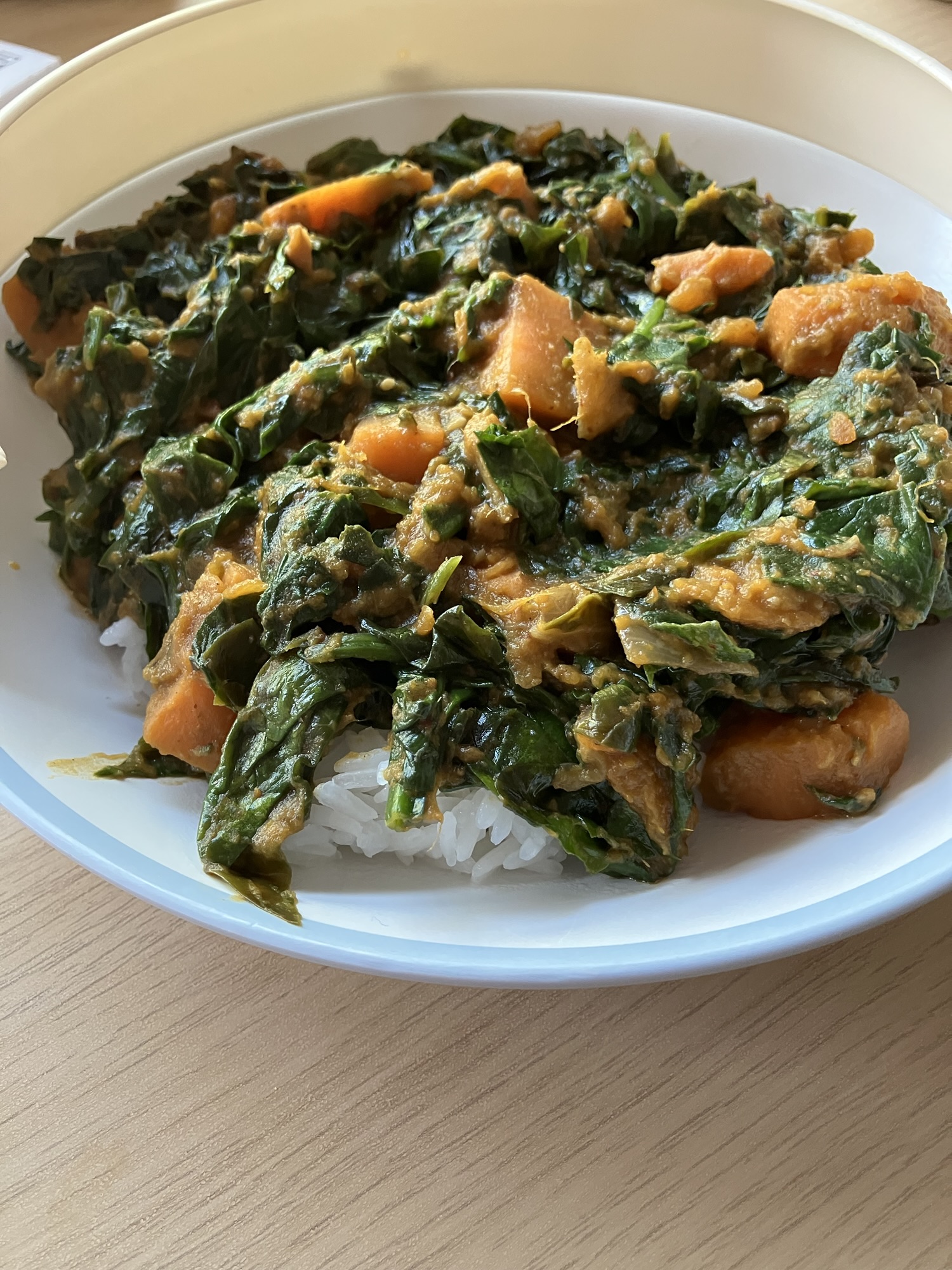
I’m trying to consume fewer animal products. I was inspired both by my wife, who is a vegan, as well as by the new Dutch food pyramid. I cooked a vegan curry for this side of the home at the end of March. In early April, I cooked a chicken pasta for myself, but the other two meals I cooked this past month have been vegan. One was another curry. The image description app I used correctly identified one of the ingredients as sweet potato, which I think is rather cool.

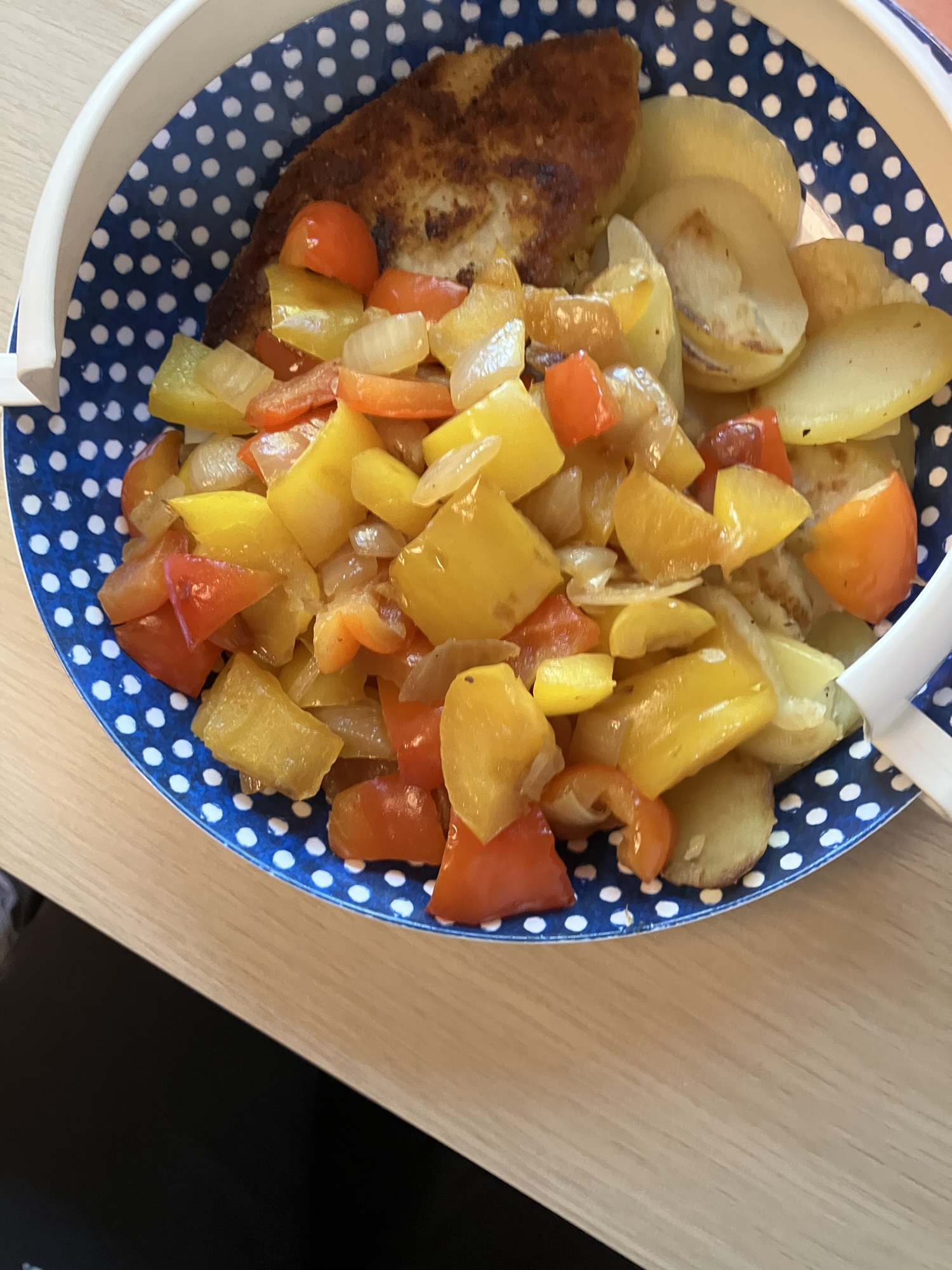
The other was baked potatoes, onion, bell peppers and a veggie schnitzel (which the EU has decided soon can’t be called schnitzel anymore due to it not containing animal, despite no-one knowing where a cow’s schnitzel is located on its body).

Last month, I said the month was hard only to conclude at the end of writing my post that it was better than I had initially thought. I unfortunately can’t say so of April. The last few days have been slightly less horrible than the weeks prior, but I’m not getting my hopes up about this continuing in the right direction. I feel a little guilty about this, because I did do more cooking activities than I used to do. I’m wondering whether I might be depressed or something. Since I’m also experiencing significantly more sensory overload than I used to, something neurological might also be going on. I’m getting bloodwork soon to rule out a vitamin deficiency (possibly B12), because I’ve been on pantoprazole in a high dose for years and have a history of several deficiencies. I’m not sure what I hope the test will show.

Unmasking…

Hi everyone. I’ve been struggling intensely for a while now. The aggressive meltdown that caused me to land with my head on the floor (as I mentioned in the comments on that post, I wasn’t actually thrown) was only the proverbial straw that broke the camel’s back. I’ve been having chronic headaches and nausea that the doctor says aren’t due to the fall. Last Wednesday, I had a fever just when the doctor took my temp, so she concluded I must have the flu or something. I doubt it, as I didn’t have a fever any other time my temp was taken and I’m not having any other flu symptoms. I’m more sensitive to stimuli, mostly sounds and scents, than I used to be. Unfortunately, my ability to argue hasn’t gone, so the staff believe I’m “oppressing” them when I refuse them access to my room when wearing strong perfumes. This morning, my support coordinator told me to stop pacing my room, saying it’s compulsive and that compulsive behavior only worsens over time. She may be right about that, but it’s not like I’m doing anyone any harm by pacing and it’s not like the staff deal with the reason for my being more compulsive. I’m pretty sure I’m in significant burnout and the obvious solution to my staff seems to be to repress my behaviors that indicate I’m in distress.

I’m trying to read up and listen to podcasts on autistic self-discovery and unmasking. Not that I have the attention span to read for longer than about fifteen minutes at a time. Or that I think any of the recommendations I find, are useful to me, simply because I have an institution and rather behaviorist staff to deal with. I’m also unsure where to draw the line between valid unmasking and infringing upon other people’s rights. For example, apparently I’m not allowed to ask staff to wear less perfume because that’s “oppressive” and I don’t know where it’ll end when I keep “choosing” to be by myself rather than accepting staff who are essentially presenting in a willfully overloading manner.

Hypervigilance in Trauma Survivors #AtoZChallenge

Hi everyone and welcome to my letter H post in the #AtoZChallenge. Today, I want to talk about a major symptom of (complex) PTSD which I struggle with a lot: hypervigilance.

Hypervigilance is an increased awareness of one’s environment and seemingly unimportant details in it. That is, often people who experience hypervigilance constantly scan their surroundings for signs of threat, but that doesn’t mean they’re hyper aware of everything going on. In fact, they often miss out on actually important aspects of their surroundings, such as missing part of a conversation they’re having.

There is a sensory aspect to hypervigilance, ie. increased sensitivity to noise, smells or other sensory stimuli. However, there are also cognitive and emotional aspects to it. People who are hypervigilant due to (complex) PTSD often overanalyze the things happening around them and too easily perceive them as threatening.

I for one commonly overanalyze things that I perceive. It doesn’t help that people often expect me to appraise already overloading stimuli differently based on other factors involved. Like, due to being autistic, I get very easily overwhelmed by loud noises, crowded environments, etc. However, due to both autism and C-PTSD, I also overanalyze my perceptions. For example, I often judge myself for being overwhelmed because, for instance, my fellow residents “can’t help” making certain noises.

People with complex PTSD often experience hypervigilance about other people’s intentions too. I for one am always looking for signs that the people who mean the most to me are going to betray me. It’s not like I want to, but that’s been my experience most of my life.

Hypervigilance can also show up in physical symptoms. An increased startle reflex is part of the diagnostic criteria for PTSD. Many people with (C-)PTSD also struggle to relax even when there are no sudden stimuli or changes to the environment. Which, now that I type it, I realize is nonsense: the environment is always changing even when people who aren’t neurodivergent or trauma survivors or both, do not notice. I last week had a meltdown because I was overwhelmed by the sounds in the living room, only to be told by the staff that it was totally silent. Well, except for a fellow resident’s tablet, the TV, the dishwasher and I’m not even counting the relatively “minor” everyday sounds, like birds chirping outside, the staff station clock ticking, etc.

Anyway, hypervigilance like I said can show up as physical symptoms. Many people experience an increased heartrate, heavy breathing, higher blood pressure, etc. After all, stress (and hypervigilance is majorly stressful) activates the body’s nervous system.

I don’t yet know what can be done about hypervigilance. I follow movement therapy, but so far, it’s incredibly slow-going. It doesn’t help that, like I said above, the world is ever-changing. In other words, even though my therapist talks about baby steps, I know the real world doesn’t work like that.

Feeling Love #SoCS

Hi all. Today’s prompt for Stream of Consciousness Saturday (#SoCS) is “love”. I was immediately reminded of a moment, about seven years ago, when I learned of emotional development and learned that seven-year-olds can feel and understand complex emotions like love. I can’t say I don’t value people, but I have no idea what “love” feels like. When I told my wife about this, she was upset until I explained that it doesn’t mean I don’t consider her special. Maybe “love” is just not the right word for it, or maybe it is.

Now that we’re in the process of divorcing, I am the one feeling the most distress over the idea of not considering my wife my partner anymore. I wouldn’t say I’m very romantic, like I wrote last year in response to a WordPress daily prompt, but I’m the one out of the two of us who feels the most comfortable with romantic gestures, such as giving one another heart-shaped gifts. In fact, I feel slightly sad that my wife would prefer I no longer make “romantic” gifts for her.

Does this mean I feel love? Or is it just something I’ve rationally connected, like when my wife and I got married thinking this was the way to go if we wanted to show each other that we’ll always be together? I wonder about this many times: how much of my expression of my emotional experience is genuinely in alignment with my actual feelings and how much is learned as part of the process of growing up? In some ways, it doesn’t matter, as emotional development is partly learned in all people. However, what I mean is, do I actually no what I feel or am I just mimicking how I see other people label certain experiences?

In this respect, I am always reminded of a snippet in a book on autism. A mother had explained to her autistic son that he was feeling jealous when his sister got a doll and he didn’t. The next time he expressed jealousy, this time at his sister getting attention while he didn’t I believe, his mother again said he was probably jealous. The boy then replied that jealous is when his sister gets a doll. This is often how I express feelings too. Does it mean I love my wife because we’re on the phone for at least an hour everyday? Does love only count when I give her heart-shaped gifts? Can I love other people besides my wife? Does it, in this respect, matter if we were to stay married or now that we’re divorcing but will remain best friends? I honestly have no idea.

The Hardest Part of Being Me

Hi everyone. Today I’m joining the Writer’s Workshop. One of the prompts this week is to elaborate on the most difficult aspect of being you. This is a fitting prompt, as I’ve been struggling again lately.

I could respond to this prompt in several ways. There are things that make me stand out in a negative way in society. For example, autistics are not commonly valued in a neurotypical-centered world. I was reminded of this yesterday when I read an article on the Center for Consultation and Expertise website about the difficulties autistic women in particular face. I for one am often told that I’m only mildly autistic if I’m even autistic at all. This stings, as well my autism diagnosis was confirmed four or five times due to constant doubts among professionals and yet especially for someone assigned female at birth, I’m quite a stereotypical autistic. Yet because I was assigned female at birth, people attribute my behaviors to other things, like borderline personality disorder.

However, autism as a whole isn’t something that is difficult about being me. Rather, the way society doesn’t accommodate me as an autistic person, makes life difficult for me.

Instead, I’m going with a specific trait that might be attributable to autism but also to the brain injury I acquired shortly after birth or other things: my poor distress tolerance and general emotion regulation issues.

These are, like I said, also possibly attributable to autism. Many autistics face these challenges. In my case, it’s however also the fact that these problems are being misunderstood that makes it hard for me to live with them. Like I said, many autistic women/AFABs get diagnosed with borderline personality disorder or the like and treated like they’re purposefully acting out for attention. Emotion regulation difficulties are among the core traits of BPD, yet they are also part of neurodevelopmental conditions like autism or ADHD. I would like to say that even people with genuine BPD aren’t purposefully acting out for attention, but that’s still what the current establishment claims.

I’m struggling in particular with the fact that, occasionally, I seem to be able to cope with distress quite well and at other times, I’m seen as the queen of sweating the small stuff. This has to do with my difficulty figuring out when I’m overstepping my own limits (or when I’m being pushed beyond my limits by others). I honestly don’t know how to break this cycle yet, as when I seem okay, people usually keep adding on to my load of things to deal with. Then when I snap, they see it as me being purposefully difficult. I’m hoping I’ll at some point find a way to deal with this.

Wife #WotW

Hi everyone. No #WeekendCoffeeShare this week, so I thought I’d find another way to sum up my week. I’m joining Word of the Week. It’s often hard for me to pick just one word or phrase to summarize my week. This week’s is “wife”. I contemplated other words and phrases, like “divorce prep”, “stressors”, etc., but my wife is the one who’s pulled me through most of the stressors.

For those not aware, my wife and I, who have been best friends for over eighteen years and married for over fourteen, will be getting a divorce sometime in the next couple of months. The reasons are personal and mostly irrelevant, as we’ll remain best friends hopefully for life.

Last Monday, my wife found out that the practical part of the reason we didn’t go through with divorce when we were first deciding on it last year, isn’t likely relevant to us. This was a financial reason that I won’t go into. Suffice it to say that, when we saw the mortgage advisor on Tuesday, we found out that even in the worst case scenario, both of us will manage financially.

I do struggle emotionally with the idea of divorce and particularly the fact that our house will be fully signed over to her. Not that I ever lived in that house or that I’m ever going to again. Practically, it’ll make no difference, but it does feel kind of off that I’ll essentially be signing myself out of the opportunity to live in a “normal” house for life. Then again, in reality, I did this in 2019 when moving into long-term care.

On Wednesday, my wife and I established a pattern of multiple, long phone calls. That day we were on the phone seven times. I was struggling with feelings of self-hatred over the ways I’ve treated my wife poorly over the years. Particularly, I was struggling with the idea of emotional vs. cognitive empathy. I’m an emotionally sensitive person or so my wife says, but I still end up hurting my wife and other people regularly. I guess that’s me being autistic though.

I also talked to my wife about how I’m regularly being confined to my room for having meltdowns in the living room. I somewhat see the reason behind this, though not fully because my behavior scaring other residents, isn’t the full story (there’s also some part about my being presumed competent enough to hold it together). However, what I clearly don’t understand is staff’s inability and might I say regularly unwillingness to help me prevent having a meltdown. I’m still kind of struggling with the battle between autonomy and protection.

Yesterday, I was trying to figure out how to get to a cerebral palsy meeting in Utrecht next week. The restaurant the meeting is being held at, cannot be reached by ParaTransit taxis. I might be able to travel by train, but that’d be quite a challenge too. Again, it was my wife helping me make decisions. I’ll most likely not go to the meeting this time, but remain in the WhatsApp group so that I’ll get a feel for the other people attending and have more time to make arrangements. By the way, my wife and I had four phone calls and she said we’d better create a new pattern or we’d have to call each other a negative amount of times tomorrow (7-4-1-etc.). Maybe I’m wrong though, as my wife said the number of times we’d be calling each other had to be a prime number and four isn’t one.

My 2026 Word of the Year

Hi everyone. I’ve been debating for a few weeks now whether to choose a word of the year (WOTY) this year. I did so some years, but haven’t had a WOTY for a few years. I just came upon Deb’s announcement of her WOTY and this gave me the kick in the behind I needed to decide on one.

So what will my word of the year for 2026 be? I’ve had a few on my mind, but finally settled on: EXPERIENCE.

This year, I hope to experience more of what life has to offer. This includes being more mindful of my daily activities, purposefully choosing ones that enrich me. This includes crafting, cooking and baking, blogging and writing in general and reading. Today, despite struggling quite badly and feeling depressed, I managed to craft and write.

Like I shared when writing about my hopes for 2026, I also intend to expand my social circle. I feel rather insecure about this, being that I’m nearly 40, autistic and multiply-disabled. However, I’m embracing the opportunities to socialize that come my way. Today, I did try out Discord again in hopes of finding the community I used to find on forums back in the ’00s. It’s not the most intuitive social networking app, but I’m getting the hang on it.

I should say that I used to do with Discord servers what I do with Subreddits and Facebook groups, ie. I collect them as it were. This needs to stop. After all, social circles aren’t based on the number of likes or comments on a social media post. It’s about quality, not quantity. I struggle with this. It’s probably in part related to my anxious attachment and the fact that I’ve had more than a few groups I was deeply invested in only to be kicked out. Then again, I didn’t invest in genuine personal connections other than with my wife. That needs to change. If I want to experience all that life has to offer, I have to offer a part of myself too. This is scary, but I hope it’s doable.

Fear (Or Another Four-Letter F Word)

Fear. I’ve used this word as a starting point for my writings many times. The idea comes from Mari L. McCarthy’s journaling prompts. The idea is to pick a four-letter F word and write about it or use it as a prompt. Well, I’m doing that now, but I doubt I’m actually going to write about fear. I honestly don’t know what to write at this point and am not feeling anything in particular. That is, I guess I “should” be feeling something, but I don’t know what. Alexithymia. That’s what I believe this is called. Any emotional state for me is “good”, “bad” or “neutral” like right now. I don’t ever feel totally relaxed I believe. There’s always some level of stress or anxiety or fear in my body or mind.

My movement therapist tries to tell me that my body needs to get used to the feeling of being relaxed, because due to my early childhood trauma, it never learned to trust this feeling. That makes some sense, in that I almost always feel like I’m on high alert even when I’m half asleep. Is that even possible? And if so, isn’t it just normal? Do I even know what “normal” is, being that I’m autistic and otherwise neurodivergent, multiply-disabled and a trauma survivor? I doubt it. But if I’ve lived my life like this for nearly four decades, is there any way of changing it? I hope there is, because this feeling of always being on high alert is exhausting.


This is another freewrite I originally typed up in Google Keep, then finished here.

Disabled Ace Day

Hi everyone. I once again haven’t been active on the blog much. I’ve been listening to a lot of podcasts lately, mostly true crime. Today though, I decided to check out the podcast The Ace Couple. In their most recent episode, which came out today and which I’m currently listening to, the podcast hosts said that it’s disabled ace day today. Ace, for those not aware, is short for “asexual”.

Like I shared when writing my post for coming out day, I’m for the most part asexual. I’m still figuring out where exactly I fit on the asexual spectrum. For those who don’t know, since sexuality isn’t an all-or-nothing thing, asexuality is a spectrum describing anyone who experiences significantly less sexual attraction to other people compared to the general population. People who are not asexual, are commonly called allosexual (“allo” being Greek for “other”). This also clarifies that people on the asexual spectrum, even people who are altogether ace, may experience sexual desire and pleasure.

I do not claim to be an authority on asexuality. Had I been able to be open about my queerness all this time, I might’ve been able to gather more information without feeling guilty. Like I said, I’m still figuring things out.

This is also where disability comes in. Commonly, it’s thought that disabled people, particularly those with intellectual or developmental disabilities, don’t experience the same sexual feelings as non-disabled people do. This is simply not true, although disabled people are more often taught to suppress our sexual feelings. After all, particularly those with intellectual and developmental disabilities are too often seen as “children in adult bodies”. I myself have used these analogies when describing emotional development. Because it finally enabled me to get sort of okay care, this analogy appeals to me even though it’s inherently ableist.

When a disabled person identifies as asexual or somewhere on the ace spectrum, it is then too easily thought that this is because of the way the person was raised or educated. This is the counterstereotype I so often used to talk about in my early days on WordPress (oh my, I need to bring some of those old posts back): if we want to defeat the idea that disabled people can’t have sex, asexual disabled people could be seen as harming the cause, similarly to how I’m seen as harming the cause for community-based support by living in an institution. In reality though, prejudice and oppression are systemic, not individual. Besides, it’s not our job as marginalized people to fit ourselves into society’s neat boxes, whether these are stereotypes or counterstereotypes or other ways of telling us who we are and how we should live our lives.

This doesn’t mean I’m not influenced by prejudice. Regularly, I think I’m too disabled for a relationship and that’s why I’m ace. I’m pretty sure that’s not true, as I do have many years of being in a relationship with my wife before either of us clarified our authentic needs and wants to the other. I remember writing a post back in 2008, which I’m not going to bring back here (don’t worry, wife!), in which I described not knowing whether I was actually attracted to her and thinking I certainly wasn’t interested in sex. If that doesn’t tell me I’m ace, what does?

The more I write, the more memories confirming that I’m indeed asexual, come to mind. I was quite repulsed as a teen, purposefully skipping the biology chapter on reproduction and refusing to read the sex ed material that my parents brought me at around age nine. Then again, I’m pretty sure my refusing to read it was because I hated reading Braille at the time and my parents made quite a big deal of me reading this book.

However, what if my asexuality is in fact related to my being multiply-disabled, including autistic? Does that mean I’m doing the disabled or autistic communities a disservice? I don’t think so, because like I said before there’s no value in dictating who I am. Besides, as someone who lived for twenty years not knowing she’s autistic and yet who was autistic all along, chances are we’ll never know for sure.

I’m joining in with #WWWhimsy.

Care Needs

Last year, when I was first feeling like I was falling apart at my current care home, I wrote a list of my “needs” and E-mailed it to my assigned staff and support coordinator. I heavily watered down my wishes, thinking a need isn’t the same as a want and whatever comes out of a discussion of my needs, should be working for everybody involved, not just me. For example, I asked for more clarity on what activities I’d be doing each day and offered to use my whiteboard, but also said staff could just ask me what I thought I’d be doing and help me find a suitable activity; this last one was then put into my day schedule, ie. “Staff upon leaving asks Astrid what she’s going to do next”. Needless to say, this didn’t work for me, being autistic, at all, as it leaves the same amount of unstructured chaos as the old wording, which was simply that I had “alone time”, did.

Now, more than a year later and with the Center for Consultation and Expertise involved to help me and my staff improve my quality of life, I’ve written another list, but this time, it doesn’t offer solutions for my unmet needs; rather, it’s simply a list of problems I encounter at this home. In a way, I feel that being solution-focused should be more constructive, but then again this time I have the consultant to think up possible solutions to come closer to meeting my needs.


This post was written for the Six Sentence Story linky, for which the prompt this week is “need”.