Sunday Ramble: Motivation and Positivity

Hi everyone! I’m feeling full of ideas today, but none make it out of my head and into my hands. I’m talking both crafting and blogging here. Thankfully, with respect to blogging, I can always count on some great bloggers to provide me with prompts. Today, I’m participating once again in E.M.’s Sunday Ramble. This week the topic is positivity. Here goes.

1. What are the greatest attributes about you that make you feel good about yourself?
First up is, of course, my creativity! Many years ago, I would have said my intelligence, but I don’t really value that as much anymore. I do still consider it an asset that I’m a quick learner, but it’s not like I feel particularly good about being intelligent. It does make me feel good that I have many interests and I do consider that both related to my creativity and my intellectual ability.

2. What is/are your biggest motivation/s to get things done?
I find that I’m very much driven by an internal sense of motivation that comes in spurts and then goes away completely again. I’m not really sure what motivates me to do things I’d not otherwise be motivated for, other than maybe a kick in the butt from my staff.

3. Do you have any tips that could help others with their own motivation?
No, not really. I mean, other than getting treatment for obvious mental health problems that stand in the way of motivation, such as depression and anxiety. It may also help, if like me you’re neurodivergent (autistic, ADHD, etc.), to ask for help with step-by-step instructions on daily life tasks. There are groups for this on Facebook, such as Neurodivergent Cleaning Crew (I’m not a member of that one as I don’t do my own cleaning). That still may not help with actual motivation though.

4. As you are sitting there reading this question, look around you. What item in your home/work/car (wherever you are) made you smile when you looked at it?
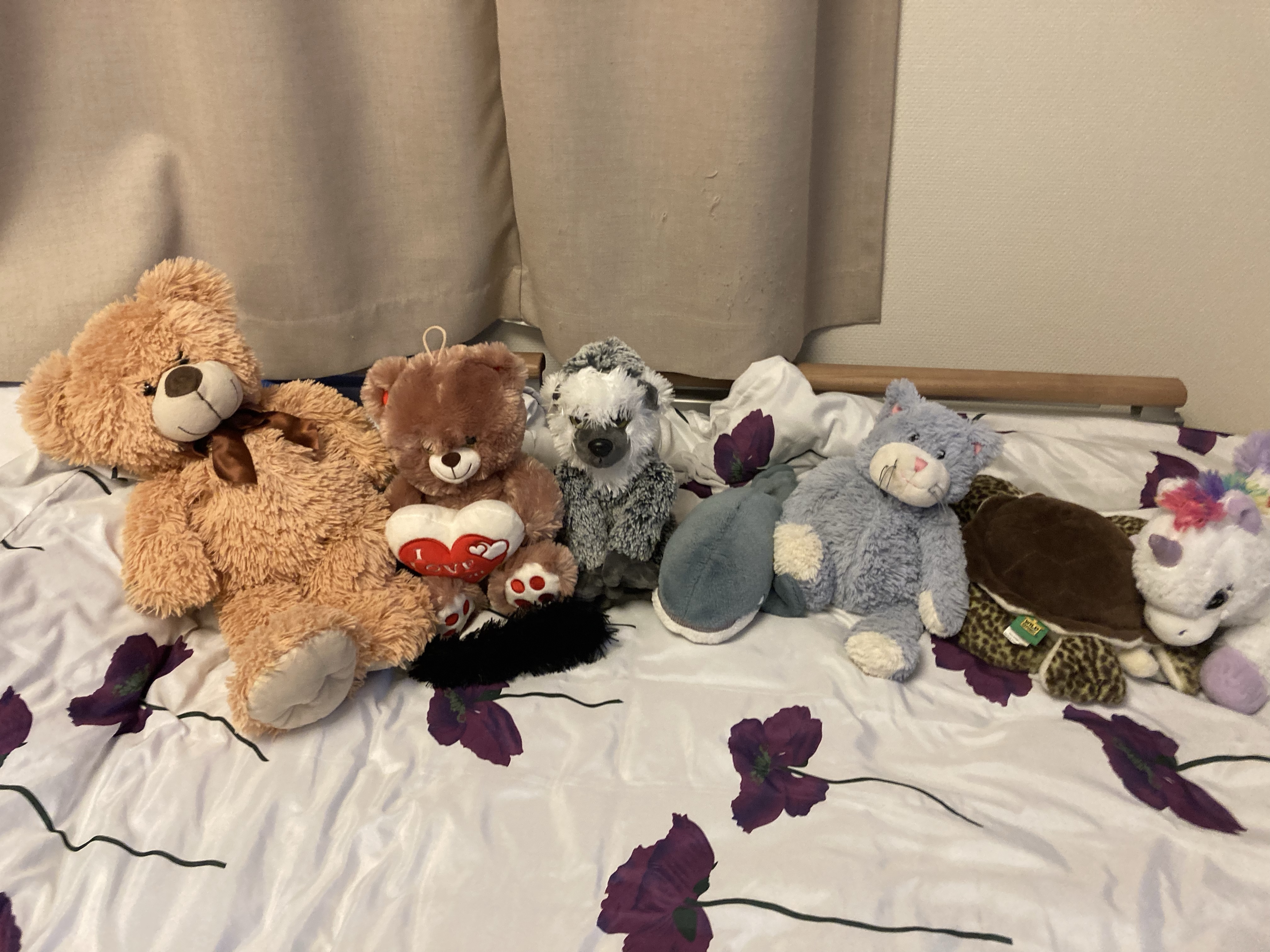
I cannot actually look at it, being that I’m blind, and I cannot touch it from where I’m sitting at my desk, but my bed with all my stuffed animals and the satin duvet cover and pillow case that I got from a staff definitely makes me smile! I just had to leave my desk to take a picture (of course I did arrange the stuffed animals for it!).
5. What always makes you laugh and smile in your life?
My husband’s jokes! He has the funniest sense of humor.

How about you? What always makes you laugh and smile?

Unconsciously Incompetent #SoCS

When I was in college studying applied psychology (it was really an orientation year to Bachelor’s of social work or related fields), my tutor had an interesting theory about how we learn by first being unconsciously incompetent. Then we move on to being consciously incompetent, by which she meant we are aware of our lack of knowledge and skill. Then, after years of college, we move on to being consciously competent. Once being experienced in the workforce, we then become unconsciously competent, which means we no longer need to be aware of our competence, since it’s become muscle memory.

I reached the stage of conscious incompetence when my tutor told me flat out that she was passing me for communication skills only if I promised never to enter the field of social work, psychology or any related field of study or work again. Thankfully, I was aware that my communication skills exam had really gone badly just before she told me, so I didn’t just need to be dragged into conscious incompetence.

I think I might need a similar experience with macrame. I started practising on Thursday and, though I managed the square knot, spiral knot and lark’s head knot quite easily eventually, I am pretty sure I’m still unconsciously incompetent. In other words, my work is horribly ugly but I think it will do.

The only thing is, because I sort of know I might never reach the stage of even conscious competence, I am too scared to show my work online for judgment. After all, as much as I am self-conscious about it, I also would really like this to work out!

Similarly, though I knew before that horribly messed-up communication skills exam at least on some subconscious level that I’m not suited to become a social worker or psychologist, I wanted to be one. That’s probably why I went into linguistics, which, though it isn’t necessarily within the helping profession, is still a communicative field of study. I only went into it to have a student psychologist tell a newspaper that “a blind autistic who wants to study something communicative” is going to have a pretty hard time of it, when they were promoting their autism buddy program. That pretty much sent me into conscious incompetence as soon as I read it, which thankfully was six weeks into the academic year. I guess that’s what happened the time the first person to comment on my question about macrame told me it would be really hard too. Only that’s before I’d started. I’m not sure that’s conscious incompetence though. It looks rather like low self-esteem.

This post was written for Stream of Consciousness Saturday, with the prompt of a word containing “Comp”.

Poem: Locked Up Inside

In my bubble
I sit
Staring out
At the world
Outside

From around me
I hear
People talking
To me
But I can’t respond

Through the invisible wall
I try
To reach out
To someone
But I can’t

A tight grip
Of panic
envelops me
Because I know
I’m locked up inside


I have had the concept of being “locked up inside” in my head for a few days now. I first came across the phrase in an E-mail support group for parents of children with selective mutism, a disorder in which a child is unable to speak in certain situations due to intense social anxiety. I have never had this diagnosis, but as a teen and young adult, did experience periods of mutism due to anxiety and dissociative freeze responses. I use the term “locked up inside” for a feeling of intense anxiety which causes a freeze response that leads to an inability to speak and sometimes move. The feeling of being “locked up inside” is particularly frequent and intense lately.

I am linking this poem to dVerse’s Open Link Night.

Autism Diagnosis and Rediagnosis: Do Labels Matter?

Earlier today, I saw a blog post about adjusting to a late autism diagnosis. The author didn’t receive her diagnosis till her mature years, while I was 20 when first diagnosed as autistic. Still, I could relate to some of the things she discusses.

Particularly, I related to the fact that diagnosis changed my perspective in quite a radical way. I was no longer just a bad, difficult person. I was autistic. Always had been.

As regular readers of my blog might know, I have had multiple autism assessments since my first diagnosis in 2007. The reason for this is complicated and mostly related to the fact that professionals kept questioning my diagnosis and wanting further testing. At one point, the records of my most extensive assessment disappeared due to a change of electronic record keeping systems and this led to my then psychologist jumping at the opportunity and removing my diagnosis altogether.

Most autism support groups online are open to self-diagnosed individuals. The main one I was part of at the time, however, I found out, was not. I was heavily criticized and distrusted by the other members after I’d lost my diagnosis. They thought my psychologist had finally unmasked me as someone with a personality disorder rather than autism.

Of course, I also needed an autism diagnosis in order to get the right support. With just borderline and dependent personality disorder on my file, I would be treated much differently by the mental health agency than with autism as my diagnosis. I wouldn’t be able to get support from the intellectual disability services agency either. Thankfully, I got my autism diagnosis back.

Interestingly, the psychologist who removed my autism diagnosis, always said that diagnoses didn’t matter, yet she was the one constantly throwing around new diagnostic labels at me. In a sense, an official diagnosis doesn’t matter, in that self-diagnosis is valid too, at least outside of the need for services. For instance, I self-identify with a dissociative disorder even though I haven’t had this official diagnosis in over eight years. However, to say that labels don’t matter and that all that matters are the symptoms, as she said, is quite frankly wrong. Especially in the context of the need for services.

After all, I am the same person with the same symptoms whether I am diagnosed as autistic or as having borderline and dependent personality disorder. The treatment approach is quite different though. With autism, I need structure and a fair amount of support. With BPD and DPD, I mostly need to be taught to self-regulate by being made to take responsibility. Of course, in an ideal society, services aren’t rigidly based on someone’s diagnosis, but in our current healthcare system, they are. Because of this, I am so glad I currently have a well-established autism diagnosis and that my current support team at least don’t question it.

Friends and Buddies

This week’s topic for Throwback Thursday is friendship. I was never really good at making friends. I still don’t have any real friends other than my husband. I mean, of course I could consider some of my fellow clients “friends”, but our relationship isn’t as deep as that of normal adult friendships.

In early childhood, I did have one friend. Her name was Kim and we used to make mud castles together. Or anything out of sand and water really. Kim’s last name translates to “peat” and my father used to jokingly call her “Kim Mud” rather than “Kim Peat”.

When I went to the special school for the visually impaired at the age of five, I started in a first grade class despite being of Kindergarten age. All girls in my class were at least a year older than me and they enjoyed “babysitting” me. In exchange, for the next three years, I’d help them with their schoolwork.

By the age of nine, I transferred to a different school for the blind. Though I did have a friend there, I was also an outcast and got heavily bullied.

My best time socially was my one year at the special ed secondary school for the blind. I had one good friend there, but also got along pretty well with everyone else in my class and most kids in my school in general.

All that changed when I entered mainstream high school at the age of thirteen. Within a month, everyone had formed cliques except for me. A few months later, my favorite clique took me under their wing and pretended to be my friends, only to drop me again when they’d had enough of me. I was friendless for the remainder of the six-year program. I didn’t really care. Or maybe I did, but I was determined to show my parents and teachers that I could earn a mainstream high level high school diploma. And I did. Not that I use it for anything now, but oh well.

Another topic mentioned in the Throwback Thursday post title at least is buddies. This reminds me of the autistic student buddy program I was part of during my two months of attending university. This program assigned a psychology student volunteer buddy to an autistic student to help the autistic with planning their coursework or other activities related to their studies. It worked in theory, but the catch was that these buddies were volunteers helping only with certain things for one or two hours a week at most. At the time, you couldn’t get paid support workers for assistance related to college or university studies, as the reasoning was that if you could be a student in college or uni, you should be able to do the planning and related tasks yourself. Needless to say my buddy got overwhelmed within a week. I feel intensely sorry for her.

The reason I mention this, besides it being in the post title, is the fact that I realize I struggle to maintain a distinction between social and professional relationships and, with the buddy, things got even muddier. I mean, friendships are supposed to be reciprocal, while professional relationships are not. For this reason, I am allowed to unload my shit to a professional without needing to listen to theirs. Professionals, however, get paid, while friends don’t. With the buddy, the situation got complicated, in that my fellow students called on my buddy to calm me when I was in a meltdown. That clearly wasn’t her role.

This thing about lack of reciprocity, however, also probably killed off that mainstream high school friendship I pretended to have. I don’t blame myself entirely though: my so-called “friends” also felt obligated to hang out with me out of pity, and that’s never a good reason to be someone’s friend.

This Is “Profound Autism”?: Reframing the Discussion Around Complex Care Needs

A few days ago, there was a discussion on the Autism Science Foundation’s Facebook page in which parents of autistic adults with complex care needs were describing their children with the hasthag #ThisIsProfoundAutism. I asked to reframe the discussion to include people with multiple disabilities including autism in general, because it is rarely (but not never!) autism, no matter how severe, alone that causes a person to be completely dependent on caretakers. I then explained that due to the combination of my disabilities, I need 24-hour care, including one-on-one for most of the day.

Not surprisingly, I was quickly met with the question whether I was saying I needed 24-hour help with basic tasks such as eating, bathing, dressing myself, etc. Well, the Autism Science Foundation page is a public Facebook page and I didn’t want the people on my friends list (including immediate family) who don’t know this, to judge me for it, but the short answer is yes. While I, like presumably most “profoundly autistic” people who don’t have physical disabilities, am physically capable of eating and dressing myself for the most part with some difficulty, my executive dysfunction means I still need help with them. As for bathing, well, I basically need someone to wash me, because, while I can physically hold a washcloth in my hand, I don’t have the organizational skills to actually work out the ritual without a ton of supervision and even then it’d lead to a lot of meltdowns.

I did, incidentally, point out that I recognize intellectual disability as a valid additional disability that needs to be taken into account when I asked to reframe the discussion. After all, that’s most likely what’s causing these autistic adults to be unable to understand instruction and to be completely dependent. For me, it’s a combination of executive dysfunction, which is a direct autism symptom, blindness, mild cerebral palsy, and other things.

I also do recognize that the need for support with severe challenging behavior is not the same as the need for help with basic personal care. One does not exclude or necessarily include the other and one is not more valid than the other. I, for one, am somewhat more independent in terms of eating, dressing and bathing than my severely intellectually disabled fellow clients. I am a lot more dependent where it comes to the effects of my challenging behavior.

I also do not mean to say that autism on its own cannot possibly cause a person to need a lot of care. It can. I am reminded of a girl I read about on Dutch social media many years ago, who indeed had hardly any functional communication skills but did have an IQ above 85. She, unlike me, didn’t have any additional disabilities. She was completely left behind in the care system: she was too severely disabled for traditional child and adolescent mental health services, but her IQ was too high for intellectual disability services. Really, I should not have called for reframing the discussion to include those with multiple disabilities, but those with complex care needs in general.

That being said, I strongly disagree with those people who say that just because I can write, means I should have ignored the conversation, since it clearly wasn’t meant for me. The fact that I can write, does not make me not dependent on care providers and does not mean policy or lack thereof won’t affect me. I am autistic and that, along with my blindness and other disabilities, causes me to need the extensive care I get now.

Life Skills I Struggle With As a Multiply-Disabled Person

Earlier today, Ann Hickman wrote an interesting list of ten life skills she is teaching her autistic teenager. As a teen, I missed out on most of these lessons she mentioned, leading to a big gap in my skills as well as my awareness of them.

Of course, lack of education isn’t the only reason autistics and otherwise disabled people may struggle with life skills. I struggle with many of them due to lack of energy, executive functioning issues and other things.

Today, I am sharing life skills I struggle with and why.

1. Personal hygiene. I remember vividly my sister gave me a deodorant for my fourteenth birthday as a hint. I didn’t get it. I wasn’t taught about hygiene much beyond childhood, but even if I were, I didn’t grasp the concept.

Similarly, because we had a bath at my parents’ house, I didn’t learn to properly shower. I didn’t know until a few years back that you’re supposed to use body wash when showering each time.

Other personal care tasks, I simply cannot do due to my physical limitations. I cannot clip my nails, for instance. I know some other blind people (presumably without physical disabilities) can, but other blind people I know go to the pedicurist for this.

2. Meal preparation. While in the training home, I tried for weeks to learn to put peanut butter or jelly on my bread without success. My mother can’t do it blindfolded either. My father can, but he assembles all his supplies around him in a very structured manner.

To be honest, I never had to prepare my breakfast or lunch before going into the training home, as we didn’t eat breakfast at my parents’ home and my lunch was always packaged by my mother (or I’d eat a sausage roll at the cafeteria).

There are probably ways I could prepare my own meals if I really need to. I mean, when living on my own, I just ate plain bread without toppings. However, I prefer my staff prepare it for me.

3. Cleaning. This is a difficult task for most blind people, but it can be done. I can dust my desk and table with minimal help if I’m reminded to do so. However, I can’t vacuum or mop the floors. I learned both, but with each house having a different way it’s set up, it’s very hard to find my way around it with a mop or vacuum cleaner.

What I struggle with most with respect to cleaning, is remembering how often each task needs to be done and actually organizing them. For example, in the training home, I’d clean the top of the doors each week despite no-one ever touching them. On the other hand, I’d procrastinate about changing my bed sheets, sometimes leaving them on for months.

4. Getting around. Ann mentions navigation for a reason: regardless of high-tech solutions to help people navigate, they still need to learn to use maps or to use public transportation. For me as a blind person, mobility was always more important, as it additionally involved safe white cane travel. I never mastered this, even with seven years of mobility training in special education and many more lessons once out of special ed. I only recently learned that more blind, neurodivergent people struggle with white cane usage.

Currently, I can for the most part move around inside the care home by myself, but I cannot at all get around outside without a sighted guide. My parents used to blame this on lack of motivation. While I am pretty sure this, as well as anxiety, does play a part, it is also about other things. Besides, lack of motivation is not the same as laziness. In my case, it feels as though the activity of independent travel overloads me cognitively to the point where I feel incapacitated.

I am assuming Ann’s son is “just” autistic, whereas I am multiply-disabled: autistic, blind and mildly physically impaired. However, with this article, I want to make it clear that there are many reasons a disabled teen or young adult might struggle with life skills and, for this reason, many different approaches to supporting them.

Keep Calm and Carry On Linking Sunday
loopyloulaura

Suicidal Ideation in Childhood: Some Reflections

Earlier today, someone online asked a group of autistic women about suicidal ideation in childhood and at what age it started. It is common knowledge that depression and suicidality are near-universal among autistics. After all, we are taught, be it consciously or not, that our autistic way of expressing ourselves is unacceptable.

I remember my first autistic burnout at age five. I don’t have clear, verbal memories of the experience, but my inner five-year-old might and I do experience somatic and emotional flashbacks. The family story about the event is that I was ill with the flu. At the same time (coincidentally or not) my parents were making arrangements for me to start at the school for the visually impaired. I started in mid-May, before the end of the school year.

At the time, I wasn’t actively suicidal as far as I’m aware. I started having those thoughts when I was around age seven. I have a vague memory of telling my mother that I wanted to die sometime around that age.

Interestingly, I never made suicide attempts. Even the times I planned my “final day alive”, I never had any idea how I was going to go about actually doing it. This fact was later used to “prove” that I wasn’t serious.

I mean, when I was 21 and admitted to the psych unit, my parents came to tell the psychiatrist that I’d threatened suicide ever since I was seven-years-old, almost adding triumphantly: “See, and here she is, alive!” They said I just wanted attention.

Then again, is it somehow bad that I, deep down, didn’t really want to die? I just didn’t see any alternative. Of course I didn’t want to die by suicide. I imagine at least most people don’t really want to; instead, they want a better life. But I couldn’t get that at that time or so I thought. Does that make me a bad person? I don’t think so.

It’s so sad that, at least in my family, the red flag of long-time, severe suffering was ignored as a sign of “attention-seeking”. As if a seven-year-old even has the capacity to use suicide threats to manipulate their parents for mere attention without anything else going on with them.

Desperate Yet Determined #WotW

Hi everyone. What a week it’s been. I’ve been swinging between despair and determination, sometimes experiencing both at the same time. Let me share.

Last week, I was in a very depressive, dysregulated, suicidal state. I finally managed to tell my assigned home staff about the nature of the “monster” in me, ie. my suicidal thoughts. She decided to E-mail the current behavior specialist assigned to my care home asking her for help in finding me someone to talk to about this. I mean, I have my nurse practitioner at mental health, but I cannot seem to get it through to him how I’m truly feeling.

I also E-mailed my nurse practitioner, only to get a response saying we’ll talk about it on the 23rd. Well, that was the final straw for me and I’ve pretty much decided I’ve had it with treatment with him. I mean, I know I should have called the team, but it’s not like this is the first time he doesn’t pick up on my signals, be it in E-mails, on the phone or even face-to-face. Our talks have pretty much been meaningless forever. Honestly, the only thing he’s helped me with is getting the right medication, the topiramate, for my nightmares.

This week, I’ve been swung back and forth between the thought that truly there is no hope for me and the thought that, maybe, if I stand my ground firmly enough, I will be able to access the right help somewhere.

I’ve also been ruminating over those two years I’ve been in treatment with my current mental health team. My nurse practitioner told me a year ago that “we could search half the country for a suitable therapist but that wouldn’t make sense”, adding that we’re stuck with each other (as if it was something he hadn’t just decided on himself). Half a year earlier, he wanted to refer me to the specialist autism center, but that got shoved off the table for a reason I was never told. I have been saying for all of the two years that I’ve been in treatment with this team that there are two things I want to work on: my trauma-related symptoms and seeing if I can lower my antipsychotic. Neither has even remotely been started yet. After two years, I’m done.

I am not so naive to think my nurse practitioner is actually going to give in and actually help me find someone else this time around. I have a tiny bit of hope focused on the behavior specialist for my care home, but not much. Even so, I’m pretty sure I can get by with no help from any mental health professionals at all. It won’t be easy on me or my staff, and that’s one reason my staff might pressure me to stick with mental health. Thankfully, so far they don’t.

On the physical health front, I’ve also been swung back and forth between despair and determination. After thinking kind of wishfully that my abdominal discomfort was almost gone last week, it returned on Saturday and has been pretty bad all of this week. Nonetheless, my GP wants me to stick to my current regimen of one magnesium tablet (laxative) per day for two more weeks and have the staff call back to evaluate then. I was pretty upset yesterday when I heard this. Now I’m more resigned to the idea that there’s no hope for improvement of my symptoms.

Overall, right now, despair is taking over, but thankfully I’m not actively suicidal right now. There must be some tiny flame of determination in me somewhere.

How was your week?

Word of the Week linky

Why Do I Need One-on-One Support? #31Days2021 #Blogtober21

Yay, it’s October and this means it’s time for Blogtober 2021. Last year, the prompts were based on song titles. This year, there are no prompts. However, Kate Motaung of Five Minute Friday also relaunched the 31-day writing challenge after a break last year and there are prompts for this year. The first prompt is “need”. We can do a five-minute freewrite, but I’m no good at sticking to five minutes or at not editing my writing.

Yesterday I had my care plan review. I was really concerned about my need for one-on-one support being reassessed later this year. Not that the care plan review would really matter for this or so I’m told, but now that we were all together (my home and day center staff, the behavior specialist and my mother-in-law), I wanted to raise the issue. It’s the behavior specialist’s job to write the reapplication paperwork and I questioned whether it sufficiently documented my need for one-on-one. To get things clear in my mind, I am going to write out why I need the support I need.

Firstly, I am blind and have a mild mobility impairment due to cerebral palsy. This, combined with my psychiatric illnesses, means I cannot move about outside the care home, or even outside of my room, independently much at all. This means that the staff need to be alerted when I leave my room looking for them, so that they can come out looking for me.

I am autistic. In my case, I get severely overloaded having to function in a group setting, such as at the day center. Even with noise-canceling headphones on, I still get distracted from trying to do things on my phone while there. Besides, if I do have functioning headphones, they will block out so much noise that I’m essentially cut off from my surroundings and can’t be alerted should something happen. This creates intense anxiety.

This anxiety also leads me to be unable to function on my own for long periods of time. I can, if I’m doing well, be left on my own in my room for up to about 30 minutes at a time. It doesn’t help that I know rationally that someone might be in the next room, because emotionally, if they’re out of earshot, they might as well be on the North Pole.

Autism also means I tend to fixate on routines. In my case, I tend to hyperfocus on the times my staff are going to leave me alone and this creates even more anxiety even when they’re still present. For this reason, staff need not stick to rigid rules of what time exactly they’re going to leave me, but rather to the order of activities.

If I’m left alone for prolonged periods of time, I can often feel incredibly unsafe and start to ruminate, which can easily escalate into self-destructive thoughts and actions. I may also run off in a fight-or-flight response.

I have complex PTSD, as well as dissociative symptoms. This means I can experience apparent age regressions. I get triggered very easily. Flashbacks, too, can lead to a fight-or-flight response.

Thankfully, now that I’m on the right medication, I don’t get as many flashbacks as before. However, I still do experience many serious behavioral issues that can be prevented or averted by the fact that I have one-on-one support most of the time.

I’m pretty sure a critical assessor would be countering that my one-on-one would not help me learn to cope with my anxiety. Thankfully, the goal of my long-term care plan is stabilization, not development. In other words, the original assessors for my long-term care funding did not feel I am trainable anymore. Otherwise, I would not have gotten approved for what is essentially lifelong care at all. The only thing is that my one-on-one care exceeds the care normally paid for by my long-term care profile. Oh well, let’s hope the assessor sees my need for it for at least another year.