Life Skills I Struggle With As a Multiply-Disabled Person

Earlier today, Ann Hickman wrote an interesting list of ten life skills she is teaching her autistic teenager. As a teen, I missed out on most of these lessons she mentioned, leading to a big gap in my skills as well as my awareness of them.

Of course, lack of education isn’t the only reason autistics and otherwise disabled people may struggle with life skills. I struggle with many of them due to lack of energy, executive functioning issues and other things.

Today, I am sharing life skills I struggle with and why.

1. Personal hygiene. I remember vividly my sister gave me a deodorant for my fourteenth birthday as a hint. I didn’t get it. I wasn’t taught about hygiene much beyond childhood, but even if I were, I didn’t grasp the concept.

Similarly, because we had a bath at my parents’ house, I didn’t learn to properly shower. I didn’t know until a few years back that you’re supposed to use body wash when showering each time.

Other personal care tasks, I simply cannot do due to my physical limitations. I cannot clip my nails, for instance. I know some other blind people (presumably without physical disabilities) can, but other blind people I know go to the pedicurist for this.

2. Meal preparation. While in the training home, I tried for weeks to learn to put peanut butter or jelly on my bread without success. My mother can’t do it blindfolded either. My father can, but he assembles all his supplies around him in a very structured manner.

To be honest, I never had to prepare my breakfast or lunch before going into the training home, as we didn’t eat breakfast at my parents’ home and my lunch was always packaged by my mother (or I’d eat a sausage roll at the cafeteria).

There are probably ways I could prepare my own meals if I really need to. I mean, when living on my own, I just ate plain bread without toppings. However, I prefer my staff prepare it for me.

3. Cleaning. This is a difficult task for most blind people, but it can be done. I can dust my desk and table with minimal help if I’m reminded to do so. However, I can’t vacuum or mop the floors. I learned both, but with each house having a different way it’s set up, it’s very hard to find my way around it with a mop or vacuum cleaner.

What I struggle with most with respect to cleaning, is remembering how often each task needs to be done and actually organizing them. For example, in the training home, I’d clean the top of the doors each week despite no-one ever touching them. On the other hand, I’d procrastinate about changing my bed sheets, sometimes leaving them on for months.

4. Getting around. Ann mentions navigation for a reason: regardless of high-tech solutions to help people navigate, they still need to learn to use maps or to use public transportation. For me as a blind person, mobility was always more important, as it additionally involved safe white cane travel. I never mastered this, even with seven years of mobility training in special education and many more lessons once out of special ed. I only recently learned that more blind, neurodivergent people struggle with white cane usage.

Currently, I can for the most part move around inside the care home by myself, but I cannot at all get around outside without a sighted guide. My parents used to blame this on lack of motivation. While I am pretty sure this, as well as anxiety, does play a part, it is also about other things. Besides, lack of motivation is not the same as laziness. In my case, it feels as though the activity of independent travel overloads me cognitively to the point where I feel incapacitated.

I am assuming Ann’s son is “just” autistic, whereas I am multiply-disabled: autistic, blind and mildly physically impaired. However, with this article, I want to make it clear that there are many reasons a disabled teen or young adult might struggle with life skills and, for this reason, many different approaches to supporting them.

Keep Calm and Carry On Linking Sunday
loopyloulaura

Suicidal Ideation in Childhood: Some Reflections

Earlier today, someone online asked a group of autistic women about suicidal ideation in childhood and at what age it started. It is common knowledge that depression and suicidality are near-universal among autistics. After all, we are taught, be it consciously or not, that our autistic way of expressing ourselves is unacceptable.

I remember my first autistic burnout at age five. I don’t have clear, verbal memories of the experience, but my inner five-year-old might and I do experience somatic and emotional flashbacks. The family story about the event is that I was ill with the flu. At the same time (coincidentally or not) my parents were making arrangements for me to start at the school for the visually impaired. I started in mid-May, before the end of the school year.

At the time, I wasn’t actively suicidal as far as I’m aware. I started having those thoughts when I was around age seven. I have a vague memory of telling my mother that I wanted to die sometime around that age.

Interestingly, I never made suicide attempts. Even the times I planned my “final day alive”, I never had any idea how I was going to go about actually doing it. This fact was later used to “prove” that I wasn’t serious.

I mean, when I was 21 and admitted to the psych unit, my parents came to tell the psychiatrist that I’d threatened suicide ever since I was seven-years-old, almost adding triumphantly: “See, and here she is, alive!” They said I just wanted attention.

Then again, is it somehow bad that I, deep down, didn’t really want to die? I just didn’t see any alternative. Of course I didn’t want to die by suicide. I imagine at least most people don’t really want to; instead, they want a better life. But I couldn’t get that at that time or so I thought. Does that make me a bad person? I don’t think so.

It’s so sad that, at least in my family, the red flag of long-time, severe suffering was ignored as a sign of “attention-seeking”. As if a seven-year-old even has the capacity to use suicide threats to manipulate their parents for mere attention without anything else going on with them.

Thieves!

When I was little, my parents would store their sweets (usually licorice but sometimes other sweets too) on a shelf just within my and my sister’s reach in their pantry. I’m pretty sure they’d tried putting them in higher places but we’d just climb up stairs or other furniture to reach them.

Invariably, on Saturday and Sunday mornings, when my parents slept in, I’d lead my sister to the pantry and we’d steal some sweets. Yes, I am pretty sure I took the lead.

I obviously thought they were unaware. That is, until one day when I was five and had just learned to read. There it was, on the sweets shelf, a paper that read “BOEVEN” in large print. This is Dutch for “crooks” or “thieves”. My parents never actually confronted us about grabbing their candy except on this one playful occasion.

In reality though, I still wasn’t truly aware that my parents knew. In fact, I remember one day when I was about fifteen, my parents had left like eight hamburgers on a plate in the kitchen and I sneaked into it to eat one at a time. My parents never confronted me and it wasn’t until a few years ago that I realized they must’ve known. That is when the shame at having eaten this many hamburgers caught up with me.


This post was written for Friday Writings, for which the optional prompt this week is food. It is a an autobiographical piece.

Too Many Toys

Today’s topic for Throwback Thursday is toys and pastimes. The first question Maggie asks in her post is: “Did you have a lot of toys?” The short answer would be that yes, I was privileged to have quite many toys, but I must say I wasn’t so spoiled that I always got the latest trendy toy.

I probably shared this story before, but I played with toys quite a lot until I was at least eleven. By that time, my parents and teachers were looking into options for secondary schools and their opinions couldn’t have been any different: while my parents wanted me to go to mainstream grammar school, my teachers felt special education at their low-level secondary school for the blind, preferably residential, was in my best interest. My mother one day took me for a “mother-daughter walk” explaining the school’s stance and said that the reason they felt I needed residential special ed, was my behavior. That, in turn, she attributed to my having too many toys. The logic, I never quite understood, but it must’ve been something like my being so spoiled that I somehow felt entitled to display challenging behavior.

She went on to explain that, at the residential school, I would only be allowed one doll and one soft toy. She had given me a Barbie doll for my birthday earlier that summer, but told me she regretted it as soon as she received the school’s report. Needless to say, I always felt weird about playing with dolls from that age on, even though I continued to play with toys and dolls and everything until I was at least fifteen.

Fast forward some ten to fifteen years. When I was in my mid-twenties and diagnosed with dissociative identity disorder, I felt it might help my littles (child alters) if we had toys again. I first bought a box of old Barbies for €70 on a marketplace site. That wasn’t a wise decision as, though the box did arrive, the Barbie dolls were in such bad condition I eventually threw them away. I then decided to buy a couple of new ones at a toy store, but the littles hardly played with them. They prefer soft toys.

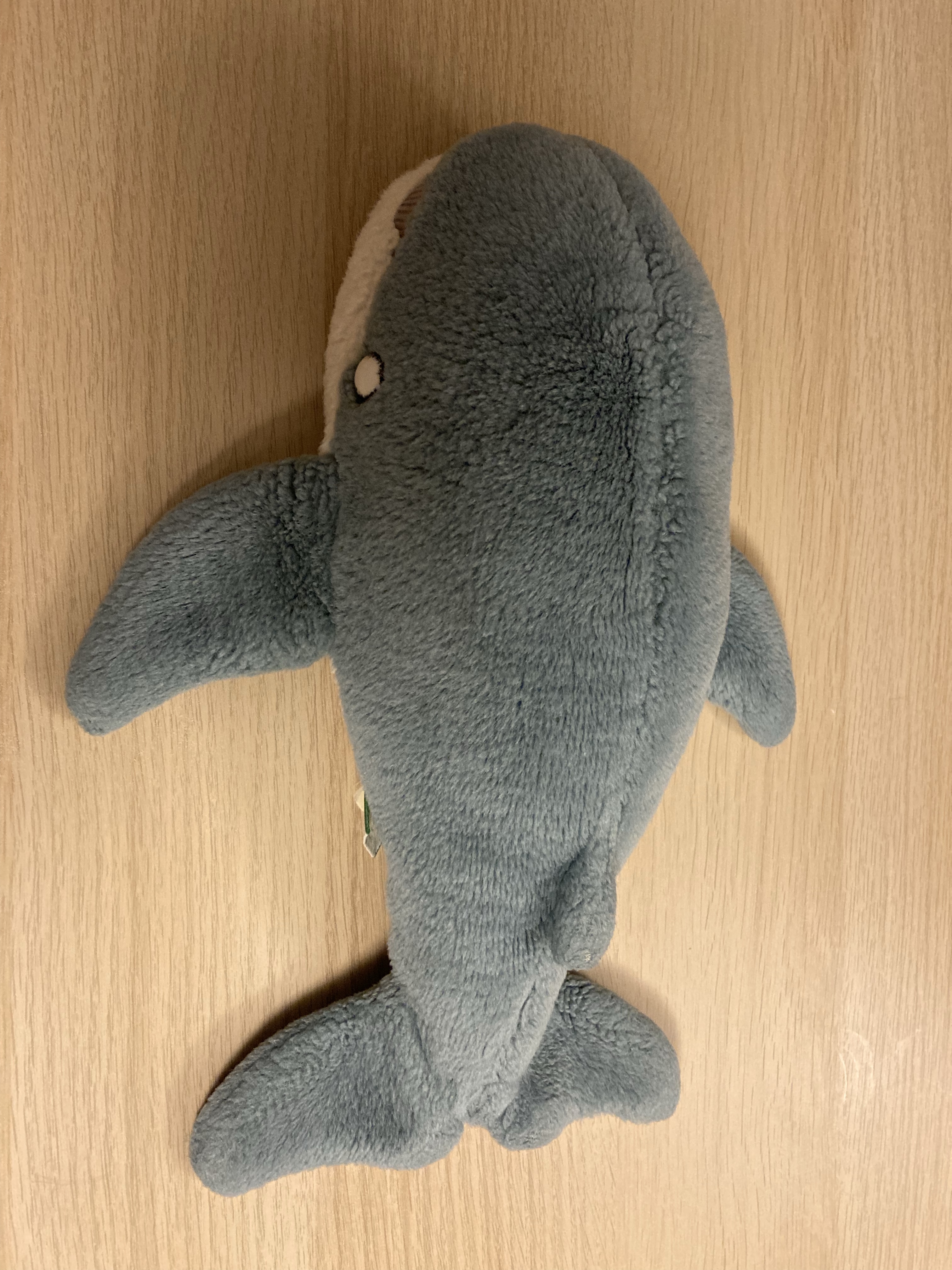
Speaking of which, one of Maggie’s questions is whether you still have any toys from your childhood. I don’t, as they’re probably all at my parents’. However, I do still have my stuffed whale Wally, whom I got when I left the NICU at three-months-old. I still sometimes sleep with it.

Wally

Did you have many toys growing up?

I Am Not a Calculation Mistake

Like I mentioned last week, I have been doing a Bible study plan on YouVersion called Hope Heals in the Midst of Suffering. I finished it yesterday and it was awesome. It was written by Katherine, a woman who survived a severe stroke shortly after becoming a mother, as well as her husband.

The plan follows Joseph’s story, the part of Genesis I had gotten stuck on in my Bible in a Year plan. I was glad to read it now.

At one point, Katherine shares that, about a year after her stroke, she is still unable to perform many basic functions. She is still in adult diapers, unable to eat, unable to even lift up her head. Her family is having Thanksgiving dinner with her son, then a toddler. As the family are playing with her son, she wonders if there was a mistake. Should she have died from her stroke?

It was at this point that a lightbulb went off in my head. I, too, have often wondered whether my life is a mistake. A calculation mistake, to be exact.

You see, I was born over three months premature. Officially, I was born at 26 weeks 4 days gestation. However, it is quite probable given the circumstances of my conception that my mother really wasn’t yet 26 weeks along. At the time, 26 weeks gestation was the cutoff for active, life-saving treatment in the NICU.

My parents weren’t even sure I should be treated actively. At one point, when I’d suffered a brain bleed, my father asked the neonatologist what he was doing with regards to my treatment. “We’re just keeping her alive,” he said. He (or his nurse) added that my father shouldn’t interfere in my treatment or he’d lose custody of me.

In 2004, when I was eighteen, this same doctor was quoted in a newspaper as saying that he sometimes meets preemies he’s kept alive back in his early days as a doctor, about whom he wonders: “What have we done?!” I at the time tried to reassure myself that he wouldn’t have meant me. Or would he? I, after all, am multiply-disabled and in long-term care.

The devotional in the Bible plan I was reading continued. Katherine at this point heard God clearly speak: “I am God. I do not make mistakes.”

This was what I needed to hear! I have tried to find my neonatologist on Google several times since that newspaper article. However, I don’t need his opinion. I have talked to my father about his views on my quality of life several times, but it hasn’t helped. I don’t need my father’s opinion either. God chose for me to be kept alive and that’s what matters.

Grace and Truth

Also joining Friendship Friday this week.

Birthday #WotW

Hi all on this beautiful Sunday! It’s already 8:30PM as I start typing my post. It’s my 35th birthday today and I spent most of the week stressing about it and the weekend celebrating it. For this reason, I’m choosing “Birthday” as my word of the week, even though the week is practically over already.

Early in the week, I talked over my birthday with my husband. I had already invited my parents to come over to Lobith today. They hadn’t seen the house since we’d bought it, or the inside of it at all for that matter. My parents need to drive over two hours from their home to Lobith and I’d asked them to drop me off at the care facility in Raalte on their way back. For this reason, I pretty much felt obligated to invite them over for dinner in Lobith. However, this also stressed me out, as it would mean I wouldn’t be in Raalte till like 8PM, by which time my one-on-one would’ve left.

My husband told me I could text them with a time proposal for them to arrive, like early afternoon. That way, they still had some hours to be with us and could still be dropping me off in Raalte and arrive home at a reasonable time. My father doesn’t text and my mother doesn’t drive, so I texted my mother to ask her if this was okay with both of them. It was.

Yesterday, my mother-in-law picked me up in Raalte and we drove to my in-laws’ house. It was good to be there. I in fact had only been there once since the pandemic started. Before then, and especially before I went into long-term care, I’d be at my in-laws’ at least once a week on average. I always loved walking their dog, a black lab called Bloke. My mother-in-law and I walked him again yesterday.

For dinner, we indeed had lasagne and indeed without celery. It was great! I also had a Magnum Billionaire ice cream for dessert.

I also got lovely presents. One of my sisters-in-law had been sent shopping for the largest Rituals gift box she could find. I think it’s amazing!

Today, like I said, my parents visited. I don’t have the greatest relationship with my parents. Like usual, my father kept infodumping on his interests, which he was able to relate to our house in Lobith, since he practically renovated my parents’ house on his own. I could hardly get a word in, but my husband seemed interested. I made some smalltalk with my mother.

The presents I got from my parents, were great though. I had asked them for a surprise box from my favorite beading shop, which happens to be local to them. Aside from that package, I also got another box of jewelry-making supplies they’d found at a thrift store, a turtoise soft toy and fresh cherries and strawberries.

When I returned to the care facility at about 6:15PM, I had dinner: noodles another client and staff had cooked this morning. It was good.

Overall, the day was good. So was the rest of the week for the most part. I seem to slowly be crawling out of the dark pit of emotional dysregulation I was in last week. I’m relatively calm considering the fact that my birthday is a trigger for my C-PTSD.

How was your week?

Word of the Week linky

Looking Forward to Summer

One of Mama Kat’s writing prompts for this week is to share what you’re looking forward to about summer. Summer is my favorite season. I just love the sunshine and warm temperatures, even though I don’t care for temperatures above 30°C. In 2018 and 2019, we had a lot of crazily hot weather, with temps rising to nearly 40°C on several days each year. I don’t like that. However, usually our summers are warm but not hot.

The main thing I look forward to each year, is my birthday. My birthday is this coming Sunday – I’ll be 35. This year, I don’t really have much planned and am a bit apprehensive about it, but I bet I’ll still have fun once it’s there.

On Saturday, my husband and I are going to visit my in-laws. My husband talked about asking his Mom to make lasagne. Without celery, mind you. Yes, she usually puts a small amount of celery in her lasagnes and, while I am not so picky anymore that I’ll fish it out of my serving, I don’t like it at all.

I haven’t asked my mother-in-law for any specific present, so I’m not sure what I’ll get. Last year, she gave me a giant teddy bear.

On Sunday, my actual birthday, my parents will visit me and my husband in Lobith. They haven’t seen the house since we bought it, so my husband will likely have a lot to show them. I’m a little worried about topics to talk about, as I don’t want to cause tension by bringing up my own issues. My staff suggested I tell my parents that we went to the monkey zoo a few weeks ago or the like.

I asked my husband for an outdoors side table for on my balcony. From my parents, I asked for jewelry-making supplies. I really hope my creative juices will be flowing again soon.

I will probably return to the care facility by about 6PM. During our evening coffee break, I will treat my fellow clients at the care home to custard cupcakes or nut bars (those who can eat those).

As for my plans for the rest of the summer, I am hoping to visit some new places, like the local large playground. Aside from social distancing, most restrictions due to the pandemic will be lifted by this Saturday (hopefully not to return again by the fall). I also hope to go on many walks, as well as sit on my balcony some more.

What are you looking forward to this summer?

Mama’s Losin’ It

A Very Intense Day Today

Today was an intense day. I started it with a weigh-in. To my surprise, I had lost almost 2kg. Last week, I had gained 1kg compared to the week before, so I had decided to try to cut back on snacks. That lasted all of one day and then I was back to snacking as usual. I don’t really trust my scale, as it isn’t officially calibrated, but well, who cares? I feel pretty fit and healthy and at least remain within the same 2kg range.

At 11:30AM, I had a nurse practitioner’s appt. My new’ish assigned home staff attended it with me rather than my assigned day activities staff, who usually does. Yesterday, this staff had been my one-on-one too and we had discussed my frequent dissociation and switching. She asked me whether I wanted to talk about it to my nurse practitioner and at first I said yes. Then later in the evening, I got anxious and decided to E-mail my nurse practitioner. I explained about the frequent switching and flashbacks. I also expressed my concern that, if the alters take over too much, my team will resort to denying their reality and ultimately to denying my reality as a whole. Then I will have lost all the trust I’ve gained in my team so far.

I can’t remember the entire appt, but at one point, Jane popped forward. She is the one most in denial of my trauma-related symptoms and yet it seems like she’s always the first to pop out and reveal our being multiple to a professional. My staff had probably already met her, and I think so has my nurse practitioner, but not to this extent. Thankfully, neither one objected to her being openly out.

I started feeling depersonalized after Jane was back inside and it didn’t fully clear up till just about an hour ago. In the evening, it got particularly bad.

Then for whatever reason, Karin, one of our fourteen-year-olds, popped out and started talking about a high school memory. We were still partly in the here and now, as she apparently recognized our one-on-one. Thankfully, our one-on-one reassured Karin that she’s now safe and the memories are in the past. She also told us that our teachers and parents, while probably meaning well, didn’t really help us and that none of our issues is our fault. That still feels rather off. I mean, of course I didn’t choose to be blind, but my parents reminded me over and over again that my behavior was definitely a choice. They always saw (and maybe still see) me as one giant manipulator, not an autistic, multiply-disabled trauma survivor. And they’re not the only ones. If I’ve learned one thing in my nearly 35 years of existence, it’s that sooner or later, people will always come to the conclusion that I’m one giant manipulator.

Basic Mistrust

I have been compelled to read up on emotional and psychosocial development. One theory is Erik Erikson’s theory, which states that, at each different stage in life (from infancy to old age), a particular conflict is present. In infancy and early toddlerhood, this conflict is basic trust vs. mistrust.

I initially thought that this stage corresponds pretty much to the first adaptation phase in attachment theory, which takes place between birth and age six months. When I checked it though, it includes this stage as well as the first socialization phase, age six to eighteen months. This may be one reason why I relate strongly to basic mistrust even though, in attachment theory terms, I function in most areas consistent with the first socialization phase.

One thing I’m facing lately is a chronic feeling of anxiety and distrust. In my care plan, my emotional development is outlined and in the fear domain, I am said to function at an age comparable to somewhere between zero and eighteen months. This includes all of Erikson’s first stage of psychosocial development. By contrast, it encompasses both the first adaptation and first socialization phase of attachment development. The reason my development in this area isn’t pinpointed to either of these two phases, is that I experience both basic fear (consistent with the first adaptation phase) and strong separation anxiety (consistent with the first socialization phase). Apparently, a baby under six months cannot yet express separation anxiety.

I have little idea why I might experience such strong anxiety, as in, what in my early development contributed to it. I mean, my parents claim I didn’t have these issues until I started to lose my eyesight at age seven. Seven is another important age in both cognitive and psychosocial development, but I don’t think that one is particularly important in my life. The earlier stages seem to make far more sense to me.

Of course, I do know that I probably didn’t have optimal care in my early life. This isn’t anyone’s fault. I was, after all, born prematurely and spent the first three months of my life in hospital. Though my parents visited me often, I don’t think I could rely upon them for meeting my every basic need. After all, they cannot possibly have been in my proximity 24/7, like the mother of a typically-developing child usually is at least for the first few weeks to months. My nurses must’ve provided me feeding and comfort at least part of the time.

As for affection, I have absolutely no idea. NICU nurses aren’t likely to be able to provide any significant level of affection to a baby at all, but I guess my parents would’ve made up for that. I went into this when discussing mother as source and mother as place of attachment. The truth is, I honestly mostly rely on my current feelings to guide my ideas. I, after all, don’t have many early memories of affection. My first memory related to it is from age four or five and it involves my mother using a nickname for me that referred to her needing to be at my side all the time. Then again, most people don’t have many early memories at all and remembering is still a form of reconstruction. In other words, because I experience a lot of basic mistrust now as an adult, it is easier for me to remember the memories that point to this.

This post was inspired by Fandango’s one-word challenge (#FOWC), the word for today being “Basic”.

Angry and Dissatisfied

Today, I feel flooded with emotional flashbacks that I’m not 100% sure about what triggered them or even what they are about. To give myself some insight, I picked up the book Journal Writing Prompts for Child Abuse Survivors again. Somehow, the prompts about anger appealed to me.

Growing up, I was always described as “too quick to anger”. There is some truth to this, in that I have and always had an extremely low level of distress tolerance.

My parents would react to this with resentment, but they’d generally solve my problems anyway. This at one point was described as having low expectations of me. When the psychologist who did my latest autism assessment, said that, I was triggered. After all, if my parents had expected me to be able to work stuff out myself, would that have been any better? I understand all about letting babies “cry it out” and I’m not a fan of it. I don’t have a clue whether I was left to “cry it out” a lot. I think so, as I was in the hospital for the first three months of my life and I don’t expect the nurses to have attended to each baby’s every cry. As such, even if my parents did attend to my every cry for attention, I must’ve been allowed to learn some self-regulation through “crying it out”.

My parents weren’t the most patient people in the world. At one point, my father explained to me that a family is like a business, in that it has to be run efficiently. As such, I can understand why my parents rarely let me work stuff out on my own. I also understand why they resented helping me.

Growing up though, my poor distress tolerance skills were seen as mere anger and oppositionality. I’m not sure why people perceived me as always angry. They weren’t just my parents, after all. Maybe I am quick to anger. I don’t know, but to be honest I think distress is different from anger.

When I became an adult and was admitted to the psych hospital, my nursing diagnosis at least off the record was “angry and dissatisfied”. Again, I’m pretty sure the staff confused distress with dissatisfaction. Distress is an inability to cope. Dissatisfaction is an unwillingness to accept the situation. I was perfectly willing to be discharged back into independent living if that was what was deemed necessary, but I didn’t promise I’d cope. This was considered blackmail.

Now that I’m in long-term care, my staff no longer see me as angry or dissatisfied a lot. Even so, I haven’t changed much. I still swear and scream when my computer or iPhone won’t cooperate. Staff do help me now, but they don’t resent it anymore. This has also allowed me to practise asking for help in more productive, proactive ways, which, in turn, helps me become frustrated less easily. I like it that way.