Early Memories of Physical Activity

A few months ago, I read on another blog about Carrie Underwood’s book Find Your Path: Honor Your Body, Fuel Your Soul, and Get Strong with the Fit52 Life. One of the aspects that immediately appealed to me in the book, are the journal prompts. Yes, duh, you know, I’m a sucker for journal prompts. However, Carrie Underwood’s journaling prompts are not just random one-liners, they’re deep questions. One of them is about early memories of physical activity. Today, I want to share my thoughts on this.

As a young child, I loved playing outside. I used to build sandcastles in the wooden sandpit my father had built, not even caring that the wood hadn’t been treated so it got moldy every once in a while. I remember telling you all the story of how my father used to call my Kindergarten friend, whose last name translates to Peat in English, “Kim Mud”.

When I got older, I loved learning to rollerskate. I remember joining an informal neighborhood rollerskating “club” led by the oldest of two girls who lived next door. She was my age and could rollerskate real good or so we all thought. I wasn’t nearly as good or even as good as my own younger sister, but who cared? I didn’t.

I got a large tricycle when I was about seven or eight because I couldn’t ride a bike due to my cerebral palsy. Not that I could safely ride a bike, given my visual impairment, but apparently the rehabilitation physician had no idea. I occasionally rode my tricycle, but preferred to walk around the neighborhood.

However, by age seven or eight, when I started to lose my vision, my physical activity level also started to decrease. I am pretty sure it’s more than just my vision though, but there’s no way to prove this as my parents stopped taking me to specialists around that age. I am considering asking my GP or the intellectual disability physician at the care facility for a referral back to rehabilitation medicine, because I want to learn to make the most use of the mobility I do have.

I did till my mid-teens love to sit on the swings. I’m not sure that counts, as it is a sedentary activity, but you do move your legs pushing yourself. I would go on the swings for hours on end. Now though, I get dizzy even going on the swings for five minutes at a time.

A thing I also did from toddlerhood until I moved out of my parental home at age nineteen, was this crawling-in-place movement while in bed. By the time I hit adolescence, my parents complained that I ruined the bed and made too much noise, but I continued to move in this way exactly until I moved to the independence training home. I could do this for hours on end too and I now realize it’s probably a form of autistic stimming.

Overall, I wasn’t physically active in most of the traditional ways. I wasn’t in sports as a child and P.E. was one of my least favorite classes. However, I can’t say I sat on my butt all the time. I didn’t even as an adolescent, though I probably was more sedentary then than I should have been.

How about you? Were you physically active as a child?

Rebirth

I remember reading a story some years ago in the book Preemie Voices by Saroj Saigal. This is a collection of autobiographical letters from people who were once premature babies in the university hospital NICU Saigal worked for. I, like the contributors, was a preemie.

In this particular story, the author shared how she felt she has three birthdays: one, her actual birthday, the second, her original due date, and the third, the day of her rebirth. In this author’s case, her rebirth meant being diagnosed with Asperger’s Syndrome (her choice of words).

I haven’t experienced one such pivotal moment in my life. I mean, I too could choose the day I was diagnosed as autistic (March 16, 2007). Then again, my diagnosis has been removed and reaffirmed so many times that I could just as easily choose the last time I was diagnosed (May 1, 2017). Besides, self-diagnosis is valid too.

I could choose the day I was given long-term care funding (June 4, 2019). Maybe that is the most pivotal moment in my life, but it didn’t exactly mean I was reborn.

I could, of course, choose the day I became a Christ follower (December 7, 2020). Many people in the Evangelical Christian community say they are Born Again and indeed, rebirth in Christ is a common Biblical concept. However, I am more of the opinion that, as Christians, we are on a continuous path towards God. I believe that, each time I consciously pick up my Bible, or the cross my husband gifted me and which I use for prayer, or each time a message from God truly enters me, I am transformed a little bit. I don’t believe that I will be made fully new until the day of Jesus’ return.

All that being said, I do believe I am not the exact same I was a year ago. I am not even the same I was yesterday. Or when I started writing this post. In my view, every single moment is an opportunity for rebirth. Every second we are given is another second chance.

This post was written for Reena’s Xploration Challenge, for which the prompt this week is a theme: rebirth.

Because I’d Had a Stroke…

I couldn’t possibly be autistic, my psychologist said, because I’d had a stroke as an infant and that somehow precluded a diagnosis of autism. Never mind that autism is genetic and said stroke supposedly didn’t change my genetic makeup to make me neurotypical. I, however, had to be diagnosed with acquired brain injury-related behavior change instead, but then again I couldn’t either, because I was too young when I sustained the stroke for my behavior to be considered as having changed either; after all, a six-week-old infant hardly shows any behaviors that would be considered significant in an adult. For this reason, I ended up with just some regular personality disorders, specifically dependent and borderline PD. Never mind that these have their onset in early adulthood and I’d shown symptoms since childhood. As it later turned out, my psychologist’s reason for changing my diagnosis had nothing to do with logic and everything with her wish to kick me out of care.


This post was written for the Six Sentence Story link-up, for which the prompt word is “stroke”. It isn’t completely factual, in the sense that, though my psychologist kept referring to what happened to me at six weeks of age as a stroke, it was actually a brain bleed. That doesn’t change the rest of the story though.

Being God’s Beloved Child As an Enneagram Type Four

Today, I read some about the Enneagram again. As regular readers of this blog will know, I’m a type Four. Type Fours’ core motivation is to be fully understood as their unique and authentic selves. As such, Fours often focus on their being different from other people in some fundamental way. I am no different (pun intended) in this respect.

When I was in the early days of my psych hospital stay, my parents came to talk to the psychiatrist. They told him that, ever since I’d realized I am different because of my blindness at roughly age seven, I had tried to make it look like I was different in a ton of other ways. For instance, I identified as autistic (with which I was eventually diagnosed), thought as a teen that I was a lesbian (I am not), etc. Indeed, identity confusion was quite a common experience for me. According to my parents, this was all because I refused to accept the fact that I am blind, rather than because, well, I felt different in some rather interesting, somewhat impalpable ways.

Today, as I read the Day 1 section of The Enneagram Type 4 by Beth McCord, I realized I’ve always focused my attention on how I am not just essentially different from everyone else, but in some fundamental way more defective than everyone else. In reality, this is not true.

I am reminded in this respect of a sermon or something I once heard about a king having two daughters who both got lost in a shipwreck and stranded with farmers or something. Years later, the king found out that his daughters were still alive and he sent out some men to track them down. One daughter believed she was the king’s daughter, while the other didn’t. To whom does it matter? Of course, to the one who believes. This is probably what it is like to be a child of God: we are all children of God, but only those who believe it will delight in His kingdom. I find this comforting to my non-believer friends, realizing that God does not somehow condemn those people or something. Of course, there is the difference that God is all-knowing and all-powerful, so He could’ve made everyone believe.

However, my point is that there is nothing that makes me less of a child of God because of who I am or what I do. I am also not more defective than anyone else based on any of my differences, be it my autism or my blindness or whatever. Neurodiversity and disability rights are clear on that. No matter how fundamentally different I feel as an enneagram type Four, or as an autistic, multiply-disabled trauma survivor, or as just plain ol’ me, I am still God’s beloved child and I do not need to – cannot even – attempt to earn that status any more. After all, Jesus Christ purchased that status for me on the cross.

I am linking this post up with Inspire Me Monday.

Autism and Aggression: An Autistic Adult’s Perspective

April was Autism Awareness Month. In previous years, I have dedicated my #AtoZChallenge to autism, but this year, I chose a different topic. For a while, I had it in mind to focus on developmental disabilities in general, but, as you can see, I chose another topic entirely. However, the topic of autism is still on my mind. In the coming weeks, I want to offer more of an insider’s perspective on autism and its characteristics. After all, I am autistic and I feel that the blog coverage on autism is heavily divided between parents of autistic children sharing their stories and adult autistics sharing advocacy. Now there’s nothing wrong with advocacy – I feel passionate about it too -, but there is also nothing wrong with personal experience stories. What is wrong is when these are mostly one-sidedly coming from neurotypical (non-autistic) parents of autistic children. Hence, my insider’s perspective.

For my first post, I am choosing a rather controversial topic: aggression. When parents talk about their child with autism, one of the first things they will usually mention is the child’s aggressive behavior. And in fact, this was the first thing my parents would say when asked to describe my problem behaviors too. It was also what got me to be referred to the mental health agency for an evaluation at age 20, which ultimately led to my autism diagnosis.

I don’t know about statistics of aggression in general, but it is highly stereotypical to equate autism with violent behavior. Autistics are not more likely to be deliberately violent than neurotypicals and they are, in fact, more likely to fall victim to violent crimes.

That doesn’t mean aggression doesn’t occur and, when it does, that it isn’t related to the autistic person’s autism. To say that it’s a “comorbidity” is, in my opinion, doing the autistic a disservice. It is, however, an issue that arises in the interaction between the autistic person and a highly autism-unfriendly world. After all, at least I have often gotten aggressive when my needs for autism-supportive care are not met.

For instance, one day in the psych hospital, a nurse, whom I will call Sara, had said one evening that she’d get back to me the following day after morning report to talk about getting me unsupervised off-ward privileges. The next day, I went up to Sara, but wasn’t able to communicate clearly what I wanted. “I’m not your assigned nurse today,” Sara said. “Go to Daisy if you want something.” Now the nurse I’ll call Daisy was a temp worker, so clueless about my needs or what I’d talked to Sara about the previous day. I got very irritable, because Sara had promised me she’d get back to me and now she was referring me to Daisy. I screamed, walked around the ward restlessly and constantly nagged the staff in an irritable voice. By handover, a third nurse, whom I’ll call Robert, came on and said that he’d put me in seclusion if I didn’t calm down right away. “Go on then, stupid,” I shouted. So he did.

This was not my worst incident of aggression ever. As a teen, my mother reports, I would hit her. I currently still occasionally slap or push staff. Usually, this again results from staff not following through on something or not following my daily routine.

I feel strongly that, though not all incidents of aggression can be prevented by parents or carers providing autism-sensitive support, a lot of them can. If an autistic is aggressive anyway, there are much better ways of handling it than solitary confinement.

loopyloulaura

Also linking up with #PoCoLo.

Mental Health and Creativity #AtoZChallenge

Hi everyone. For my letter M post in the #AtoZChallenge, I’d like to talk about mental health as it affects my creativity and vice versa. There’s a common stereotype, and it isn’t entirely untrue or so I’ve heard, that people with severe mental illness are also often particularly creative. At the same time, autistics are commonly thought of as especially unimaginative. Now I indeed don’t have the most vivid imagination, but I wouldn’t say I have aphantasia (the inability to form mental images) either. I wish I were more imaginative and able to create things in my mind’s eye than I am though.

Anyway, my mental health is interconnected to my creativity in that, when I am depressed, I cannot usually put the effort into doing anything creative. For years while in the mental hospital, I struggled to write even one blog post a week. Now that I’m more stable, I at least find myself able to write almost daily. Still, I notice that my crafting ebbs and flows with my mood.

I also experience a huge flow of ideas sometimes, but am not always able to put them into action. For example, I have been wanting to craft a polymer clay squirrel for weeks and did indeed mix the colors I wanted to use for it, but I haven’t actually gotten down to starting on the sculpture itself.

Due to my autistic obsessiveness, I can perseverate about a particular aspect of my craft for a while, then lose interest completely. Some autistics have special interests that last for years or even a lifetime. I don’t. In my case, I am really lucky that I still enjoy polymer clay pretty much everyday nine months after having started the hobby. I do tend to change which aspect of it I’m most interested in though. Right now, of course, it’s mixing colors.

My creativity impacts my mental health in a positive way, in that I find in it a means of distracting myself from my anxious or depressing thoughts. When I accomplish something in the area of my creativity, it is a true mood booster. Conversely, of course, when I experience frustration while crafting, it can have a negative effect on my mental health.

#WeekendCoffeeShare (April 2, 2022)

Hi everyone on this cold Saturday evening. I am joining #WeekendCoffeeShare today. I’m afraid I just have water or maybe the staff has put some soft drinks in the fridge by now. My favorite soft drink, Dubbelfrisss, wasn’t cold when I had my evening drink about an hour ago. Anyway, let’s have a chat.

If we were having coffee, I’d tell you that I finally have been crafting again today after a week of just watching crafty videos and doing nothing creative at all. That is, I’ve been blogging, which counts too, of course, but I haven’t touched my polymer clay or jewelry-making supplies or macrame cords or anything.

Today, I finally did a couple of pieces for the mobile for the baby my sister is expecting. I also finished the polymer clay hedgehog I’d started on about a month ago. At first, I was disappointed, because I’d used up all of a particular color for its body and now it was nowhere to be found, so I couldn’t do the ears in the same color. Turns out real hedgehogs also have slightly differently colored ears than their bodies. Besides, I never really meant to be doing a fully realistic sculpture anyway (I can’t).

If we were having coffee, I’d share that the rest of the week was quite meh. I’ve been having tons of plans in my head, but no ability to actually put them into action. Today, I also experienced a ton of flashbacks and internal chaos. Seriously, the discrepancy between my intellectual ability and my emotional immaturity is really getting at me. I find that I can intellectually think of a lot of things that emotionally I cannot handle at all. I’m not sure if this makes sense.

If we were having coffee, I’d tell you that I may want to research an autism support method by Colette de Bruin. My assigned home support staff pointed it out to me and said she’s pretty much using the method on me already, but I may benefit from learning about it myself.

If we were having coffee, I’d share that I am very happy with the latest iOS update. I finally was able to do some reading again on my iPhone yesterday, since the update fixed a bug that caused my Braille display to become pretty unresponsive. I usually read with just my Braille display, as I don’t like VoiceOver’s synthetic speech for that.

If we were having coffee, lastly I’d tell you that I have a quiet weekend, because my husband isn’t coming over and I have no other plans. Next week though is going to be busy, especially the weekend. I am going to the nationwide cerebral palsy day with my mother-in-law. I will be attending a workshop on aging with CP in the morning, which I am really looking forward to. In the afternoon, I’ll be attending a yoga class. I may not be able to write a coffee share post then, especially since I’m also supposed to stay up-to-date with the #AtoZChallenge. I’ll be certain to write about it though.

How have you been?

Sunday Ramble: Motivation and Positivity

Hi everyone! I’m feeling full of ideas today, but none make it out of my head and into my hands. I’m talking both crafting and blogging here. Thankfully, with respect to blogging, I can always count on some great bloggers to provide me with prompts. Today, I’m participating once again in E.M.’s Sunday Ramble. This week the topic is positivity. Here goes.

1. What are the greatest attributes about you that make you feel good about yourself?
First up is, of course, my creativity! Many years ago, I would have said my intelligence, but I don’t really value that as much anymore. I do still consider it an asset that I’m a quick learner, but it’s not like I feel particularly good about being intelligent. It does make me feel good that I have many interests and I do consider that both related to my creativity and my intellectual ability.

2. What is/are your biggest motivation/s to get things done?
I find that I’m very much driven by an internal sense of motivation that comes in spurts and then goes away completely again. I’m not really sure what motivates me to do things I’d not otherwise be motivated for, other than maybe a kick in the butt from my staff.

3. Do you have any tips that could help others with their own motivation?
No, not really. I mean, other than getting treatment for obvious mental health problems that stand in the way of motivation, such as depression and anxiety. It may also help, if like me you’re neurodivergent (autistic, ADHD, etc.), to ask for help with step-by-step instructions on daily life tasks. There are groups for this on Facebook, such as Neurodivergent Cleaning Crew (I’m not a member of that one as I don’t do my own cleaning). That still may not help with actual motivation though.

4. As you are sitting there reading this question, look around you. What item in your home/work/car (wherever you are) made you smile when you looked at it?
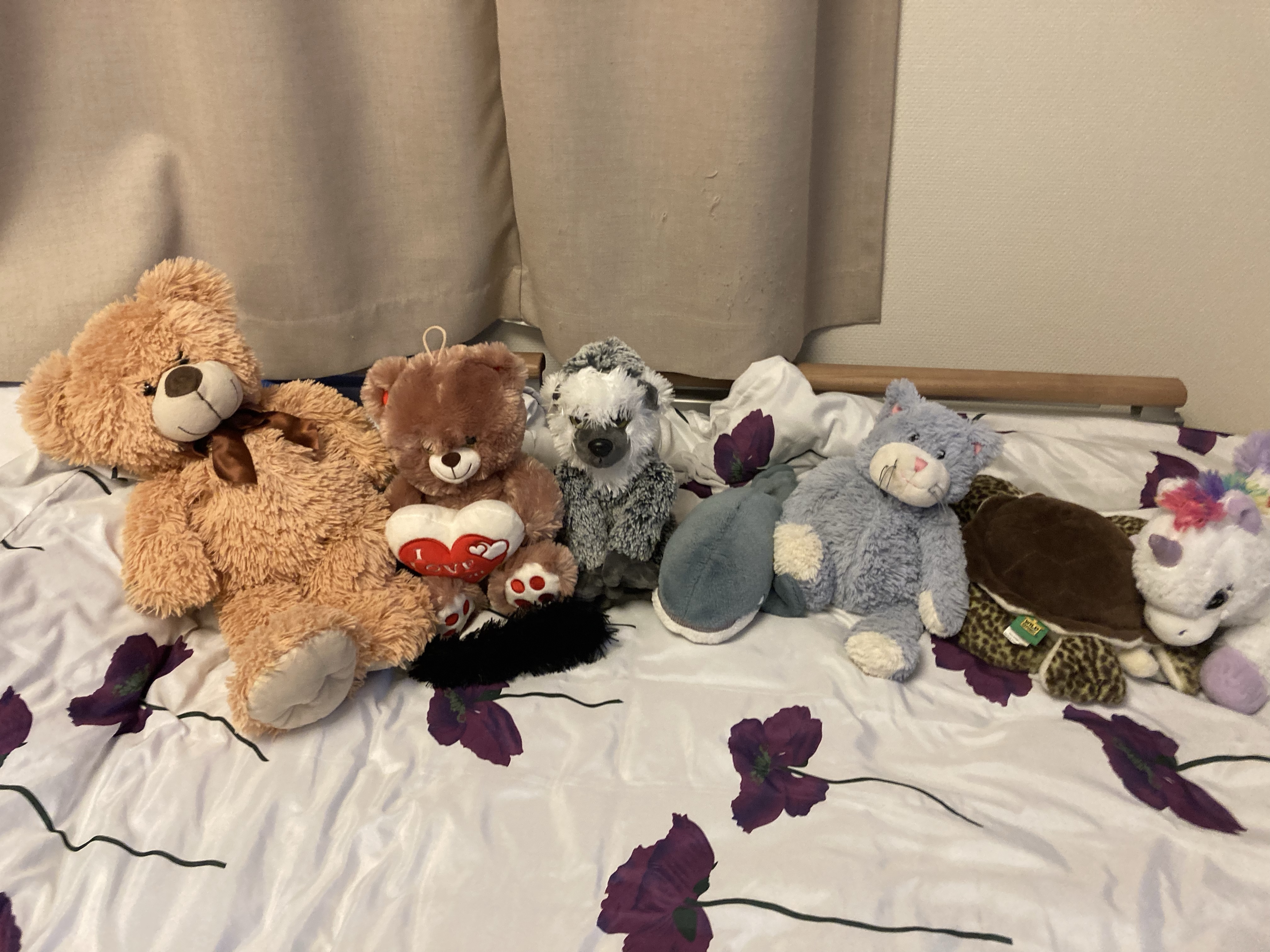
I cannot actually look at it, being that I’m blind, and I cannot touch it from where I’m sitting at my desk, but my bed with all my stuffed animals and the satin duvet cover and pillow case that I got from a staff definitely makes me smile! I just had to leave my desk to take a picture (of course I did arrange the stuffed animals for it!).

5. What always makes you laugh and smile in your life?
My husband’s jokes! He has the funniest sense of humor.

How about you? What always makes you laugh and smile?

Unconsciously Incompetent #SoCS

When I was in college studying applied psychology (it was really an orientation year to Bachelor’s of social work or related fields), my tutor had an interesting theory about how we learn by first being unconsciously incompetent. Then we move on to being consciously incompetent, by which she meant we are aware of our lack of knowledge and skill. Then, after years of college, we move on to being consciously competent. Once being experienced in the workforce, we then become unconsciously competent, which means we no longer need to be aware of our competence, since it’s become muscle memory.

I reached the stage of conscious incompetence when my tutor told me flat out that she was passing me for communication skills only if I promised never to enter the field of social work, psychology or any related field of study or work again. Thankfully, I was aware that my communication skills exam had really gone badly just before she told me, so I didn’t just need to be dragged into conscious incompetence.

I think I might need a similar experience with macrame. I started practising on Thursday and, though I managed the square knot, spiral knot and lark’s head knot quite easily eventually, I am pretty sure I’m still unconsciously incompetent. In other words, my work is horribly ugly but I think it will do.

The only thing is, because I sort of know I might never reach the stage of even conscious competence, I am too scared to show my work online for judgment. After all, as much as I am self-conscious about it, I also would really like this to work out!

Similarly, though I knew before that horribly messed-up communication skills exam at least on some subconscious level that I’m not suited to become a social worker or psychologist, I wanted to be one. That’s probably why I went into linguistics, which, though it isn’t necessarily within the helping profession, is still a communicative field of study. I only went into it to have a student psychologist tell a newspaper that “a blind autistic who wants to study something communicative” is going to have a pretty hard time of it, when they were promoting their autism buddy program. That pretty much sent me into conscious incompetence as soon as I read it, which thankfully was six weeks into the academic year. I guess that’s what happened the time the first person to comment on my question about macrame told me it would be really hard too. Only that’s before I’d started. I’m not sure that’s conscious incompetence though. It looks rather like low self-esteem.

This post was written for Stream of Consciousness Saturday, with the prompt of a word containing “Comp”.

Poem: Locked Up Inside

In my bubble
I sit
Staring out
At the world
Outside

From around me
I hear
People talking
To me
But I can’t respond

Through the invisible wall
I try
To reach out
To someone
But I can’t

A tight grip
Of panic
envelops me
Because I know
I’m locked up inside


I have had the concept of being “locked up inside” in my head for a few days now. I first came across the phrase in an E-mail support group for parents of children with selective mutism, a disorder in which a child is unable to speak in certain situations due to intense social anxiety. I have never had this diagnosis, but as a teen and young adult, did experience periods of mutism due to anxiety and dissociative freeze responses. I use the term “locked up inside” for a feeling of intense anxiety which causes a freeze response that leads to an inability to speak and sometimes move. The feeling of being “locked up inside” is particularly frequent and intense lately.

I am linking this poem to dVerse’s Open Link Night.