Fear (Or Another Four-Letter F Word)

Fear. I’ve used this word as a starting point for my writings many times. The idea comes from Mari L. McCarthy’s journaling prompts. The idea is to pick a four-letter F word and write about it or use it as a prompt. Well, I’m doing that now, but I doubt I’m actually going to write about fear. I honestly don’t know what to write at this point and am not feeling anything in particular. That is, I guess I “should” be feeling something, but I don’t know what. Alexithymia. That’s what I believe this is called. Any emotional state for me is “good”, “bad” or “neutral” like right now. I don’t ever feel totally relaxed I believe. There’s always some level of stress or anxiety or fear in my body or mind.

My movement therapist tries to tell me that my body needs to get used to the feeling of being relaxed, because due to my early childhood trauma, it never learned to trust this feeling. That makes some sense, in that I almost always feel like I’m on high alert even when I’m half asleep. Is that even possible? And if so, isn’t it just normal? Do I even know what “normal” is, being that I’m autistic and otherwise neurodivergent, multiply-disabled and a trauma survivor? I doubt it. But if I’ve lived my life like this for nearly four decades, is there any way of changing it? I hope there is, because this feeling of always being on high alert is exhausting.


This is another freewrite I originally typed up in Google Keep, then finished here.

“One Chance!” Still Haunts Me…

Today, I’m feeling like writing but am uninspired, so I’ve been checking out a ton of writing prompts and the like. I’ve been fiddling with various notetaking apps too so that I can finally write snippets without them needing to be finished right away. I know I could do WordPress drafts, but I for whatever reason don’t like that. I’m now trying out Google Keep.

One of the writing prompt series was Halloween-themed and the question was about my most recent nightmare. I can’t remember and, thankfully, I rarely get vivid nightmares anymore. I do get snippets of conversations that replay in my dreams. “One chance!” yells the staff trying to force me to accept her new colleague. Those two words haunt me. I have had this experience before.

I recently learned that PTSD nightmares do not necessarily involve the details of your trauma. I don’t know whether the Redditor who said this, based this idea on the DSM, as I’m fairly certain that in the criteria for PTSD, nightmares do need to be trauma-specific except in young children. However, even just reading that someone else experienced vivid dreams that aren’t necessarily connected directly to their trauma, feels validating.

When I was living on my own, I experienced extremely vivid dreams almost nightly and, even when those dreams weren’t directly connected to my trauma, they were disturbing nonetheless.

In a somewhat similar fashion, the staff’s comment haunting me, in itself, might sound rather innoceous. I mean, I know that it doesn’t necessarily take physical or sexual abuse for someone to be traumatized (again, contrary to what the DSM says), but if this comment were a one-off experience rather than a symptom of the rather traumatizing power dynamics involved in institutional care settings, it wouldn’t have stuck with me. Or it might have, but it wouldn’t have had the negative connotation it has now.

There’s a reason secondary triggers are a thing. I often feel shame about the numbers of triggers I have. Usually though, when the context isn’t in itself distressing, I’m able to point out that something is a trigger for me and move on.

Not with this one, but then again it was actually a boundary that was crossed. If this had happened with three people who aren’t professionally related, it’d have been considered a form of harassment. I still struggle with this concept: that what is considered “normal” in a care setting, would be considered a violation anywhere else.

Grief: Dealing With Loss (Of Any Kind) #AtoZChallenge

Hi everyone. I’ve been struggling a lot lately again and, as a result, today am particularly late writing my #AtoZChallenge contribution. Today’s letter is G and I want to talk about grief.

Grief can refer to a person’s reaction to losing a loved one to death. That’s the most heard of definition anyway. Grief for a loved one who has passed away can last very long and, in fact, isn’t considered abnormal for the first year. If a person still experiences significantly distressing symptoms of grief more than a year after their loved one has passed, they may be diagnosable with prolonged grief disorder (also known as complicated grief).

Grief, of course, can also refer to the distressing symptoms experienced after losing a beloved pet. It doesn’t matter in this respect that the pet isn’t human; grief can still be experienced very deeply. I mention this because, like I said on Saturday, my spouse and I lost our cat Barry that day.

Grief, however, can also relate to distressing symptoms experienced after a loss that isn’t due to death. For example, heartbreak is in a way grief too. So are the distressing symptoms I experienced when losing my sight and, later on, many acquired skills due to autistic burnout.

Most people will be familiar with the five stages of grief described by Elisabeth Kübler-Ross. These stages are denial, anger, bargaining, depression and acceptance. In reality though, many people will not necessarily experience these stages in order and they may fall back due to stress. Still, many of the symptoms associated with the earlier stages in this model, made it into the criteria for prolonged grief disorder. Symptoms of prolonged grief include:


  • Identity disruption (eg. feeling as though a part of oneself has died).

  • Marked sense of disbelief about the death.

  • Avoidance of reminders that the person is dead.

  • Intense emotional pain (eg. anger, bitterness, sorrow) related to the death.

  • Difficulty reintegrating, such as problems engaging with friends, pursuing interests or planning for the future.

  • Emotional numbness (absence or marked reduction of emotional experience).

  • Feeling that life is meaningless.

  • Intense loneliness: feeling alone or detached from others.

Of course, people can experience many of these symptoms without having lost a loved one to death. Emotional numbness and avoidance of triggers, after all, are also symptoms of post-traumatic stress disorder. Many other symptoms occur in people who were traumatized in some way too. As an example, I relate to all symptoms when the aspect of bereavement is removed, and not just since Barry was put down. I don’t know whether that makes sense, but oh well.

#WeekendCoffeeShare (September 21, 2024)

Hi all on this beautiful Saturday in September. I’m joining #WeekendCoffeeShare today. It’s 7:30PM, so I just had my last cup of coffee for the day. I also had a delicious smoothie I made. I must admit, I normally don’t make the best smoothies, or at least I don’t really like them myself. This one though was absolutely great! I used banana, pineapple, coconut water and a bit of cinnamon. The cinnamon was old, so even though I’m pretty sure I put quite a bit into my smoothie, I only got a slight taste of it. I shared what I had left with my fellow residents, but since this is a virtual get-together, you are invited to grab a virtual cup.

If we were having coffee, first I’d share about the weather. It’s been absolutely gorgeous with daytime temperatures of about 23°C most of the week. It’s also been quite sunny. Mornings are chilly, but then again it’s September, so that makes perfect sense. Tomorrow is supposed to be the last warm day and then next week daytime temps are supposed to drop to as low as 13°C.

If we were having coffee, I’d probably be stating the obvious if I said I’ve been walking a lot. I sometimes feel guilty when this is pretty much all I do during my allocated activity time. Then again, I tell myself the weather isn’t going to be as beautiful as it is now forever.

I also have been taking photos on my walks. That is, I usually hand my phone to my staff, who then will be snapping the pictures. I enjoy it nonetheless. Yesterday, we were able to capture a bunny.

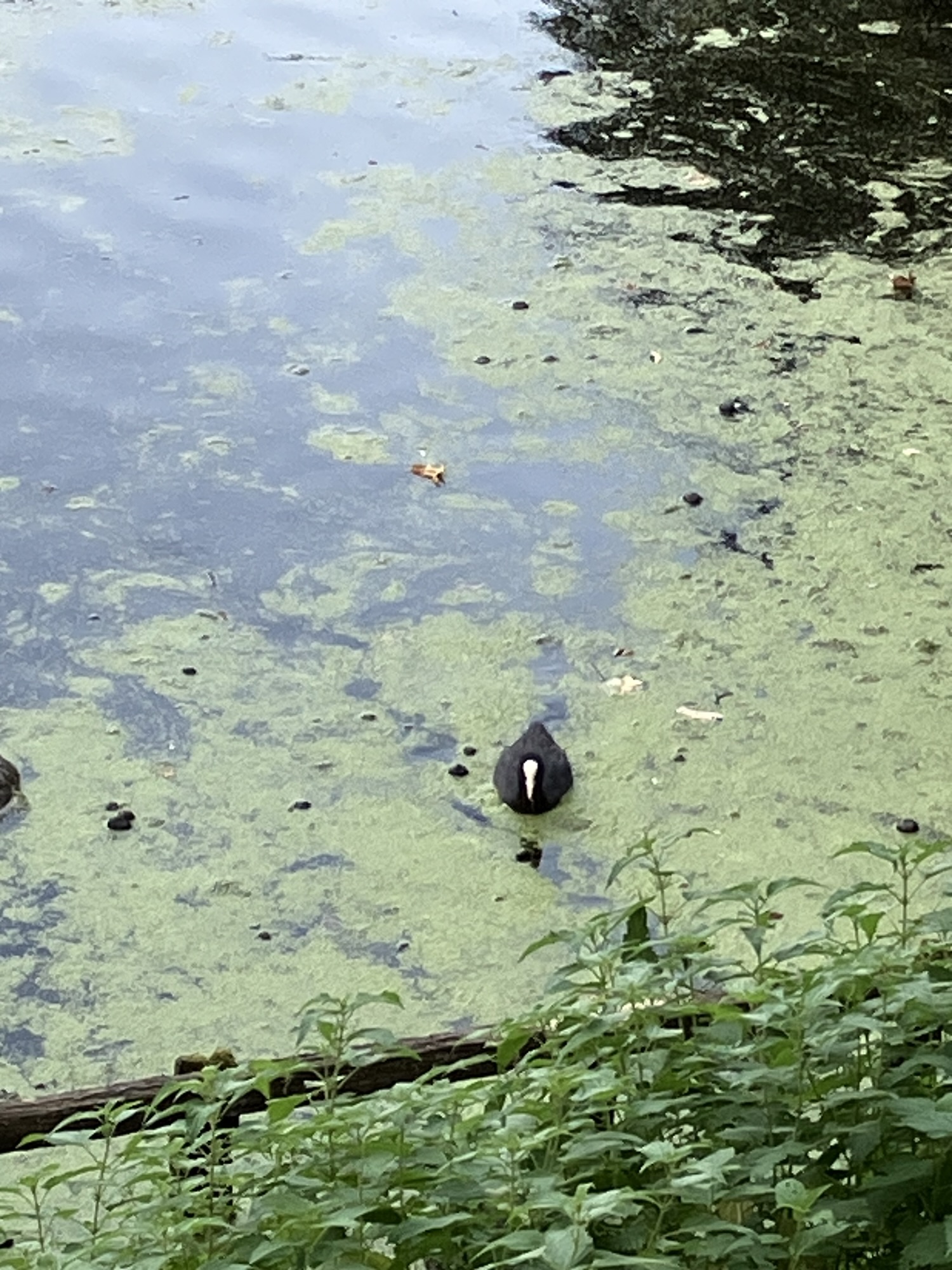
I have also been loving using Be My Eyes and other image description apps. Be My Eyes was even able to correct me and my staff on what type of bird was swimming in the institution pond.

If we were having coffee, I’d talk a little about the new iOS and WatchOS versions that came out on Monday. They’re quite stable and there aren’t many bugs affecting VoiceOver or Braille use. That’s a rarity with the first release of a major software update. I didn’t initially think I’d care for iOS 18, but WatchOS 11 does have some nice features and I’d need iOS 18 for that. I am looking forward to seeing my Vitals trend in a few weeks.

If we were having coffee, I’d tell you that I’ve been struggling a little with flashbacks and nightmares. I am, thankfully, for the most part still able to cope.

If we were having coffee, I’d share that on Wednesday, I celebrated one year in my current care home. I treated the entire home to burgers again, like on my birthday, but this time the salad I made as a side dish was the highlight for me.

If we were having coffee, lastly I’d tell you that on Thursday, it was my and my spouse’s thirteenth wedding anniversary. We drove to Nijmegen to have lunch at what I consider to be my favorite restaurant, Dromaai. Not that the food is exceptionally good, but I have fond memories of eating out here with my partner when I still lived in Nijmegen.

September Dreams and Memories

Last night I dreamt of being admitted to the psych hospital. It’s no wonder, since the anniversary of my actual admission isn’t very far away, on November 3. September 23 is my anniversary of going into long-term care and last Wednesday, I celebrated one year in my current care home.

I was reminded yesterday that September is a bittersweet month. That is, I was reminded of the sweet aspect, ie. it being me and my spouse’s wedding aniversary yesterday. The bitter aspect has overshadowed my days with flashbacks and my nights with dreams more than I’d like. I am, thankfully, still coping.

I am hoping that, as I acquire more pleasant memories here at this home, the flashbacks and nightmares will lessen. I know I was saying something similar when reclaiming November in 2021. I hope this time around I will choose following my dreams and aspirations over re-enacting the past.


Sharing this post with Friday Writings #145, for which the optional theme is dreams and memories. This was more of a freewrite than anything else, but oh well.

My Medication Musings: Topamax

Hi everyone. I had a med review today, which prompted me to write a post in my series discussing the various medications I’ve been prescribed. Today’s med review mostly concerned topiramate (Topamax), so I’ll write about that.

Topamax is an anticonvulsant usually prescribed for epilepsy. It has also shown effectiveness in treating migraines. How exactly it works is not known, but it does in these cases, although it’s not the first choice of treatment for either epilepsy or migraines.

I have neither epilepsy nor migraines. Besides, the highest dose of Topamax I ever took, 75mg/day, is far lower than the effective dose for these conditions. The reason I took Topamax is because it is also believed to help with PTSD-related nightmares and flashbacks. The way my psychiatrist explained it to me back in 2021, it might even lower my general distress level slightly. Well, it didn’t.

Topiramate can have significant side effects, including cognitive impairment, tingling in the hands and feet, and others. On 75mg, I experienced slight tingling, but I honestly don’t know whether I ever had any other side effects. I do have quite horrible tremors in my hands and legs, but these could be from any of my medications or from something unrelated altogether, although my doctor didn’t say what.

I, after some tweaking, eventually settled on a dose of 25mg twice daily. I never really questioned its effectiveness until I was wanting to taper another medication, Abilify, about two months ago and my prescribing physician and I reviewed all of my current psych meds. I said that none of my meds except for my antidepressant, Celexa, seemed particularly effective. The doctor then decided I could discontinue my morning dose of Topamax.

Today, I had a review. Though I have been a bit more distressed lately than usual, this could have many causes, including fellow clients being in distress more than usual too. Furthermore, I don’t experience an increase in nightmares or flashbacks. I admitted that most of my flashbacks are emotional, in the sense that I get dysregulated when triggered rather than having a visual reliving. I’m not sure whether these have increased.

When the doctor asked me what I wanted, I was clear: to discontinue my other 25mg of Topamax as soon as possible. This will happen in mid-August.

I am, honestly speaking, also guided by general principles in addition to personal experience: I learned about a year ago that a then recent systematic review had disproven the effectiveness of topiramate for PTSD-related symptoms.

No Such Thing As “Minor” Trauma

Recently, there was a discussion online I participated in about what caused our complex PTSD. I mentioned emotional, mental and physical abuse, bullying, a few instances of sexual violation and medical trauma. Most others not only went into far more detail than I was comfortable, but also discussed traumatic experiences that seemed far worse compared to those I’d gone through. When I mentioned this, saying reading others’ stories made me feel as though my trauma was minor, someone else commented how there’s no such thing as “minor” trauma.

Indeed, if something was significant enough to have caused C-PTSD, it was traumatic, and this means it was major. I am reminded of something my spouse said at one point when I was seeing a potential new trauma therapist back in 2013 (who ended up rejecting me for reasons not related to me). I was doubting the reality of my trauma. To this, my spouse said that, in reality, something as “minor” as slipping on the bathroom floor, could be life-threatening, so in theory I could’ve developed PTSD from that. I didn’t and I didn’t develop PTSD from any of my countless other falls, but I might have. Of course, this is a bit far-fetched, and of course I couldn’t have developed complex PTSD from falling, but I hope my point is clear: it’s not always easy to distinguish between events that objectively speaking count as trauma and things that don’t.

There are trauma centers here in the Netherlands that adhere very strictly to criterion A (the presence of things that count as trauma, according to professionals) in DSM-5 for treating people with (C-)PTSD. I’m not sure I’d meet their criterion. I mean, yes, I did experience exactly one potentially life-threatening medical event that I remember, when I was four. I was also hit quite regularly, but does that go beyond “tough love”? If it doesn’t, I’m pretty sure it doesn’t meet the trauma criterion for (C-)PTSD.

Then again, I’m not seeking to get into one of these centers. Tomorrow, I’ll have a get-to-know-me appointment with the care agency’s therapy practice. They haven’t yet decided whether they can help me or not. I hope they can, because right now I’m feeling rather hopeless.

Heal

Today’s prompt for Five Minute Friday is “Heal”. I read several of the responses before writing mine. Some left me feeling all sorts of things, which I will try to articulate in the below freewrite.

Is it possible to heal from a hurt you can’t explain in words? Can something that you can’t describe in words, a memory that is just visceral, even be traumatic? I am referring to preverbal trauma, of course and, in theory, I know the answer: yes, it exists and yes, healing is possible.

However, in reality, how can I prevent my cognitive processes from constantly interfering with my experiences? Or should this be prevented at all? I mean, if I can rationalize that I’m now in 2022, living in the care facility and not in whatever danger my body thinks (feels?) it’s in anymore, does it even matter that I endured preverbal trauma?

After all, it’s a fact that I did: I was born prematurely, spent the first three months of my life in hospital and had several complicated surgeries before the age of five. The question is whether said possibly-traumatic events affected me and, if so, how to heal from them.

Dealing with Anxious Attachment and Attachment Loss

Okay, I’m probably giving up on the 31-day writing challenge. I love the prompts, but right now, they just don’t seem to inspire me. I’m not feeling well at all right now. Haven’t for about a week or more. Like I shared in my post on Sunday, I have been feeling triggered by my staff being on sick leave. It’s not just that, of course. The change of seasons with all its triggers to my time in crisis back in 2007, doesn’t help either. The emotional flashbacks are so bad I’m considering asking my nurse practitioner to temporarily up my topiramate. For now though, I’ll write a little about attachment loss and abandonment issues.

When I was first diagnosed with complex PTSD and dissociative identity disorder in 2010, part of the consultation that led to this diagnosis involved an attachment styles questionnaire. I scored highest on the anxious/preoccupied attachment style. This means that I tend to depend heavily on others. I struggle to admit this, but it is true.

As such, I fear attachment loss or abandonment a lot. Most anxiously attached people tend to seek another relationship right away when one ends. I don’t have any exes, since my husband was also my first boyfriend, but I do notice it in other areas. For example, now that my assigned staff is on sick leave, I’ve already been thinking about who will become my assigned staff if she ends up not returning. Which, in fact, is something I cannot get out of my head for whatever reason.

Anxiously attached people also tend to cling to dysfunctional attachment figures far too long. Again, I don’t experience this in my marriage, but I did experience it in the psych hospital. I had an assigned staff who was rather adamant that I become more independent than I could be, but I accepted her as an authority for far too long. Same with my psychologist.

I, thankfully, left that place. However, I do find that something I read while researching attachment loss for this post, makes a lot of sense: the idea that leaving a relationship on paper doesn’t mean being emotionally detached from that attachment figure. Again, not my marriage, but with respect to my care situation, yes, that’s so me! I still experience vivid dreams (not necessarily nightmares!) about the psych hospital. I also still look up things about my former care agencies, thinking maybe I should go back. I still find myself being influenced by what my past care providers said about me, no matter how harmful and wrong. This may be one reason I don’t generally meet the avoidance criterion of classic PTSD, but am rather the opposite: I find myself drawn to things that trigger me. Now if only I could find a way to truly let go of the emotional baggage I’m carrying with me.

Why Do I Need One-on-One Support? #31Days2021 #Blogtober21

Yay, it’s October and this means it’s time for Blogtober 2021. Last year, the prompts were based on song titles. This year, there are no prompts. However, Kate Motaung of Five Minute Friday also relaunched the 31-day writing challenge after a break last year and there are prompts for this year. The first prompt is “need”. We can do a five-minute freewrite, but I’m no good at sticking to five minutes or at not editing my writing.

Yesterday I had my care plan review. I was really concerned about my need for one-on-one support being reassessed later this year. Not that the care plan review would really matter for this or so I’m told, but now that we were all together (my home and day center staff, the behavior specialist and my mother-in-law), I wanted to raise the issue. It’s the behavior specialist’s job to write the reapplication paperwork and I questioned whether it sufficiently documented my need for one-on-one. To get things clear in my mind, I am going to write out why I need the support I need.

Firstly, I am blind and have a mild mobility impairment due to cerebral palsy. This, combined with my psychiatric illnesses, means I cannot move about outside the care home, or even outside of my room, independently much at all. This means that the staff need to be alerted when I leave my room looking for them, so that they can come out looking for me.

I am autistic. In my case, I get severely overloaded having to function in a group setting, such as at the day center. Even with noise-canceling headphones on, I still get distracted from trying to do things on my phone while there. Besides, if I do have functioning headphones, they will block out so much noise that I’m essentially cut off from my surroundings and can’t be alerted should something happen. This creates intense anxiety.

This anxiety also leads me to be unable to function on my own for long periods of time. I can, if I’m doing well, be left on my own in my room for up to about 30 minutes at a time. It doesn’t help that I know rationally that someone might be in the next room, because emotionally, if they’re out of earshot, they might as well be on the North Pole.

Autism also means I tend to fixate on routines. In my case, I tend to hyperfocus on the times my staff are going to leave me alone and this creates even more anxiety even when they’re still present. For this reason, staff need not stick to rigid rules of what time exactly they’re going to leave me, but rather to the order of activities.

If I’m left alone for prolonged periods of time, I can often feel incredibly unsafe and start to ruminate, which can easily escalate into self-destructive thoughts and actions. I may also run off in a fight-or-flight response.

I have complex PTSD, as well as dissociative symptoms. This means I can experience apparent age regressions. I get triggered very easily. Flashbacks, too, can lead to a fight-or-flight response.

Thankfully, now that I’m on the right medication, I don’t get as many flashbacks as before. However, I still do experience many serious behavioral issues that can be prevented or averted by the fact that I have one-on-one support most of the time.

I’m pretty sure a critical assessor would be countering that my one-on-one would not help me learn to cope with my anxiety. Thankfully, the goal of my long-term care plan is stabilization, not development. In other words, the original assessors for my long-term care funding did not feel I am trainable anymore. Otherwise, I would not have gotten approved for what is essentially lifelong care at all. The only thing is that my one-on-one care exceeds the care normally paid for by my long-term care profile. Oh well, let’s hope the assessor sees my need for it for at least another year.