Am I a Monster?

Hi everyone. I’ve been struggling really badly once again. Nearly three weeks ago, I had an outburst that caused the second staff so far at this home to request to the team manager that she not be required to support me for a while. This staff used to be one of my three assigned staff. Another was a student and has since left this home to continue her education at the intensive support home I used to live at. The third one is still my assigned staff, but she only works a day or two a week.

With the staff who previously requested to not support me for a while, I’ve since talked things over, though she still refuses to be honest about the thing that got me to be angry with her, ie. her using literally every opportunity to assign me a temp worker. Because of this, I’ve felt like I had to apologize for my anger (which I see is necessary) but she wouldn’t have to apologize for or explain her behavior that upset me. With the current staff, I don’t have this issue, but I do mistrust her for having pretended to have talked it over then decided she couldn’t handle it anymore a few days later.

I realize part of the problem is my attachment anxiety. As a result of this, I mistrust people who try to come close and be there for me, because I know that if they truly knew me, they’d reject me. Which is, of course, true in theory at least: no-one in life is there for anyone else unconditionally. And, given that I sometimes don’t know who I truly am, I worry that I’ll be worse than even I can imagine if I let my guard down.

Of course, it’s also a self-fulfilling prophecy, as you can see from the fact that two staff in the past year have already rejected me. The current one even claimed she wouldn’t.

Even if I’m in the midst of severe self-doubt, I am (almost) certain that I won’t become physically violent if I let my guard down. The problem is that words hurt too, and I can unfortunately say quite nasty things even without meaning them. I mean, there’s been one instance, back at the intensive support home, when I hurt someone’s feelings with a literal personal attack: I said that it was her fault that she got hurt during a fellow client’s outburst. This staff never requested to not support me anymore. With the two who so far did here, my comments weren’t intended as they came across and, while they could literally be seen as hurtful, I didn’t mean them personally and had no bad intentions whatsoever.

I struggle intensely with this knowledge, that I don’t intend to hurt people but that I do it nonetheless. I also struggle to figure out a way to stop this. After all, they are not insults that caused these staff to reject me (though I called them both bad names too). If they were the insults, it’d be doable to erase these from my vocabulary, as I’ve mostly successfully done with certain other words. However, like I said, they were their interpretations of my comments about how they don’t know me that hurt their feelings. This is harder for me to process, as it means being aware of every possible interpretation of something I literally say. This is quite hard for me as an autistic person with virtually no cognitive empathy.

Besides, as I now realize, I probably have low emotional empathy too, as I wasn’t able to predict that the staff was just going through the motions when I thought we’d talked things over. She in fact supported me through an intense movement therapy session and I didn’t pick on her struggling at all. This makes me feel even worse than the fact that I didn’t realize at the time that my words were hurtful.

This low emotional empathy realization makes me feel like I’m a monster. Aren’t autistics supposed to have high emotional empathy? Aren’t psychopaths and narcissists the ones with low emotional empahty? I mentioned possibly being a narcissist to my wife and she denied I am. Then again, aren’t narcissists masters at making their loved ones believe they are the victim? Is all this my attachment anxiety talking, or is there some truth to the idea that I don’t deserve to be supported?

#WeekendCoffeeShare (April 27, 2025)

Hi everyone. I really wanted to write a #WeekendCoffeeShare post yesterday, but was dealing with neck and shoulder pain and was quite tired, so I lay in bed by 9:30PM. I originally intended this to be a quick lie-down and planned to write my post after my music pillow had auto-disconnected after thirty minutes. Well, before those thirty minutes were up, I set the pillow to keep playing until I either manually turned it off or its battery was empty. Guess what? I know for a fact that the latter happened sometime during the night, because the pillow was no longer connected when I woke up at 8:30AM, but I swear I didn’t hear its pretty loud sound indicating it needs charging. I slept like a log!

Anyway, all this to say I’m doing my coffee share on Sunday evening. I’ve just had my last cup of coffee for the day, but I can serve you some soda or tea. Let’s have a drink and let’s catch up.

If we were having coffee, first as usual I’d talk about the weather. We’ve had some rain, some sunshine and some clouds. Today, the daytime temp was 19°C. We’re supposed to get almost summerlike temps of 23-24°C this coming week.

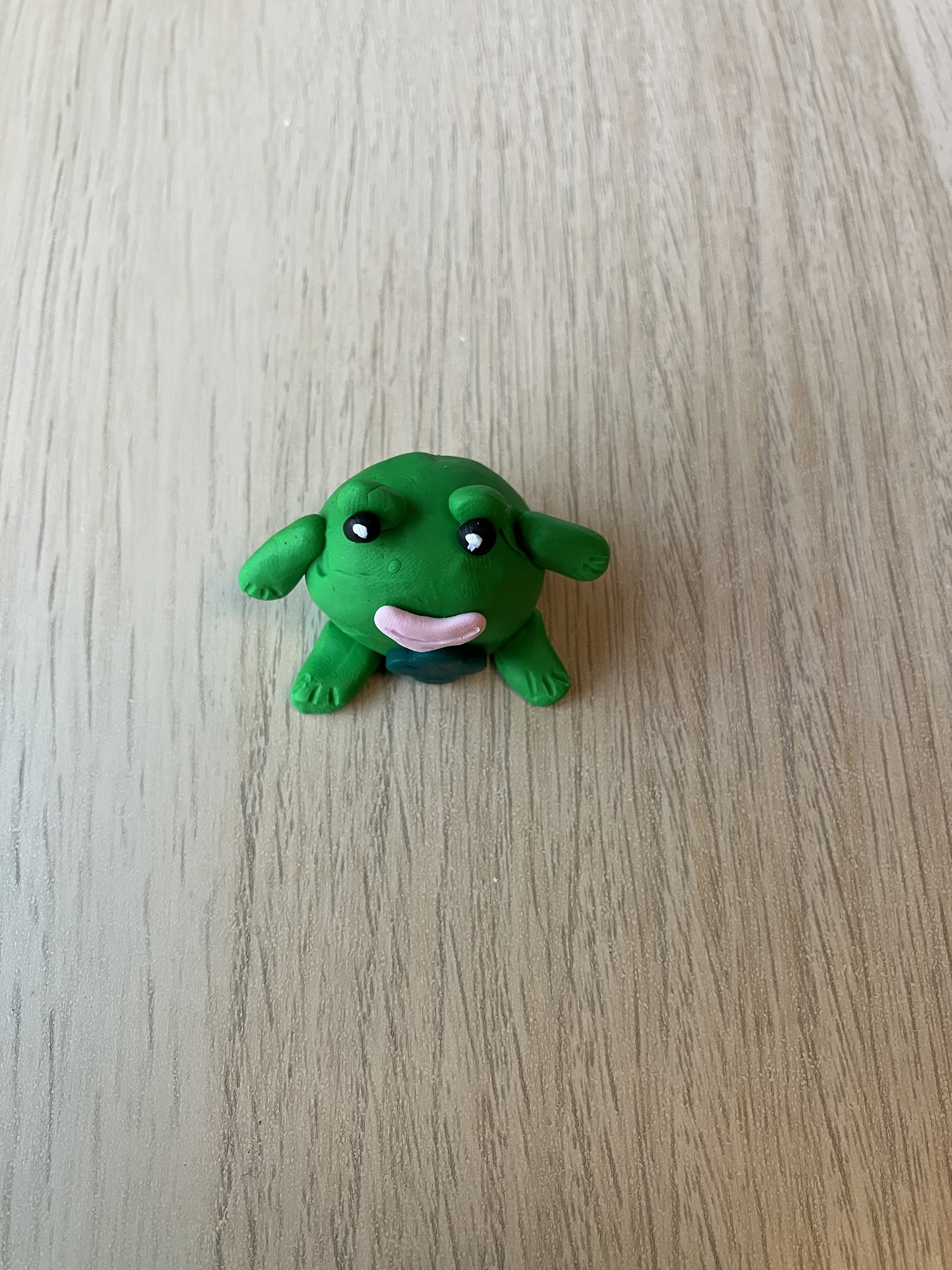
If we were having coffee, next I’d share that I’ve been crafting again. I made several polymer clay frogs for staff members who are recovering from surgery. The frog (Dutch: “kikker”) is sometimes used as a symbol for cheering someone up (“opkikker”). The first one took me over an hour to finish, but the second one was so much easier once I’d figured out how I wanted it. Here’s the second one.

If we were having coffee, then I’d tell you that I have a new assigned staff. One of my two assigned staff is on long-term leave for familial reasons and the other is a student. I had been a bit angry at the student for various reasons, among which her way of communicating the temp worker situation with me. The new one will be my assigned staff together with the student. I can get along with her pretty well.

If we were having coffee, finally I’d make use of the fact that I write my coffee share on Sunday to share that my spouse and I had an important discussion today after our outing to have lunch and shop. We have made up our minds that we’re getting divorced. We will continue to be best friends, but since there’s no sexual or romantic component to our relationship and we’re not living together nor intending on ever doing so again, it makes sense that we officially divorce. We have been having this on our minds for several months already, so the discussion, though hard, wasn’t altogether a surprise to me. We mostly need to work out how much my spouse owes me for my contribution to our mortgage, so that the house can be completely my best friend’s and no longer mine. I guess I will from now on refer to my spouse as my best friend to ease the transition for me.

It may seem like I’m not affected emotionally by this decision, but I am. I mean, I’ve mentioned a few times that my spouse and I will always be soulmates, but the fact is nothing is for certain. When we got married after all, it was to affirm our everlasting love to one another. Though our feelings for each other haven’t changed all that much since we first met in 2007, there’s this voice in me telling me this is the beginning of the end. I tell myself this is attachment anxiety talking. Whether it is or this fear is real, doesn’t really matter in the present moment though, as right now we’re still soulmates.

Attachment Theory for Personal Growth #AtoZChallenge

Hi everyone and welcome to my eleventh attempt at doing the #AtoZChallenge. I’m doing it on personal growth and self-improvement this year and, for my letter A post, I want to talk about attachment styles.

Attachment theory was first developed by John Bowlby (1907-1990). Bowlby was educated in psychoanalysis but didn’t feel that this idea took into account a person’s environment.

Attachment theory is based on the bond between a child and their primary caregiver (usually mother) early in life. Bowlby observed that, if a child’s need for consistent, secure attachment isn’t met, that child will develop emotional, social and sometimes even cognitive problems.

The idea of attachment styles comes from Mary Ainsworth (1913-1999). She designed something called the “strange situation”. In this experiment, young toddlers (between 12 and 18 months of age) were observed during their interactions with their mothers, a stranger who was at one point introduced into the situation, and while alone.

This led to the idea that there are three distinct attachment styles:


  • Secure: the child reacts with distress in the absence of their mother but is easily soothed by her.

  • Resistant (now known as anxious or anxious-preoccupied): persistent distress that continues far longer even in the presence of the mother.

  • Avoidant (dismissive-avoidant): no outward signs of distress either when the mother leaves or when she returns: a child ignores the mother.

Later, a fourth attachment style (disorganized or fearful-avoidant) was added. Children who would be classified as having this attachment style, exhibit characteristics of both the resistant and avoidant style. For example, a child seeks comfort from the stranger rather than their mother.

Remember, attachment theory and attachment styles are based on observations of toddlers. As such, how relevant are these to adults? Current research shows that attachment styles are moderately stable over time. As such, if you had an insecure attachment style as a child, you’re likely to still have some attachment insecurity as an adult.

However, as you’ll see when I discuss other topics relevant to personal growth, hardly anything in the human psyche is black-or-white and this goes for attachment styles too. Rather, in adults, there are two continuums along which someone will function: attachment anxiety and attachment avoidance. Most people fall somewhere in the middle on both, experiencing some attachment anxiety and some attachment avoidance but not so much that it interferes with their daily life.

How does an insecure attachment style present in adults? Generally speaking, someone who leans towards dismissive-avoidant will value their independence, have difficulty sharing their emotions and have a hard time being in an intimate or otherwise close relationship.

People who have more of an anxious-preoccupied attachment style, are the opposite: they crave relationships and worry excessively about losing the people close to them, leading them towards neediness and manipulation.

People who exhibit disorganized attachment, will alternate between craving intimacy and avoiding it.

I at one point had an attachment styles questionnaire administered and scored highest on the anxious-preoccupied attachment style. I currently believe I have some avoidant tendencies too, so in terms of black-or-white attachment styles would be considered fearful-avoidant with a strong leaning towards anxious.

Gratitude List (July 20, 2023)

Hi everyone. I’m feeling like I have really been neglecting my blog. The truth is I’ve been struggling a lot, more so even than I used to. However, today I’m feeling pretty good so I’m taking the opportunity for a gratitude post. Here goes.

1. I am grateful for a fellow resident’s birthday celebration on Monday. Just after handover at 3PM, we all sat in the living room and sang “Happy Birthday” for him. We had fries and a snack for dinner too. Unfortunately, another resident did have a severe anger outburst right after we did the singing and was disruptive for the rest of the evening even when in his room.

2. I am grateful that, though on Tuesday I got the least familiar to the group staff assigned to me for my one-on-one, she was not the least familiar to me.

3. I am grateful for a comforting visit from my mother-in-law on Tuesday. It was good to be able to vent to her.

4. I am grateful for a delicious caramel ice cream bowl that my mother-in-law treated me to on her visit. Okay, my dress once again had ice cream and caramel sauce all over it, but oh well, it can be washed.

5. I am grateful for a satisfying dietitian’s appt on Wednesday. She was really content with my weight (which remains within the agreed-upon range) and my eating and exercising habits. For those who don’t know, I have a history of disordered eating, bordering on bulimia, so I particularly need to make sure my eating and exercising don’t become compulsive (in addition to not engaging in purging behaviors, of course).

6. I am grateful my assigned staff supported me for part of the morning shift on Wednesday despite there being a temp worker too. Granted, the temp worker is quite familiar with the group, but I’d more or less been told that I’d still be assigned the temp worker by default unless there are literally four regular employees.

7. I am grateful for a great experience swimming yesterday. I went into the pool with just a staff and no other residents. This particular staff has this really cool way of getting my playful inner child out, so we sang songs, jumped up and down and had lots of fun.

8. I am grateful my assigned staff agreed to contact the behavior specialist once she’s back from vacation to set up a meeting to discuss possibly finding me help in overcoming my sense of basic mistrust. It’s been getting progressively worse and is affecting my life here at the care home but also my marriage.

9. I am grateful I was allowed to borrow a fellow resident’s side-by-side bike this afternoon. It was a nice change from walking.

10. I am grateful for my spouse, who sticks by me even though I’m being quite difficult. We’ve had a few arguments and I’ve crossed my spouse’s limits a few times. I now realize this is probably my anxious attachment style getting in the way of our healthy communication. For this reason, I’m all the happier to still be going on together.

What have you been grateful for lately?

How My Attachment Style Affects My Decision-Making

Hi everyone. I have been contemplating my decision to move to my current care home from the previous one a lot lately. My assigned staff often asks me whether I might be a little too critical, because my old care home offered near-perfect supports and yet I wanted to leave. Indeed, it could be this is a factor. I’m an Enneagram type 4, after all, always looking for that elusive ideal.

However, I am also insecurely attached. Attachment is formed in early childhood between the infant/toddler and their primary caretaker. When there is frequent disruption in this attachment and/or the caretaker isn’t a safe person for the child (as in the cases of neglect or abuse), this attachment doesn’t form or forms insecurely. This then will lead to problems later in life with relationships, both romantic and otherwise.

The different attachment styles described differ per professional, but I primarily score as anxious-preoccupied. This means that I am essentially looking for close connections to people, be they my romantic partner or otherwise, but also intensely fear them abandoning me. I also relate strongly to the ambivalent attachment style, which is essentially a mix between avoidance and preoccupation. This would explain why I push people away when I sense they might be abandoning me.

This is where my decision to move out of my old care home comes in. Starting at the end of 2021, half the team of my old care home left their positions, including some staff I could get along with really well. I remember, shortly before making the decision to ask my assigned staff to involve the behavior specialist in finding me a new home, E-mailing that same assigned staff. The contents of the E-mail were rather, well, needy. I expressed the fact that I knew none of the staff currently working at my home could guarantee they’d remain with me for months, let alone years to come. I probably even mentioned my spouse, who, though we have zero intention of divorcing ever, might leave me eventually. That’s life. No-one can predict the future. And honestly, it kind of sucks.

Though my then assigned staff assured me my E-mail had nothing to do with it, she did indeed quit her job several months later. However, the fact that the team as it was when I got my one-on-one support funding, had pretty much fallen apart, gave me the impression I didn’t need to stay for the team. And since otherwise the home wasn’t suitable for me – because the other clients couldn’t speak and needed far more physical care than I did -, I started the search for a more suitable home. Which, as regular readers of this blog will know, I didn’t find. I mean, yes, my fellow clients can speak, but the support approach is very different and not in a good way from what I got at my old home.

My attachment style also means I often come across as very trusting, because I at least initially accept everyone into my life because I have such an intense fear of aloneness. This is often misjudged to be a sign of secure attachment. In fact, recently a relatively new staff tried to get me to join him on a car trip to get food for just the staff during my designated activity time. I felt kind of lured, because I didn’t want to but he was like “it’s fun, I’ll buy you a treat too” and then I didn’t feel comfortable refusing anymore. This should’ve been a big no-go had this person not been a staff member, but since he’s a staff member it was okay, according to one of the other staff I talked this over with. What this staff didn’t realize is that I’ve had previous experiences of risky encounters with men and a history of being a victim of sexual violation too. And, though of course my easily accepting others isn’t to blame for any victimization (that would be victim blaming), it is important to realize I don’t distinguish between those in a position to help me and those who aren’t, like that staff person believed.

An Interesting Nightmare

I had an interesting nightmare last night. It wasn’t even really a nightmare in the traditional sense of the word. I mean, no violence or monsters were involved. Then again, most of my nightmares don’t involve that kind of scenario.

In my dream, the last client to contract COVID in our care home, came into my room and went straight to my bed while I was lying in it. I tried to crawl to one end to keep my distance, because of course getting out of bed would mean getting stuck touching her. I eventually managed to press the call button, but no-one came. Finally, this client left, but I was utterly distressed and tried to press the call button again, but to no avail. I then went out of my room and to the living room, even though I’d decided to stay in my room while more than half of my fellow clients are positive for COVID. Then, one of the care assistants, a woman I’ve only met briefly once or twice, came to my room to have breakfast with me (apparently it was morning), but I asked for the morning staff. The care assistant explained that the staff was busy and she was having breakfast with me instead. Then I woke up.

The nightmarish aspect of the dream was, in part, the fact that a client with COVID came into my room and my bed. This to me signifies how scared I am of contracting the virus, even though I keep saying there’s no surefire way to prevent it anyway and I’m not scared of getting very ill. I am, however, quite honestly, pretty scared of the consequences of room-based self-isolation should I be positive. I mean, I’m now basically in room-based self-isolation too, but my staff don’t have to wear PPE other than surgical masks and they can still be within a five-feet distance. I’m not sure about holding my hand or holding me in an embrace, as I’ve been cautious and haven’t asked, but I know from the times I had to self-isolate with suspected COVID last year and in 2020 that those are big no-nos should I be positive. At least, my staff wouldn’t even get within a five-feet distance even while wearing PPE then.

Another aspect that was nightmarish to me, was the fact that the unfamiliar care assistant ended up helping me rather than my trusted staff. This to me signifies how I’m experiencing attachment to this staff, and she wasn’t even my assigned home support worker or another of my favorite staff. I guess this counts as a win!

Lastly, a nightmare aspect was the fact that the care assistant told me that the staff was busy. I am forever frustrated with staff being overworked and busy and at the same time, I’m trying to accommodate them as much as I can. For example, yesterday the staff (same one who was supposed to come in my dream) forgot to come by my room at 3:15PM when she had finished handover. At 3:45, fifteen minutes before my one-on-one time would start, I’d had enough and pressed the call button. I was really frustrated, thinking that I’d be left to my own resources now that over half of the clients have COVID. That would make sense, rationally speaking, since I’m not sick or whatever. Not that the other clients are very sick, but oh well. As it turned out, the staff had forgotten to show up because she hardly ever works late shifts. This, plus my nightmare, does show how easily I think that I’m being abandoned.

Sharing this post with Scott’s Daily Prompt from last Saturday on the topic of nightmares.

Dealing with Anxious Attachment and Attachment Loss

Okay, I’m probably giving up on the 31-day writing challenge. I love the prompts, but right now, they just don’t seem to inspire me. I’m not feeling well at all right now. Haven’t for about a week or more. Like I shared in my post on Sunday, I have been feeling triggered by my staff being on sick leave. It’s not just that, of course. The change of seasons with all its triggers to my time in crisis back in 2007, doesn’t help either. The emotional flashbacks are so bad I’m considering asking my nurse practitioner to temporarily up my topiramate. For now though, I’ll write a little about attachment loss and abandonment issues.

When I was first diagnosed with complex PTSD and dissociative identity disorder in 2010, part of the consultation that led to this diagnosis involved an attachment styles questionnaire. I scored highest on the anxious/preoccupied attachment style. This means that I tend to depend heavily on others. I struggle to admit this, but it is true.

As such, I fear attachment loss or abandonment a lot. Most anxiously attached people tend to seek another relationship right away when one ends. I don’t have any exes, since my husband was also my first boyfriend, but I do notice it in other areas. For example, now that my assigned staff is on sick leave, I’ve already been thinking about who will become my assigned staff if she ends up not returning. Which, in fact, is something I cannot get out of my head for whatever reason.

Anxiously attached people also tend to cling to dysfunctional attachment figures far too long. Again, I don’t experience this in my marriage, but I did experience it in the psych hospital. I had an assigned staff who was rather adamant that I become more independent than I could be, but I accepted her as an authority for far too long. Same with my psychologist.

I, thankfully, left that place. However, I do find that something I read while researching attachment loss for this post, makes a lot of sense: the idea that leaving a relationship on paper doesn’t mean being emotionally detached from that attachment figure. Again, not my marriage, but with respect to my care situation, yes, that’s so me! I still experience vivid dreams (not necessarily nightmares!) about the psych hospital. I also still look up things about my former care agencies, thinking maybe I should go back. I still find myself being influenced by what my past care providers said about me, no matter how harmful and wrong. This may be one reason I don’t generally meet the avoidance criterion of classic PTSD, but am rather the opposite: I find myself drawn to things that trigger me. Now if only I could find a way to truly let go of the emotional baggage I’m carrying with me.

Basic Mistrust

I have been compelled to read up on emotional and psychosocial development. One theory is Erik Erikson’s theory, which states that, at each different stage in life (from infancy to old age), a particular conflict is present. In infancy and early toddlerhood, this conflict is basic trust vs. mistrust.

I initially thought that this stage corresponds pretty much to the first adaptation phase in attachment theory, which takes place between birth and age six months. When I checked it though, it includes this stage as well as the first socialization phase, age six to eighteen months. This may be one reason why I relate strongly to basic mistrust even though, in attachment theory terms, I function in most areas consistent with the first socialization phase.

One thing I’m facing lately is a chronic feeling of anxiety and distrust. In my care plan, my emotional development is outlined and in the fear domain, I am said to function at an age comparable to somewhere between zero and eighteen months. This includes all of Erikson’s first stage of psychosocial development. By contrast, it encompasses both the first adaptation and first socialization phase of attachment development. The reason my development in this area isn’t pinpointed to either of these two phases, is that I experience both basic fear (consistent with the first adaptation phase) and strong separation anxiety (consistent with the first socialization phase). Apparently, a baby under six months cannot yet express separation anxiety.

I have little idea why I might experience such strong anxiety, as in, what in my early development contributed to it. I mean, my parents claim I didn’t have these issues until I started to lose my eyesight at age seven. Seven is another important age in both cognitive and psychosocial development, but I don’t think that one is particularly important in my life. The earlier stages seem to make far more sense to me.

Of course, I do know that I probably didn’t have optimal care in my early life. This isn’t anyone’s fault. I was, after all, born prematurely and spent the first three months of my life in hospital. Though my parents visited me often, I don’t think I could rely upon them for meeting my every basic need. After all, they cannot possibly have been in my proximity 24/7, like the mother of a typically-developing child usually is at least for the first few weeks to months. My nurses must’ve provided me feeding and comfort at least part of the time.

As for affection, I have absolutely no idea. NICU nurses aren’t likely to be able to provide any significant level of affection to a baby at all, but I guess my parents would’ve made up for that. I went into this when discussing mother as source and mother as place of attachment. The truth is, I honestly mostly rely on my current feelings to guide my ideas. I, after all, don’t have many early memories of affection. My first memory related to it is from age four or five and it involves my mother using a nickname for me that referred to her needing to be at my side all the time. Then again, most people don’t have many early memories at all and remembering is still a form of reconstruction. In other words, because I experience a lot of basic mistrust now as an adult, it is easier for me to remember the memories that point to this.

This post was inspired by Fandango’s one-word challenge (#FOWC), the word for today being “Basic”.

If The Staff Saw My True Nature…: Reflections on Not Belonging

Yesterday, I was in yet another crisis. I was majorly triggered when a staff told me at the dinner table to calm down or go to my room because she had other clients to attend to as well. This triggered both my fight and flight responses. I was completely convinced that this one remark proved that, if staff truly know me, they’ll abandon me. After all, if they truly knew my nature, they’d know I needed more support than they can offer. I was and still am intensely ashamed of this nature of mine, but for whatever reason, I cannot seem to change it.

I cannot stop this part of mine who thinks she needs almost literally one-on-one support all day. It isn’t even a sense of entitlement, since I don’t feel that I’m somehow deserving of more attention than the other clients. Or maybe at the core I do believe this. I’m not sure. My parents would say I do believe I’m somehow entitled to endless attention.

At one point, I lashed out at the staff member. This led to further intense shame. I was convinced that, in that moment, the staff had seen my true nature and that she was going to make sure I’d be kicked out.

For whatever reason, she didn’t. She did, I assume, write an incident report. Other than that, I must say she was incredibly nice all evening.

And yet all day I was convinced that, if the staff nor the manager were going to kick me out, they must not have seen how wicked I really am. I do know that, in truth, this was one of my worst outbursts of aggression ever. I’ve done more harmful things, but those were harmful only to myself.

The manager came to talk to me late in the afternoon. She reassured me that I won’t be kicked out. I tried to tell her that, despite my desire to be good, I feel I might need more support than my current home can provide. I wasn’t trying to elicit her pity or convince her to apply for more funding for me, but I was trying to make it clear that I may be more of a burden than she can handle. I don’t want to feel attached to the staff and the home and even some of the other clients only to be told in a month or two that after all I’m too much of a handful. The manager sort of reassured me.

And yet, when she was gone, I went online and looked at other places I might be able to move to. Not because I really want to move, but because that’s what I’m used to. I’m used to not being wanted anywhere. And it’s tempting to believe that, with how often I end up in crisis here, I don’t really want to live here myself. Ugh, I don’t know how to answer that question.