Devotion to Polymer Clay

Hi everyone. Today I’m joining John Holton’s Writer’s Workshop. I’m choosing to write on the prompt about devoting your life to art. What type of art would I devote my life to?

The question here is, are we to choose just one particular form of art that we’d devote our entire life to, or are we allowed to pick more than one form? After all, many art forms are interconnected and I would not enjoy one without the other.

For instance, I would probably not enjoy polymer clay as much if I didn’t take photos of my work and didn’t write about the craft on here. Also, if I make jewelry out of polymer clay or use polymer clay beads in a necklace or bracelet, that’s basically combining two crafts.

So, let me say I cannot choose just one art form, because, though my photographs aren’t all that artistic, I’d still have to choose between polymer clay and writing. I flat out refuse.

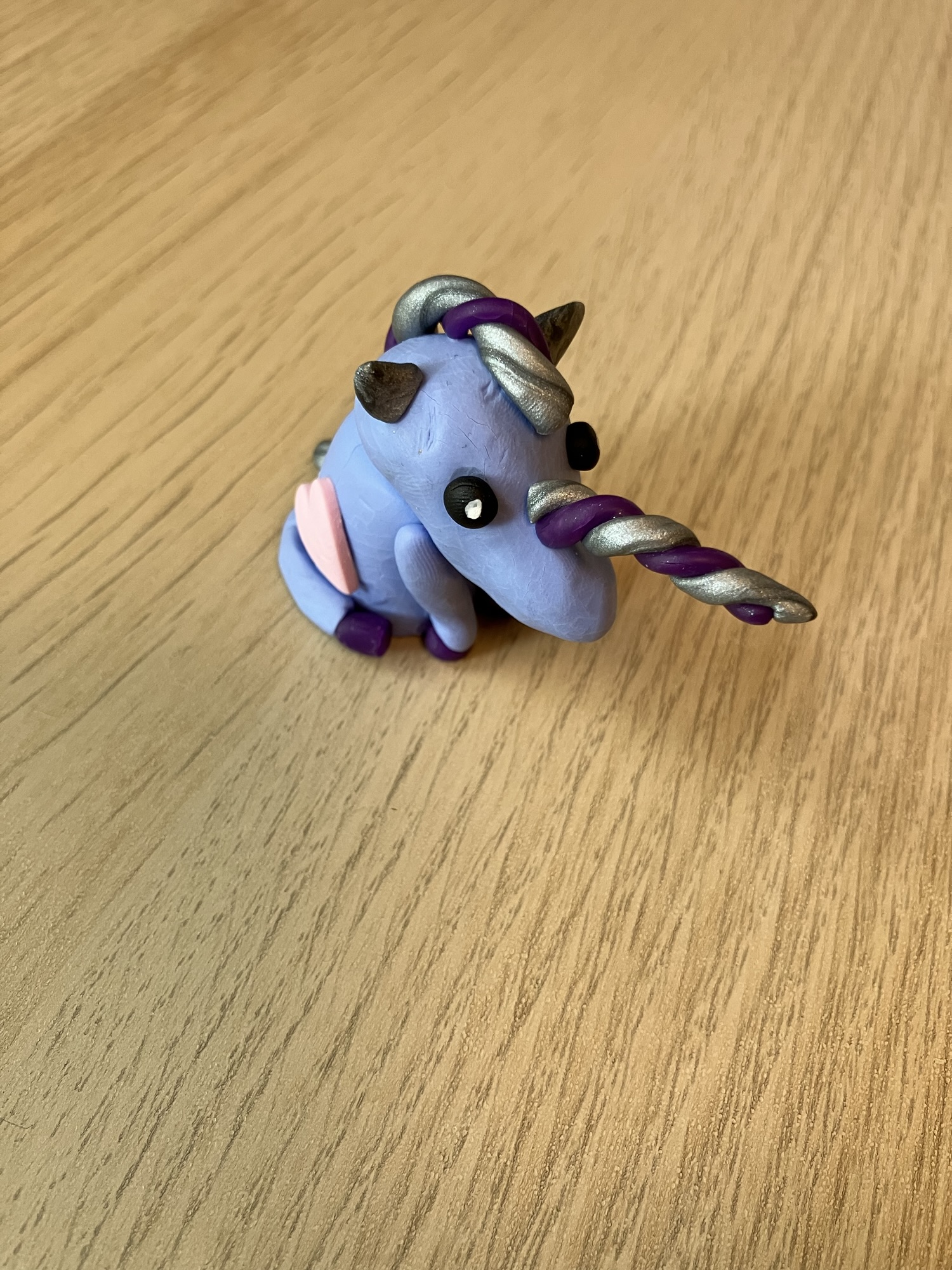
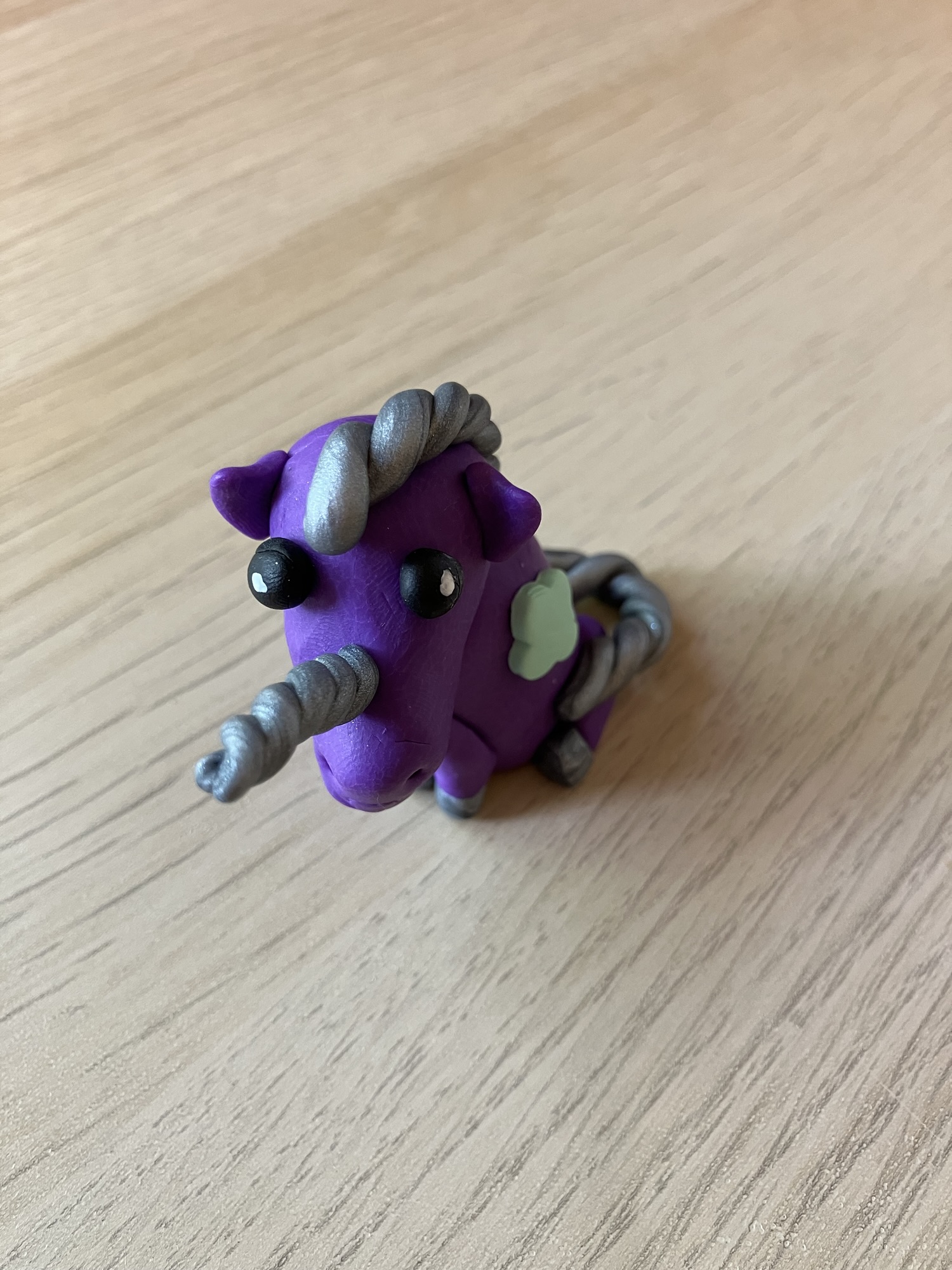
After all, though writing comes easiest to me, polymer clay is what brings me the most joy. I just love the fact that, even though I’m now totally blind, I still have some insight into colors. I also still, four years into the craft, love creating unicorns.

I made three unicorns in the past week. The latest, I haven’t baked yet because I just made it this evening. The other two I made late last week. One is probably going to be a gift to a staff who gave birth last week. I loved working with the two colors for the mane, tail and horn, but its horn is a little crooked.

The other one, which I myself like best, is for me. After all, you can never have too many unicorns.

A few years ago, I talked to my then staff about possibly creating unicorns to go into the care agency’s shop. That idea never materialized, but I’ve brought it up a few more times. I’d just love to have polymer clay as my “job”. Here, I chose anyway. And I also wrote on another prompt, because creating the unicorns is the main thing that made me smile recently.

School Reunions

Hi everyone. One of this week’s Writer’s Workshop prompts is to write a post based on the word reunion. This reminded me of two reunions, one I actually attended and one I didn’t.

The reunion I did attend was for the school for the blind I had been a student at for my last three years of elementary school in the late 1990s. The reunion took place in 2008 and it was on school grounds. The reason the reunion was held, was the fact that many buildings would be reconstructed in the next couple of years, so as to give former students and staff one last chance to see school grounds in the form they’d remembered them.

The school included buildings for both elementary and secondary school, as well as homes for the residential students and a place for leisure activities where the non-residential students had lunch too. I was a non-residential student and only attended elementary school, like I said.

There were two reasons why I wanted to attend the reunion. One was to meet former fellow students and staff. That was a success. I met my best friend from school, with whom I hadn’t been in contact since leaving this school in 1998. I also briefly talked to my fourth grade teacher. That was awkward, as I didn’t feel comfortable disclosing to him that I resided in a psychiatric hospital at the time.

The other reason I wanted to attend the reunion, was to see the school in the form I remembered. That, unfortunately, wasn’t a success, because part of the elementary school, including the classrooms, had been destroyed in a fire in 2006. Part of the building was still standing, but it was no longer useable.

I was on grounds a few more times attending smartphone use training in 2017. On May 24, I believe, there’s going to be another reunion for this school, but it isn’t on grounds and I know no-one who will be attending, so I won’t either.

This brings me to my other reunion story. IN 2013, my high school celebrated 100 years of existence. I for a while considered attending, but was still in the psych hospital at the time and besides, my entire high school experience had been quite bad. So I didn’t go.

A few years later, I got an E-mail from a former teacher there. She had been my Dutch teacher and tutor for the first year and part of the second year of my attending this school, until she went on sick leave and finally found another job. She had been at the reunion and had wondered about me. Having read part of my website, she now understood why I hadn’t been at the reunion.

This, as it turned out, would also have been my last chance of meeting the teacher who’d become my tutor after the Dutch teacher left. He got cancer about a year after I’d graduated high school in 2005 and died in 2016. I am pretty sure it was for the better that he didn’t know that I was still in the psych hospital then.

An Allergic Reaction

Hi all! Today I’m joining in with the Writer’s Workshop. One of the prompts is to write about an experience of having an allergic reaction.

I have never had very strong allergic reactions to anything. However, the fact that I would not classify my allergic reactions as strong, is probably because I haven’t fully figured them out.

I am allergic to nickel. That is, that’s what my parents have always told me. I never knew how to recognize an allergic reaction though and, with the fact that it can take some time for your body to react to nickel, even if I knew I had an allergic reaction, I wouldn’t always be sure of the cause.

When I was 15, I got earrings. After the little studs you wear for the first six weeks, I immediately switched to long, heavy, silver rings I got from my mother. No-one had told me not to wear heavy earrings for the first year. Or that silver earrings, especially those made back in the day, could contain nickel.

My earlobes started getting inflamed pretty soon, but I didn’t actually realize this was abnormal. It could’ve been the nickel, but I also constantly fidgeted with my earrings, thereby touching my pierced ears.

After a few months of wearing all sorts of, mostly quite heavy, earrings, I was wise enough to give up. For over two decades.

And then, the whole saga started over. I got new studs put in, because my old earring holes had long formed scar tissue. This time, I googled what to wear and not to wear while getting used to earrings. I only wore small studs.

However, I was unable to make sure that my earrings didn’t contain nickel. In the EU, nickel is no longer allowed in jewelry, but no-one ever checks manufacturers for compliance.

I got silver studs that the vendor said were nickel-free. Though I was fine for a few months, my ears eventually started getting inflamed again. I tried ignoring the issue, believing it would get better over time. Which, if it’s truly my nickel allergy acting up, isn’t true. In fact, the opposite is true: an allergy keeps getting worse the more someone is exposed to the allergen.

Eventually, after several attempts wearing various studs, I gave up. And this time, I’m hopefully not going to ignore my body again and have another go. Whether it was my nickel allergy acting up or I was just touching my ears too much, we’ll never know. Now I’ll just wear necklaces and bracelets, so that when I fidget with them, I’m not essentially touching a wound.

A Recent Frustration Related to My Care

Hi everyone. I haven’t blogged in over a week because I’ve been struggling once again. Honestly, I can see why judging from my experience over the past 2 1/2 years, people would say I’m always struggling anyway. The thing is, there are and there definitely were times I am or was struggling less. Besides, to say that this is just the way I am, is blaming me for the system not meeting my needs. And we all know that the system is broken and this is a reality, but I’m honestly getting frustrated with how little recognition I get for my attempts at coping with this reality and how much blame I get when I fail at doing so.

Now on to why I’m struggling again. I mentioned about a month ago that I would no longer be assigned unfamiliar temp workers. This is a definite positive. However, with this home having twenty residents, many of whom with high support needs, the pool of so-called familiar staff consists of at least thirty people. That isn’t the problem: I am fine with all thirty coming into my room to do activities with me, just like I’ve always been fine with the occasional unfamiliar temp worker. The problem is that all thirty so-called familiar staff are supposed to be assigned to me equally often and I’m not allowed to have a preference. The reason is the idea that I’ll add more people to my trusted circle if they’re required to be assigned to me more often.

I can see their point, in particular because four out of eight staff who I consider part of my trusted circle now, are either on sick leave or leaving soon, be it temporarily (on maternity leave) or permanently. I can see why one would like to avoid a situation like with my assigned staff in Raalte, who left about two months before I did and who at the time was one out of only three staff I fully trusted. Then again, I’m never going to have a circle of thirty, just like most people don’t have thirty close friends. And that’s what this whole “get to know everybody” thing feels like. I do try to expand my circle as needed, but I just can’t treat all staff the exact same unless they treat me the exact same and, in that case, we’d all be losing sight of each other’s individuality.

Besides, the staff don’t follow their own rules when it suits them. For example, it’s a rule that I’ll see one staff for my morning activity and lunchtime, but they’ve been switching that around when they felt like it, yet telling me (and each other) of the rule that they must switch at other times. In other words, the staff require me to deal with a minimum of six switches of staff per day, but when it suits them, this can be increased and yet it can’t be decreased. That’s while I made it clear in the document detailing my care needs last summer that I don’t do well with staff switches. Yet they blame me for the agreements we made back then not working, even though they didn’t follow through on most of them. Most notably, they’d told me they’d try to have a trusted staff assigned to me most days for at least part of the day and that just wasn’t happening. In fact, eight out of ten times at least, the staff assigned to do nearly four hours of support with me, was a random, unfamiliar temp worker. I don’t blame myself for this not working out.

I’m sharing this post with the Writer’s Workshop for this week. It was a recent frustration, in that this rule (about required switching) hadn’t been adhered to as strictly as it’s now until last week. I’ve also had a lot of discussions about it with my support coordinator this past week. I’m having a care plan review next week and am planning to raise this issue both specifically and as an example of a general trend towards blaming me for a broken system and mistrust towards me. After all, staff are claiming I would only want my “favorites” assigned to me if they didn’t require staff switches as often as they do now. Let me just say this wasn’t even the case in Raalte, where I did have a core team of at least somewhat trusted staff.

How My Body Has Changed As I Got Older

Hi all! This week, there are many interesting writing prompts in the Writer’s Workshop. I am choosing to write about ways my body has changed as I’ve gotten older.

I’m now 38 and I consider this an age at which positive changes can still happen. That is, of course you’re never too old to start a healthier lifestyle, but at a certain age, I assume it will not have as much effect as when you’re younger. In fact, I’ve heard that smokers have until age 35 to quit or their lungs will never be as healthy as those of non-smokers. Thank goodness I’ve never smoked.

In my case, my thirties so far were the decade of getting healthier in many ways. At age 30, I weighed 80kg (176lbs), which is over 20kg overweight for my height. I slowly started losing weight then and got to 55kg )121lbs) last year. Since then, I’ve gained some weight back on, but I’m barely 1kg overweight now at 59kg. I agreed with my dietitian that I should not gain any more weight, but the 55kg I weighed last year is also the lower border of my goal weight.

Weight aside, I got slightly fitter. When I weighed 80kg, my spouse proposed we do a brisk walk for just over half an hour each day to get the weight off, but I could barely do fifteen minutes. Now I must say I don’t usually walk as fast as that brisk walk should’ve been, but then again I couldn’t keep up with my spouse back then either and now I can walk for an hour sometimes.

I do feel that my flexibility and strength have decreased a bit. Not that I ever was flexible or strong at all. In fact, my spouse jokes that a brick is more flexible than me. However, when we tried a game of Twister at the home recently, I noticed I was hardly able to stand on all fours even in a simple position. I’m pretty sure I used to be able to do this.

My mobility also has slightly decreased. I fall when I wear anything other than my orthopedic shoes. I also used to think my shoes get damage a lot easier from the way I walk. That is until I recently looked at the shoes I wore at my wedding and saw these were damaged too just from one day.

When I got married, I was 25 and about at the weight I’m now at. I recently tried on my wedding dress just for the fun of it. The skirt fit, but the top was too tight.

With respect to appearance, I’m told I haven’t changed much over the years. That is, my spouse found my first grey hair when I was 31 and I now have quite a few, but my hair still looks dark overall. I don’t have many wrinkles either. In fact, it feels as though my frown wrinkle has decreased. That probably isn’t possible, so maybe I’m just not bothered by it as much as I used to be. I’m also grateful to report that my hands, which are among the body parts I feel most positive about, are still pretty smooth.

Overall, I don’t think there’s been an age at which I was happier with my body than now. That is, I do get frustrated with my impaired mobility and flexibility. However, when I was thirty, I was probably less fit overall and I wasn’t happy with my appearance at all. Now I feel content enough with my body to wear nice clothes and occasionally jewelry. I in fact reserve my loose-fitting sweaters and fleece vests for when I’m sick now.

Tapering My Meds… in 2034?

Hi all! One of this week’s Writer’s Workshop prompts is to write a post based on the word “medications”. I will probably have another med review with the intellectual disability physician in a few weeks. The aim for me has always been to taper my medications. This will probably take until 2034 and this time my use of the year 2034 is only partially a joke. After all, when I said that “everything will be okay in 2034” and explained to the physician that I always say “2034” when I mean “never” (because of the fact that the book by this title is about World War III), the doctor didn’t understand the joke. She actually seriously said that I’ll be on the right med regimen by 2034.

Like I said, I’ll have another meeting with her to discuss tapering my meds in a few weeks I think. Although I’d really love to decrease my medication dosage sooner rather than later, I do realize that I’ve been struggling more than usual lately. I haven’t shared about this on the blog much, but over the past several weeks, I’ve had emotional outbursts almost every evening. Part of the reason is the fact that there were quite a few temp workers assigned to me. Thankfully, as of yesterday, it was agreed that the staff will no longer send unfamiliar temp workers to me. I am very happy about this.

However, I am also concerned that the temp workers might just be the reason my already irritable brain chose to act out. In other words, it could definitely have been the case that my latest med taper wasn’t all that sensible. For this reason, I have pretty much made up my mind that I will not take another step until January or so. That way, I’ll be able to give the new agreement about no unfamiliar temp workers a fair chance. All I can hope for is that, if I tell the physician I want a break, it won’t end up being an end to it all.

After all, I do still experience significant side effects from my medication, like what I think could be a movement side effect from my antipsychotic (significant tremors and twitches) and I don’t want this to end up being permanent. This is another reason I don’t want to seriously wait for 2034 to be off my antipsychotic. By 2034, I’ll be 48 and that’s too young for crippling movement disorders.

How I Coped With Losing My “Job”

Hi everyone. This week, one of the prompts for Writer’s Workshop is to write an essay titled “How I coped with losing my job”. I don’t do well writing fictional essays and have never had a “real” job, in the sense of a paid position or even volunteer work. I did, however, once “lose my job”, in that I got told the day center I went to couldn’t keep me there anymore.

This happened sometime in January of 2018 at my first day center with my current care agency. They had had me there for eight months, in two different groups, but when I was struggling to cope at the second group, they could no longer serve me or so they said.

I felt really distressed about this. The most frustrating aspect was the fact that they blamed me for no longer being suited to the center, while in reality, three new clients had been accepted into my group and no additional staff had been hired. I remember the reason they said it was me being the problem, not the new clients, was the fact that I’d been having meltdowns shortly before they arrived. Now I know that any anticipated change will cause me distress and that doesn’t mean I’m just a problem client. However, in hindsight, I’m pretty sure they wanted me gone sooner rather than later all along, for the simple reason that I don’t have an intellectual disability.

Thankfully, I wasn’t told to leave on the spot, but got time to find a new place. I initially had no clue how to, but did remember that, in 2010, I had been helped by the Center for Consultation and Expertise (CCE). I told the staff that I wanted to involve them again.

This was a bit of a hassle, as my community psychiatric nurse from the mental health agency said I’m far too high-functioning for the CCE. I applied nonetheless and got an orientation meeting in May of 2018.

In the end, I didn’t need the CCE for finding a new day center, but the consultation was what led me to accept that living independently with my partner wasn’t working and I needed long-term care.

I did feel intensely frustrated, like I said, at being “fired” from this day center. However, in the end, I don’t blame the staff, who were just powerless in the face of my challenging behavior. I think the manager, who didn’t look beyond my psychiatric diagnoses, is partly responsible. So was the psychologist from the psychiatric hospital, who more or less made the manager accept me on partly false premises.

Attention Is a Valid Human Need

Hi everyone. One of the prompts for this week’s Writer’s Workshop is to write a post based on the word “attention”.

This immediately brings back a flood of memories of my time at the intensive support home. On one particular occasion – but I’m pretty sure there were many more -, a staff said to her coworker about a client in crisis: “It’s all attention.” She said “attention” in English, not Dutch, apparently hoping the client in crisis or his fellow clients (including me) wouldn’t understand. One of my fellow clients immediately chimed in by translating her comment into Dutch.

The idea that challenging behavior is “for attention” is often not entirely based in truth. However, even if it is, attention is a valid human need. And especially at the intensive support home, clients routinely didn’t get it.

You might think we did get more than enough attention, since the staff/client ratio is 1:2 to 1:3 at this home. But more often than not, staff were doing stuff on their phones, chatting to each other and on at least one occasion, I caught two staff playing a board game together and the third cheering for them. That third person was my one-on-one for the moment, but, because I was also playing a game with a fellow client, the staff thought it not necessary to pay attention to me. Then when I started showing signs of distress, he missed them until I ended up in a meltdown, then told me I could’ve said in a calm voice that I wanted to go to my room. Well, guess what? One of my first signs of distress is an inability to communicate effectively.

On another occasion, the fellow client about whom the staff felt the need to communicate his “attention-seeking” in English, was having an outburst again. I told my one-on-one for the moment that I could see why, because he’d been left to his own resources, often locked in his room, for most of the day. My one-on-one told me he’d had more than enough attention, since he had been having a cup of coffee with the client and had created his day schedule. As if a fifteen-minute coffee chat means you can be left alone for the rest of the day.

Remember, I and my fellow clients have a developmental disability. Most of us cannot participate in everyday conversations among non-disabled people, so when the staff are chatting to each other, most of us will feel left out of the loop. And just because staff are in the same room with us, doesn’t mean they’re attending to our needs, as my example of the board game illustrates. At that point, I needed someone to pay attention to the subtle signs that I was going to land in a meltdown.

And like I said, attention is a normal human need. Staff aren’t telling each other that they’ve had more than enough attention because they’ve had a break (that usually lasts for 45 minutes, four times a day) together. In my opinion, honestly, they should.

Memoirs and Biographies

This week, there are many interesting prompts for the Writer’s Workshop. I am still thinking I might write on a different prompt tomorrow, but usually I don’t get to it. Today, I’m choosing the prompt about memoirs, biographies or reference books. They are, after all, my favorite genre to read.

I was not an avid reader as a child. Still am not a voracious reader, but I did discover the love of reading through memoirs and autobiographies. When I was in my late teens, I briefly was a member of the UK’s national library for the blind. They sent me Braille books. Yes, the clunky hardcover volumes (often eight or more per book).

I usually chose memoirs. Among my favorites were Planet of the Blind by Stephen Kuusisto and Emma and I by Sheila Hocken.

The first is an autobiography by a person blind from the same eye condition I have. If I’m correct, Kuusisto had some vision as a child but lost it later on, like I did too.

The second, which is the first in several books, talks mostly about the author’s experience of getting a guide dog.

I eventually got kicked off the library service for losing two volumes of a book, I’m not sure which one, in the mail back to them. However, this experience is probably what got me to love memoirs and autobiographies.

I currently often read foster care memoirs. My favorite authors are Casey Watson and Maggie Hartley. Cathy Glass is good too, but she stopped writing.

I recently discovered a new-to-me foster care memoirist, Louise Allen. That’s not entirely correct: I had heard of her a while ago, but because her books have horribly nondescript titles like Jacob’s Story, I didn’t fancy reading them. Now I am currently reading Jacob’s Story and think it’s fascinating. I must say though that the book is really a crossover between fiction and memoir, since the author writes from perspectives other than her own too. That makes it all the more intriguing, but I’m not entirely sure the books would count as memoirs.

Stabilize With Medicine

I talked to the support coordinator, the one who’s officially the other part of the home’s support coordinator but attends my meetings with the behavior specialist because I don’t get along with my support coordinator (my former male assigned staff). She had talked to the intellectual disability physician and I won’t have a meeting with her on tapering my medication until late September. The reason is the fact that there’s lots of temp workers at the care home during the summer months and they want me stable for now. Well guess what? If you want to wait for there to be few temp workers, you’d better wait for 2034, as I usually say. For those not aware, 2034 is my code word for never. It’s inspired by the book called 2034, which is about World War III.

I’m pretty angry about this whole thing, because well I already have mildly decreased kidney function as is. That is, I had mildly decreased kidney function a year ago at my last bloodwork, so who knows if it’s gotten worse now? And, as you might know, kidney disease doesn’t usually cause symptoms until it’s pretty advanced.

I don’t even mind waiting till September, except that this means seven months on my current med combo rather than the originally planned six weeks. And except that who knows what will get in the way in September? For all I know, the support coordinator might’ve gotten pregnant or sick or have left like the last one.

I honestly feel like they want to stabilize me with medicine rather than with the right support. And, for what it’s worth, I’m not very stable as is. Never was. Not with five different medications, many of which on high doses.


This post was written for John Holton’s Writer’s Workshop, for which one of the prompts is to pick a line from a song you like and use it as the title of your post. I picked the line “Stabilize with medicine”, which I’m not sure is a full line, from the song Serotonin by Girl in red. This song is rather explicit, so I hope John doesn’t mind me sharing it in his challenge.