#IWSG: A Tribute to My High School Tutor

IWSG
Insecure Writer’s Support Group Badge

Today is the first Wednesday of the month and my regular readers know what this means: it’s time for the Insecure Writer’s Support Group (#IWSG) to meet. I just got an authorization for the latest JAWS, my screen reader, which turns out to support the WordPress block editor, so I’m trying that out now as I type.

I did quite well in the writing department over the month of January, having published 29 blog posts, including a poem and a piece of flash fiction. For February, I signed up for #Write28Days, so my main goal is to write a post for that challenge each day.

Now on to this month’s optional question. For the month of February, we are asked to share about someone who supported or influenced us in our writing who isn’t around anymore. Immediately, my thoughts went to my high school tutor. Even as I type this, I am still not sure whether I want to name him by his full name, as in general my relationship with him was tainted by the many conflicting interests he had to juggle as my high school tutor and the assistant principal, with me being the only student with a major disability in his mainstream school. That being said, he was a major supporter of my writing.

I must explain here that he wasn’t originally my tutor from the start, but my original tutor went on long-term sick leave, never to return, shortly before winter break my second year in this school in the middle of eighth grade. The teacher I talk about here became my tutor shortly after the winter break. In one of our first one-on-one tutor-student talks, he asked me about my hobbies I think and we somehow got talking about writing. He asked if he could read one of my stories and I eagerly agreed. I think I even wrote an original story specifically to show him.

This story was rather autobiographically-based, but not so clearly so that it could be transferred one-to-one into my school situation. My tutor did immediately notice the autobiographical elements though.

I was quite a troubled teen and struggled greatly, being multiply-disabled in a mainstream school. Sometimes, I struggled to speak. Over the years, my tutor encouraged me to write things down when I couldn’t speak, be it in fictionalized form or not. Once I got a public online diary, which later morphed into a blog, I permitted my tutor to read it, reasoning that, since it’s public, he shouldn’t even have to ask my permission.

He remained my tutor until I graduated high school in 2005. He also was the one arranging for me to go to the blindness training center after graduation, even though he full on knew this meant I couldn’t go to university right away then.

Sadly, about a year after my graduation, my now former tutor was diagnosed with cancer. He did live for another about ten years and did make it to the reunion in celebration of my high school existing 100 years in 2013. I, though, did not. My tutor died in 2016.

I am not sure whether my tutor felt I was a good writer per se. He might have thought, like my parents did during my teens, that I was overly self-centered in my writing. If he did though, he didn’t say so. In any case, he was one of the people who, whether he wanted to or not, influenced me to be a regular blogger.

Pocket Money Tales

Today’s topic for Throwback Thursday is chores and allowances. Let me share my experiences.

Regarding chores, I could easily be short and sweet: no, I did not have any. Neither did my sister. We were raised with the expectation that we’d leave the house as soon as we graduated high school, but we were hardly taught any of the skills of independence, much less expected to contribute to the household on a regular basis. My sister was occasionally expected to do the dishes once she was about twelve or so. Same probably for me, but my parents quickly decided I took too long, didn’t do it right or made too much of a fuss over it, probably all three.

My sister, who’s non-disabled, somehow managed the skills of independence by observing my parents anyway. I, being blind and multiply-disabled, did not. When I left for the independence training home right after high school, I had virtually no skills necessary for living independently. I am forever grateful I persevered and decided to take this step rather than moving out on my own right away.

Regarding allowances, or pocket money as it was known in our family, the situation was a little more interesting. I got my first pocket money at age seven. I got one guilder a week. A few months later, I’d turn eight and my father promised me I’d get two guilders a week provided I’d stop leaving the lights on in my bedroom when I wasn’t there. The reason being that, if I no longer left the lights on, he would save on electricity and could give me more pocket money. I doubt it’d seriously make a difference of one guilder a week, but I’m not entirely sure he hadn’t possibly calculated it somehow. That’s how he is, after all.

That brings me to my next pocket money story, some eight years later.
I originally couldn’t remember whether we already used euros at the time. Not that it matters for the morale of the story, but I saw the official documentation relevant to this story and now know we already had euros. I must’ve been sixteen and was rather angry because my sister got a higher allowance than I’d gotten at her age, so I now wanted more too. At first, my parents got all defensive, calling me selfish because I was playing the “not fair” card. Then, after both of us at calmed down, my father asked me to write a budget of things I’d need pocket money for. If it was within reason, I’d get what I’d asked for.

I had asked for €10 a week. I created a budget (that’s the “official documentation” I referred to above!) fitting all my personal expenses, including candy, jewelry, memberships to the children’s choir and the political party I was a member of at the time, into this budget. Ultimately, my budget showed I needed €555,60 a year. When my father saw it, he commented that I’d been far too careful to try to fit my budget into what I’d demanded. I particularly remember him saying he couldn’t believe I’d just spend €2,50 a week on candy, for example. And I must admit he was right. My father told me that €100 a month was a more reasonable allowance and so it happened that I got more than twice the amount of pocket money I’d originally fought for!

Were you taught about budgeting as a child?

My Shed

One of Mama Kat’s Writer’s Workshop prompts this week is to write about your very first apartment. I am going to cheat a little and write about the first apartment I rented rather than the very first apartment I lived in. The first apartment I rented was my student housing apartment, which I called “my shed”. This sounds affectionate in English. In Dutch, not so. “My cage”, though not as correct a translation, more correctly captures the feeling I had about this apartment.

When I got on the housing list in Nijmegen for the academic year starting 2007, the student counselor made sure I got a letter getting me to a priority place on the list because of my disabilities. This meant I was allowed to provide a preference for which student housing complex I wanted to live in. I had to list my top three. Based on the little information the housing association provided and what my support staff at the independence training home I lived in before moving to Nijmegen knew, my number one choice became the complex “my shed” was part of. My reasons were that its apartments reserved for disabled students were on the ground floor and the neighborhood was supposedly quiet.

Indeed, my apartment was on the ground floor, right beside the main entrance to the building. I didn’t have to enter the complex to get to my apartment.

It was a one-bedroom apartment. When you entered through the door, you were in the long, narrow living room and kitchen. Then you went through to something like a landing, with the bathroom on your right hand. Then, you’d enter another long, narrow room, which was the bedroom. The apartment altogether was 35m².

My apartment had just a few, very dim lights in the living room and one equally dim light in the bedroom. I guess my parents thought that I didn’t need much light since I was blind anyway. I had my desk, the one I currently still use to sit on whilst typing this post, in the living room. Other than that, I just had two kitchen chairs and a folding table to eat at. I did have one recliner that I’d gotten at a thrift store and a few rather tacky pillows. I had never thought of decorating my place at all. In fact, this past holiday season is the first time I’ve ever decorated my room and that’s quite a milestone.

Like I said, my apartment was very narrow and long. Its windows were on the short end of the apartment. Due to this and the lack of lighting, the apartment looked rather dark and gloomy. If I wasn’t depressed already, I’d become depressed from the lack of light in my shed.

The place quickly got rather filthy from my poor cleaning habits. I did try, but due to the combination of my disabilities, I just couldn’t keep the place properly cleaned. Looking back, I am so grateful my now husband didn’t go on a run as fast and as far as he could when I invited him into the shed on our second get-together.

I only actually lived in the shed for three months before landing in the psychiatric hospital. It is by far the worst place, in terms of interior, I’ve ever lived in.

Mama’s Losin’ It

Generosity

Today’s prompt for #JusJoJan is “Generosity”. I don’t tend to think of myself as a particularly generous person. That would not only be arrogant, but it would be incorrect as well. Particularly as a child, I liked receiving more than I liked giving. I was a very jealous child, often envying my sister for what she got and I didn’t.

I remember one day, when my sister and her friends had been participating in the four-day walking event in my city. It was the last day of the event and I was allowed to walk with them for this occasion. At the finish line, a parent of one of my sister’s friends had lots of candy for my sister and her friends, but he had none for me. I had a full-on tantrum in the car home even though my sister and her friends ended up giving me more candy than they kept for themselves. It caused the oldest friend, a girl my age, to cry. I was ten at the time, so far too old for toddler tantrums like this. I feel intense shame about this incident as I look back, seeing that I should have known it wasn’t fair of me to expect candy since I hadn’t walked the entire event. Much less should I have tantrummed about it in the car.

Now that I’m an adult, I am a little less worried about material goods and a lot less jealous of others, but it still doesn’t come natural to me to give material things away. Thankfully, generosity comes in different ways and I do love expressing it in other ways. I love to create my own gifts for people. Yes, of course they are material too, but that feels different.

Still, I am often reminded of the Sesame Street episode in which Bert and Ernie have a cake and Ernie gives Bert the smaller slice. Bert teaches him that he’s supposed to offer Bert the larger slice first. Then Ernie asks: “So what would you do if you were to offer me the cake?” Then he replied he’d take the smaller slice and offer Ernie the larger slice. “But you have the smaller slice now, like you wanted!” Ernie objects. This is child logic and it is incorrect. It is not how we’re supposed to be generous. We are supposed to love others like ourselves. Others before ourselves, even.

I pray God leads me to a life of greater generosity. I know I am supposed to love others as myself and that includes giving generously of myself to others. Like I said yesterday, when I trust that God will provide for my needs, He will. As a follower of Christ, I have no need to worry. In the end, everything will work out okay.

Superstitions

Today’s topic for Throwback Thursday is superstitions, amulets and charms. I had quite many growing up, but not most of the usual ones. Let me share.

My sister was born on Friday the 13th, so no-one in our family dare believe this to be an unlucky day. However, I had quite a few lucky and unlucky days particularly as a teen. Friday the 24th was unlucky, for example. The reason was the fact that on Friday, September 24, 1999, I had realized that I wasn’t going to fit in at mainstream high school and was most likely going to struggle through it all of the six years it lasted. I was determined to make school a success though, and indeed I graduated. I earned my diploma on another Friday the 24th, namely June 24, 2005. Maybe it wasn’t such an unlucky day after all.

Like I’ve said before, I believed particular dates to be lucky or unlucky too. November 2 was unlucky. Again, this was the date I landed in crisis, twice, both times on Fridays, in 2001 and 2007.

Like Friday the 13th, I didn’t hold any of the other usual superstitions either. I never struggled to walk under a ladder, to walk on cracks in the pavement and wasn’t worried when a black cat crossed my path. I did get an old horseshoe at a horse stable once and kept it. My father told me it was supposed to bring good luck, but I never hung it anywhere.

As a child, I did keep fortune-telling charms. I used to have a particular blue, glass stone with a flat and a curved side and used to ask it yes-or-no questions, then throw it. If it landed flat on its back, the answer was yes and if it landed curved side down, the answer was no. Of course, now I know it is far more likely to land flat on its back.

I also would make a wish if I was able to peel off a tangerine’s peel in one go. I know the traditional thing is about oranges, but I never ate those. Then when I’d pulled off the tangerine’s peel, the number of slices I would be able to keep together predicted how likely my wish was to come true.

Now that I’m an adult, I no longer hold many superstitions. I did have a long-standing belief for most of my adult life that I was in for bad luck eventually. This specifically involved the idea that, once I’d feel secure at a living place, I’d develop some serious illness and die. Over the past year, I’ve slowly been able to let go of this belief. My faith helps me in this respect too.

Are you superstitious?

Christmas Crafting!

I have a confession to make: this is my first year ever actually doing Christmas decorations. I used to like them as a child. Particularly though, I liked fidgeting with the little wooden snowmen and angels and Santas in the Christmas tree.

When I left my parental home to go into independence training, it never occurred to me to decorate for the holidays. Besides, I was back with my parents over Christmas. I never celebrated Christmas in my independent living student accommodation and once in the mental hospital, I hated decorations with a passion. During my first year there, I even ripped them all off. I don’t think my husband cared much for decorations during the years I lived with him either. Then when I went into the care facility, for the first two years, apparently I wasn’t feeling stable enough to decorate my room. In fact, I never quite considered it “my room”. Now I sort of do. I consider that a major win, since it means I’m beginning to feel safe in the care facility. Maybe the fact that I started decorating for Christmas, has some symbolic meaning.

I don’t have a lot of decorations. I have a store-bought, simple, ready-made Christmas tree and a couple of smaller decorations here and there. The point is I have something though.

In addition, this is probably the first year I’ve genuinely crafted something for Christmas too. I mean, during the year I did card making (around eight to nine years ago), I did create Christmas cards too, but these were so ugly a five-year-old could have made them. This year, I actually added my very own home-crafted piece to my Christmas decor.

First, several weeks ago, I created a cookie cutter polymer clay Christmas tree charm. I fully intended on finishing it off with gold Fimo Liquid after adding the balls, but decided after it got out of the oven that I didn’t really like the way it turned out after all. I don’t have a picture for this reason.

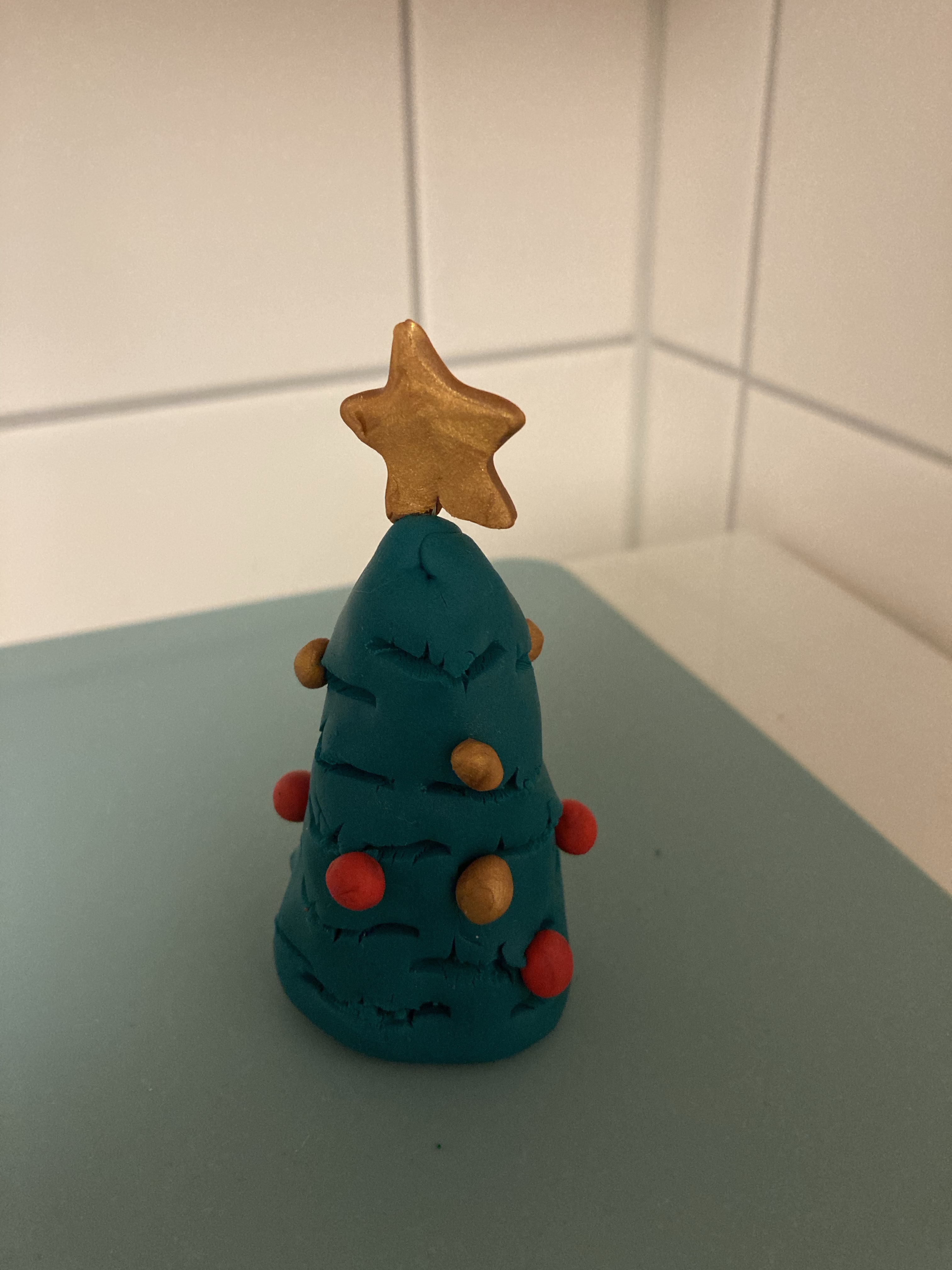
Then, last week, I found out how to make an actual three-dimensional Christmas tree. I made it using the same color (Fimo soft Emerald) I’d used for the cookie cutter charm. It’s a shame Fimo doesn’t offer Christmas tree green! I added two colors of balls (Indian Red and Metallic Gold) and added a Metallic Gold star for its top.

Later that week, one of my staff told me about a project she’d been working on in which she’d used a metal ring, a part of a tree trunk, a string of lights and some washi tape to create a Christmas decoration. I thought to myself, how fun would it be to glue my polymer clay Christmas tree onto the tree trunk and work from there.

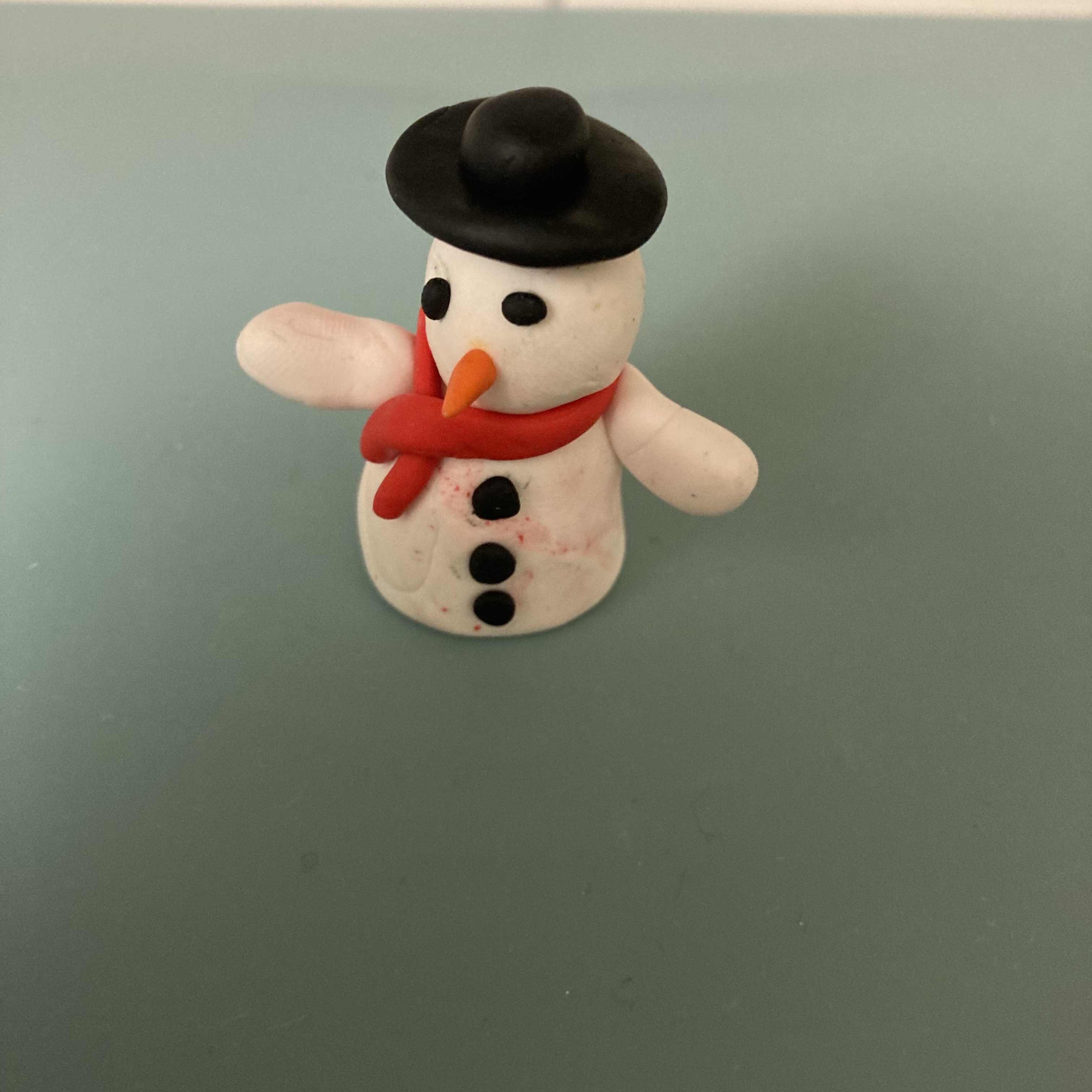
On Friday, fully having the tree trunk and metal ring project in mind, I created a polymer clay snowman too. That was a bit harder, because it had to be smaller than the Christmas tree and of course the snowman includes more intricate features.

On Saturday, when the staff who’d talked about the tree trunk project came by, she showed me the tree trunk. I think here’s where my concept development is a bit lacking, as I had absolutely no idea how huge a tree trunk would be. In my mind, I had imagined a small piece of wood, but it was the actual trunk of an actual, large tree. Yes, she’d said a tree trunk, right? Needless to say my Christmas tree, which isn’t even 10cm high or 5cm wide, would be invisible when used on this trunk.

Instead of the trunk, we decided to use a small piece of cardboard to stick the Christmas tree and snowman onto. I am not sure how well they will remain secured, as I’ve heard mixed messages about glue and polymer clay. The fake snow we used to spread around the tree and snowman, also hardly stuck at all, but for now, it’s in its place.

We decided to use a much smaller ring than the one my staff had had in mind, because of course the large ring would again drown out my polymer clay sculptures. Since the string of lights was meant for the large ring, we couldn’t use that, but we could use some mini Christmas balls and washi tape.

I couldn’t do much in creating this final project, as most of the parts had to be glued together using a glue gun, but I don’t mind. I like that I at least did the polymer clay crafting.

Do you usually do any Christmas-related crafting?

Linking up with Inspire Me Monday and #LifeThisWeek.

How I Cope With Loneliness

Today in her Sunday Poser, Sadje asks us about loneliness. She describes the experience as the feeling she gets when her family or friends can’t celebrate something important (such as the seasonal holidays) with her. This is one aspect of loneliness indeed. I feel lonely, left out even, knowing that my sister will be celebrating St. Nicholas with my parents next week and I haven’t been invited. Okay, she has a child for whom this holiday is more meaningful than it should be for me as an adult. Still, I am reminded of the last year we celebrated St. Nicholas with my family, or rather, the first year we didn’t. That was because of me: I had been admitted to the mental hospital shortly before and my parents didn’t want the hassle of having to watch me while I was on leave, so at first they suggested they celebrate the occasion without me. That year, my sister refused and the celebration didn’t go forward at all. Now that my sister has a child, there’s no way she’s going to care about whether I’ll be included or not. In fact, I’m pretty sure she’d rather have me excluded.

Loneliness, however, can take other forms too. Like I mentioned last month, loneliness comes from within a lot of the time. That’s why you can feel lonely when you’re surrounded by people. I often felt this way in the high school cafeteria.

I find that what helps me cope with loneliness is to surround myself with positive influences, both in the form of people and activities. I mean, I could dwell on my family’s rejection of me, but I do have a loving husband and loving in-laws. I also have caring staff and nice fellow clients, some of whom I consider friends.

It also helps me to engage in fulfilling hobbies, such as writing, reading and crafts. Through my blog and Facebook groups, I feel a genuine sense of connection to the outside world. Reading helps me escape my problems, including my sense of isolation. Crafts distract me and help me feel that I can be productive in a way. All of these help me overcome my sense of loneliness.

How do you deal with loneliness?

Suicidal Ideation in Childhood: Some Reflections

Earlier today, someone online asked a group of autistic women about suicidal ideation in childhood and at what age it started. It is common knowledge that depression and suicidality are near-universal among autistics. After all, we are taught, be it consciously or not, that our autistic way of expressing ourselves is unacceptable.

I remember my first autistic burnout at age five. I don’t have clear, verbal memories of the experience, but my inner five-year-old might and I do experience somatic and emotional flashbacks. The family story about the event is that I was ill with the flu. At the same time (coincidentally or not) my parents were making arrangements for me to start at the school for the visually impaired. I started in mid-May, before the end of the school year.

At the time, I wasn’t actively suicidal as far as I’m aware. I started having those thoughts when I was around age seven. I have a vague memory of telling my mother that I wanted to die sometime around that age.

Interestingly, I never made suicide attempts. Even the times I planned my “final day alive”, I never had any idea how I was going to go about actually doing it. This fact was later used to “prove” that I wasn’t serious.

I mean, when I was 21 and admitted to the psych unit, my parents came to tell the psychiatrist that I’d threatened suicide ever since I was seven-years-old, almost adding triumphantly: “See, and here she is, alive!” They said I just wanted attention.

Then again, is it somehow bad that I, deep down, didn’t really want to die? I just didn’t see any alternative. Of course I didn’t want to die by suicide. I imagine at least most people don’t really want to; instead, they want a better life. But I couldn’t get that at that time or so I thought. Does that make me a bad person? I don’t think so.

It’s so sad that, at least in my family, the red flag of long-time, severe suffering was ignored as a sign of “attention-seeking”. As if a seven-year-old even has the capacity to use suicide threats to manipulate their parents for mere attention without anything else going on with them.

Thieves!

When I was little, my parents would store their sweets (usually licorice but sometimes other sweets too) on a shelf just within my and my sister’s reach in their pantry. I’m pretty sure they’d tried putting them in higher places but we’d just climb up stairs or other furniture to reach them.

Invariably, on Saturday and Sunday mornings, when my parents slept in, I’d lead my sister to the pantry and we’d steal some sweets. Yes, I am pretty sure I took the lead.

I obviously thought they were unaware. That is, until one day when I was five and had just learned to read. There it was, on the sweets shelf, a paper that read “BOEVEN” in large print. This is Dutch for “crooks” or “thieves”. My parents never actually confronted us about grabbing their candy except on this one playful occasion.

In reality though, I still wasn’t truly aware that my parents knew. In fact, I remember one day when I was about fifteen, my parents had left like eight hamburgers on a plate in the kitchen and I sneaked into it to eat one at a time. My parents never confronted me and it wasn’t until a few years ago that I realized they must’ve known. That is when the shame at having eaten this many hamburgers caught up with me.


This post was written for Friday Writings, for which the optional prompt this week is food. It is a an autobiographical piece.

Too Many Toys

Today’s topic for Throwback Thursday is toys and pastimes. The first question Maggie asks in her post is: “Did you have a lot of toys?” The short answer would be that yes, I was privileged to have quite many toys, but I must say I wasn’t so spoiled that I always got the latest trendy toy.

I probably shared this story before, but I played with toys quite a lot until I was at least eleven. By that time, my parents and teachers were looking into options for secondary schools and their opinions couldn’t have been any different: while my parents wanted me to go to mainstream grammar school, my teachers felt special education at their low-level secondary school for the blind, preferably residential, was in my best interest. My mother one day took me for a “mother-daughter walk” explaining the school’s stance and said that the reason they felt I needed residential special ed, was my behavior. That, in turn, she attributed to my having too many toys. The logic, I never quite understood, but it must’ve been something like my being so spoiled that I somehow felt entitled to display challenging behavior.

She went on to explain that, at the residential school, I would only be allowed one doll and one soft toy. She had given me a Barbie doll for my birthday earlier that summer, but told me she regretted it as soon as she received the school’s report. Needless to say, I always felt weird about playing with dolls from that age on, even though I continued to play with toys and dolls and everything until I was at least fifteen.

Fast forward some ten to fifteen years. When I was in my mid-twenties and diagnosed with dissociative identity disorder, I felt it might help my littles (child alters) if we had toys again. I first bought a box of old Barbies for €70 on a marketplace site. That wasn’t a wise decision as, though the box did arrive, the Barbie dolls were in such bad condition I eventually threw them away. I then decided to buy a couple of new ones at a toy store, but the littles hardly played with them. They prefer soft toys.

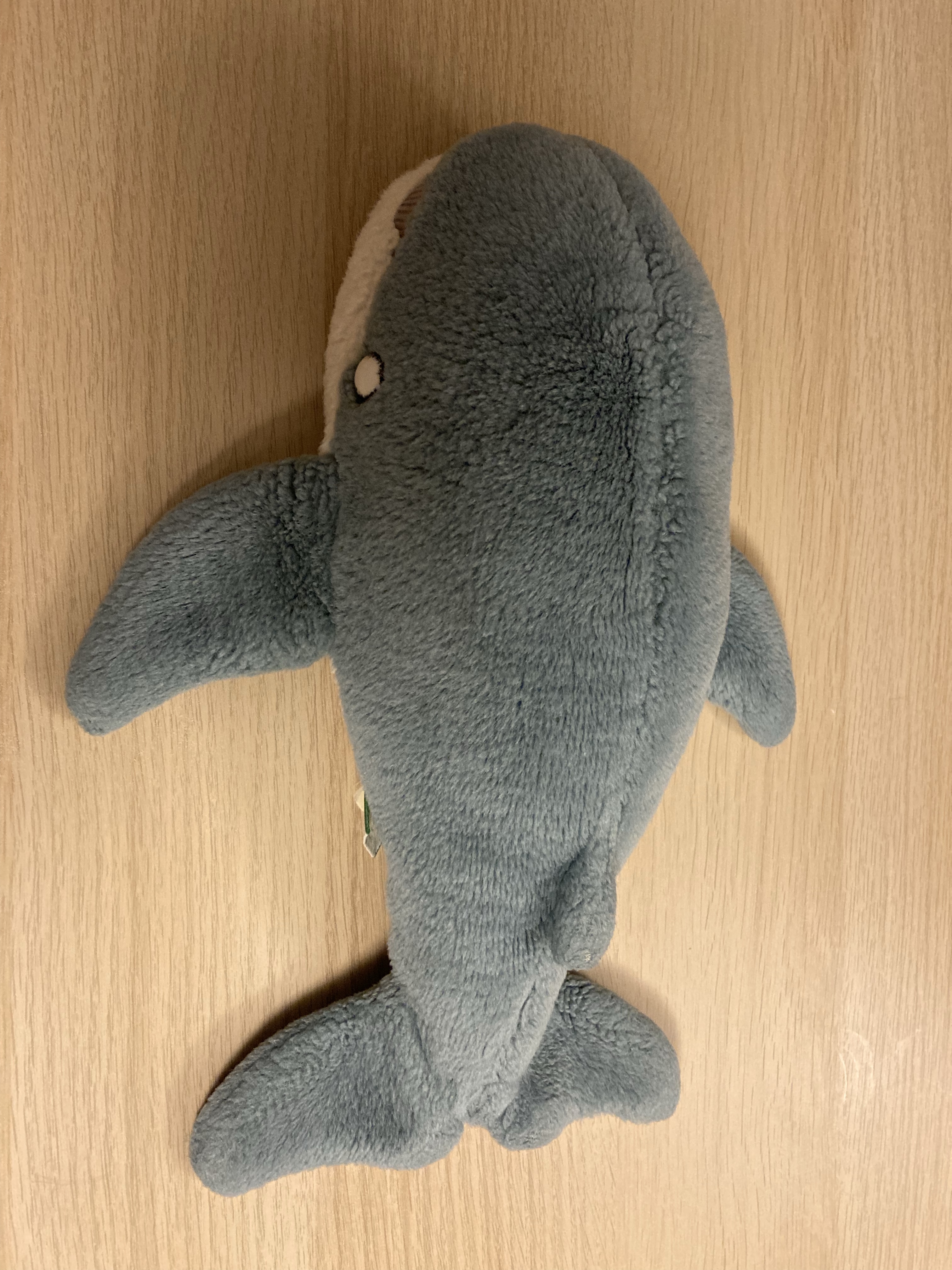
Speaking of which, one of Maggie’s questions is whether you still have any toys from your childhood. I don’t, as they’re probably all at my parents’. However, I do still have my stuffed whale Wally, whom I got when I left the NICU at three-months-old. I still sometimes sleep with it.

Wally

Did you have many toys growing up?