Brain Injury As It Relates to Intellectual and Developmental Disabilities #AtoZChallenge

Hi everyone. We’ve arrived at my letter B post in the #AtoZChallenge. I struggled with what topic to choose for this letter, but eventually settled on brain injury. As you will find out, this type of disability has a kind of controversial relationship to intellectual and developmental disabilities. After all, many people view an intellectual or developmental disability as necessarily present from birth. The American Association on Intellectual and Developmental Disabilities (AAIDD), however, considers an intellectual disability as having originated before the age of 22. In the Netherlands, the age of onset cut-of for an intellectual disability care profile in the Long-Term Care Act is 18. As such, people who acquired a brain injury in childhood affecting their ability to learn, are diagnosable as having an intellectual disability.

With respect to other developmental disabilities, such as autism, the diagnostic waters get even muddier. I, for one, was diagnosed as autistic at age 20 despite having suffered a brain bleed as an infant. Then, ten years later, the diagnosis was removed again because apparently a brain injury no matter how early on precludes an autism diagnosis. However, I could not be diagnosed with acquired brain injury-related neuropsychological or behavioral difficulties either, because these would have required a clear before/after difference. Besides, I am blind too, so most neuropsychological testing isn’t possible on me. As a result of this, I ended up with just a regular personality disorder diagnosis. Now I’m not 100% sure I don’t have a personality disorder, but it’s certainly not all there is to me diagnostically.

In the Dutch care system, people with acquired/traumatic brain injury usually fall under physical disability service providers, unless they have really severe challenging behavior. In that case, they usually either end up in an intellectual disability facility or a psychiatric hospital. There are a few specialist mental health units for people with brain injury, but these are treatment-based, not living facilities. There are also nursing home units for people with brain injury, but these cater towards people over 65.

Adaptive Behavior in Intellectual and Developmental Disabilities #AtoZChallenge

Hi everyone and welcome to day one in the #AtoZChallenge. This year, I chose intellectual and developmental disabilities as my theme. One of the defining characteristics of intellectual disability, and also a common trait of other developmental disabilities, is impaired adaptive behavior. For my letter A post, I want to talk about that.

So what is adaptive behavior? Adaptive behavior refers to the skills we learn in life in order to adapt to the expectations of the world around us. It includes the following:


  • Conceptual skills, such as literacy, self-directedness and the ability to comprehend money, numbers and time.

  • Social skills, such as interpersonal skills, self-esteem, skills necessary to obey rules and the law and avoid being victimized.

  • Practical skills, such as personal care, travel, money management, housekeeping, etc.


Adaptive behavior is sometimes also called adaptive functioning. The skills that it includes are often referred to as “life skills”. Adaptive behavior is important, because it allows an individual to adjust to the changing demands of life. It is related to intelligence, but it’s not the same.

In order to be diagnosed with an intellectual disability, in addition to a significantly below-average IQ (which I will talk about in my letter I post), a person must be significantly impaired in their adaptive functioning. However, impairments in adaptive behavior are not exclusive to individuals with an intellectual disability. People with other neurodevelopmental disabilities, such as autism, often show impairments in this area too. I, for one, do.

I’m Participating in the #AtoZChallenge Again This Year!

Okay, with my blogging not having been all that successful over the past several months, maybe this is really a stupid idea, but I’m wanting to participate in the #AtoZChallenge again. For those who don’t know, this is a challenge in April in which bloggers write 26 posts during the month, each based on one letter of the alphabet.

The theme reveal event opened last Sunday, so I’m writing to let you know what I think will be my theme for the challenge. I will, like last year and the year before, choose a broad theme that I might decide to narrow down during the challenge. My theme for this year is disability. I’m probably mostly going to focus on developmental disabilities, including but not limited to autism. I did the challenge on autism specifically once on my old blog. While that was a success, I want to have the option of writing on broader topics. I may also want to write about long-term care as it relates to disability. I was for a moment considering “life in long-term care” as my theme, but I can’t think of enough topics to write on relating to that.

Most of my posts will fall under the “Awareness” category, while some may be more suited to the “Advocacy” category. I will attempt to keep my posts relatively accessible. Hope you’ll follow along.

Gratitude List (December 3, 2022) #TToT

Hi everyone. I did a complaint post yesterday and honestly am still feeling like crap, but wallowing in it isn’t going to help. Instead, for this reason, I’m going to write a gratitude list. As usual, I’m joining Ten Things of Thankful (#TToT). Here goes.

1. I am grateful for my husband. He sticks by me through the hard place that is this new care home.

2. I am grateful for my mother-in-law. She tries to stand up for me to the powers-that-be too.

3. I am grateful for my old day activities staff. They visited me on Thursday and we had an extensive lunch together.

4. I am grateful for an opportunity to create another polymer clay flower. And a strawberry. Unfortunately, that having made that morning a relative success, was used by my staff as an opportunity to silence my mother-in-law’s attempt at speaking to the higher-ups.

5. I am grateful for the support of my online friends.

6. I am grateful that my most recent major self-harm episode, early Wednesday, didn’t cause any lasting damage.

7. I am grateful for quetiapine (Seroquel), my PRN medication. It hadn’t been refilled when I had run out of it a while ago, so I was without it when I badly needed it a few times this week. This was one of the reasons I had my major self-harm episode. However, I am so thankful it got refilled.

8. I am grateful for an electric heater. Since my heating broke down, my husband eventually called the care home to tell my staff they had to provide me a way to stay warm until my heating got fixed and they thankfully listened. Unfortunately, it seems the thing broke down as I was typing this post.

9. I am grateful the repair crew came out to fix my heating earlier this evening. Because of the type of heating, it may take up to 24 hours before my room will be comfortably warm though.

10. I am grateful for distractions in the form of books and podcasts and blogs. I may want to dive into the disability activist blogosphere once again, assuming such a thing still exists.

What are you thankful for?

I Would Never (Or So I Thought): My Changing Perspective on My Care Needs #31Days2022

Hi everyone. Today’s optional prompt for #31Days2022 is “never”. I am immediately reminded of my shifting perspectives on my care needs over the 17+ years that I’ve been in the care system. Some things I thought I’d never accept, let alone want, in my care, are now things I wish for.

Most notably, in 2008, when I’d been in the psych hospital for about three months, I was being discussed among some autism know-it-alls. When asked what I wanted them to know before the meeting – since I wasn’t present at the meeting itself -, I wrote down that I wanted to be back in the community as much as possible as quickly as possible.

Out of the meeting came the recommendation that I be transferred to an autism treatment facility on psych institution grounds. I eventually ended up going to the orientation visit for the facility and the treatment coordinator and I mutually agreed it wouldn’t be the best place for me, precisely because of what it was: a treatment facility. I didn’t need further training in independence skills, after all, because, due to the combination of my disabilities, this wouldn’t be successful.

At first, I however misunderstood the meeting’s recommendations and thought they wanted me to go into the workhome, which is essentially a long-term living facility for autistics on the same institution grounds. And this is where I started to object in a way I wouldn’t now: I didn’t want to go live on institution grounds long-term.

For the first several years of my experience in the care system, I thought that institutionalization was an excuse for poor care. I am not saying it isn’t, because people who live in the community may need more support than those who live on sheltered institution grounds. In fact, when my current care facility was built in 2015, grouping several community-based care homes together, it was out of a need for budget cuts.

However, that wasn’t the reason I didn’t want to live on institution grounds. Indeed, the reason was the fact that I perceived myself as far more independent than I currently perceive myself. Not just that, but I had a misguided view of the amount of care I could receive.

You see, in 2007, I left an independence training home, where, during the week, the staff/client ratio was usually 2:7. Granted, there was no night shift, not even a sleeping one. I could deal with that at the time and, as a result, thought I could live in a community supported housing facility with staffing available even part of the day. Never mind that this usually meant a much lower staff/client ratio, so that within staffing hours, I would need to share my staff with a larger number of fellow residents.

I also rebelled against living on institution grounds because of my wish that more people could be integrated into society with the right support. Then again, I realized within the past several years that just because I and other people would wish for integration within society, doesn’t mean society wants us in it. For example, institution grounds are just much safer to walk on for people who aren’t safe in traffic, and that happens to include me. Just because I wish all drivers would stop their vehicles when they saw me, with or without my white cane, doesn’t mean they do. And it’s not like they can’t tell I’m disabled when I’m not using my white cane.

Also in 2008 or maybe it was 2009, I saw this documentary about a care agency in the southwest of the Netherlands which had completely done away with institution grounds in 1997, even for the most severely disabled clients. The presenter started out by saying that half (I think) of the clients in another province wanted to go back into institutions. The southwestern agency’s director started talking highly of his agency’s approach, where for instance they call their support workers “personal assistants” and where he at first claimed all clients are successfully integrated within the community. The presenter started showing examples of clients who were drowning, figuratively speaking, in the community. The bottom line of the documentary was that the director made up his mind and invited the presenter to come back a year later to hear his revised approach. I am pretty sure I wouldn’t believe the presenter, saying the clients had obviously not received the right amount of support. But if you need a “personal assistant” by your side all the time in the community while you can roam institution grounds freely by yourself, living in the community isn’t necessarily the obvious choice.

When I Was Twenty

When I was twenty, I lived at the independence training home for disabled young adults in my parents’ city. I had had one particular assigned staff member for the first year that I lived there, but due to my challenging behavior, she refused to be my assigned staff any longer. I was fine with this, because I couldn’t get along with her anyway. Instead, the team coordinator became my assigned staff.

Over the next six months, we developed quite a strong bond. I started to feel like I could be myself with her. That was rather unusual, as I’d never felt like I could be myself with any outside person at all. I started to show her bits of my inner world, started to be vulnerable with her.

Then she went on vacation. When she came back, she informed me she could no longer be my assigned staff. I don’t remember her reasoning, but it was related to both her workload and our relationship.

I think back often to this staff now that my assigned staff at the care facility is leaving. It feels as though she’s rejecting me, just like the other one rejected me. After all, shortly after that staff could no longer be my assigned staff, I had to leave the training home.

I have been flooded with memories from when I was twenty again. I try to remember I’m 36 now, but attachment loss is still as difficult as it ever was.

In truth, I should have learned my lesson back then when I was still young: care staff are not there to stay. Don’t be vulnerable with them.

This post was written for Five Minute Friday, for which the prompt this week is “twenty”.

Making Up My Mind: Why I Want to Live in an Institution

Last week, the behavior specialist for my care home came by for a visit to discuss my housing profile. This is the thing with my wants and needs with respect to a new prospective care home on it. I initially wasn’t too picky, saying for example that I would most like to live on institution grounds but if that isn’t possible, a quiet neighborhood home would do too. Then when I talked to my husband, he said that an integrated neighborhood doesn’t get much quieter than my current neighborhood in Raalte. He also told me I don’t need to make compromises about where I want to live as of yet, since I will be looking to stay in my prospective new home for the rest of my life.

The reason I initially compromised about living on institution grounds, is that my current care agency has only one such institution and that one at least wasn’t admitting new clients back in 2019. I’m not sure about right now or whether not admitting new clients means they aren’t keeping a wait list either. However, I was wary of contacting other agencies due to the bureaucracies involved. Then my husband said though that this shouldn’t be something for me to worry about.

Eventually, after talking about it with my assigned home staff, my husband and my mother-in-law, I decided to make up my mind about my wishes for the housing profile. I said I’d really like to be looking at institutions.

This does mean I had to drop my objection against contacting external agencies. I offered two agencies we could contact other than my current one. One has an institution in Apeldoorn, the city I grew up in, and another in a small town elsewhere in Gelderland, about a 45-minute drive from Lobith, where my husband lives. For reference: Raalte is about a 75-minute drive from Lobith and I did agree with my husband that I won’t be looking at care homes that are farther away. The other agency has an institution near Apeldoorn and one near Nijmegen. I’m not sure the one near Nijmegen was acceptable distance-wise to my husband, but the one near Apeldoorn certainly was.

Both agencies are unlikely to refuse to consider me based on my IQ alone, even though both primarily serve people with intellectual disability. The reason I think so is that both also serve other populations and I have some experience with both agencies.

I do feel all kinds of feelings about the fact that I’ve made up my mind. For one thing, I do feel some form of shame about wishing to live on institution grounds. Back in 2006 and 2007, I wrote agitated articles about the fact that deinstitutionalization was said not to be working by some non-disabled advocates for the disabled, claiming it was poor care, not community living, that was at fault. I meant, for example, the fact that people in the community need more support to go outside if, for example, they aren’t safe in traffic, than they would need in institutions. Then, if that support isn’t provided, it’s no wonder they’d rather go back to living in the woods.

Now one of the reasons I want to go into an institution is the fact that I don’t feel safe leaving my home and the only way of preventing me from leaving it anyway is locking me up. Now tell me again you want the least restrictive environment.

Another feeling has to do with the institution in Apeldoorn specifically. My family home was quite close by that institution. So close in fact that I remember one day when I was eighteen, having an encounter with the police and being asked whether I’d run away from there. I know my parents would feel intense shame if I moved there. Then again, they probably feel intense shame at the fact that I live with people with intellectual disabilities already. Besides, who cares what my parents think?

I do have a few things I need to consider when looking at external agencies. For example, my current agency provides free, pretty much unrestricted WiFi in all rooms of all its homes and it’s available to clients if they wish to use it, which I do. I am not sure the other agencies do, but I will inquire about this when the need arises.

#WeekendCoffeeShare (April 10, 2022)

Hi everyone! I’m joining #WeekendCoffeeShare today. I just had a soft drink and a glass of water, but if you’d like a cup of coffee or tea, I’m pretty sure my staff can make you one too. Let’s have a drink and let’s catch up.

If we were having coffee, I’d tell you that a fellow client passed away on Wednesday. He had had COVID back in February, like most of us, but he didn’t fully recover. This client had been hospitalized several times during December and January because of seizures, but these finally seemed to be well under control. Unfortunately, COVID was the last straw. He had been on a feeding pump ever since he’d had COVID, but because he became increasingly uncomfortable and unresponsive, the doctor and staff decided to discontinue his feedings on Monday. I last saw him alive Monday evening. He actually lifted up his body, smiled and squealed with delight upon hearing my voice. I made the conscious decision, having already been informed that he’d be dying soon, to keep this memory as my last memory of him while alive.

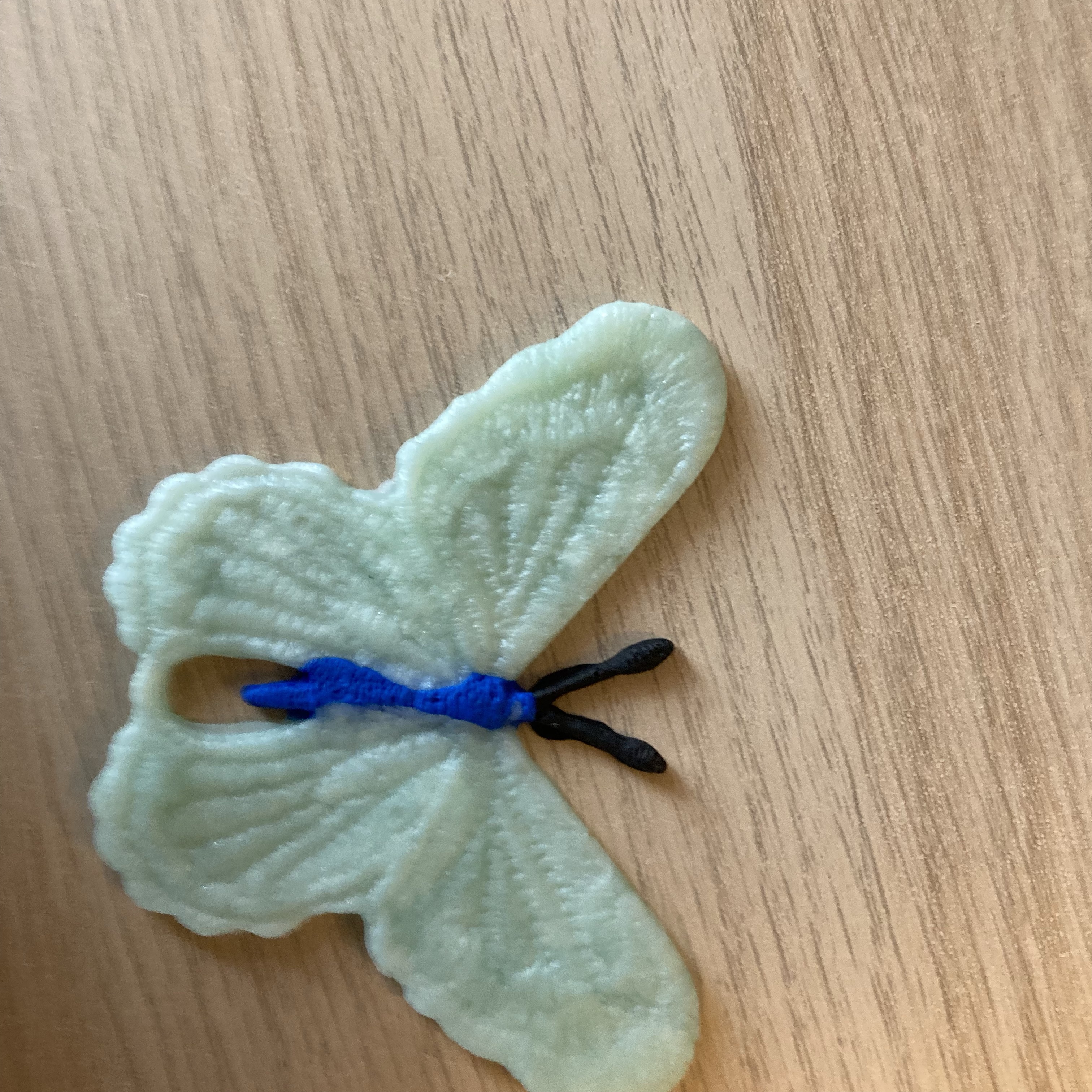
If we were having coffee, I’d share that I finally managed to craft another butterfly with the silicone mold I’d gotten for Christmas last December. I badly wanted to create a butterfly to go with the fellow client’s coffin, but wasn’t sure whether I could use the mold. However, other tutorials seemed even more complicated, so I eventually decided to give it a try. I did the wings in Fimo Effect color blue ice quartz. The body is pacific blue and the antennae are black.

If we were having coffee, I would also tell you that I have finally given in to the polymer clay color mixing thing and bought a precision kitchen scale. That plus a collection of 60 Fimo soft color recipes. Of course, I haven’t tried Fimo professional yet, but if I have to believe my staff, the colors I’ve mixed so far turn out gorgeous despite not being done with the true primary colors.

If we were having coffee, I’d tell you about the nationwide cerebral palsy day I went to yesterday. Of course, because the ParaTransit taxi had arrived at 8AM and we didn’t have to pick up any other passengers along the way, I was in Apeldoorn, where the day would be held, by 9AM. Thankfully, I had called my mother-in-law when I entered the taxi and she’d made sure to be there on time too.

The day started with a live-streamed lecture by Erik Scherder, a neuroscientist from Amsterdam. The message was quite similar to the one he’d conveyed in 2018 when I’d attended the cerebral palsy day too: that exerting yourself physically is needed to stimulate your overall neurological wellbeing. In 2018, the lecture had mostly been geared towards (young) adults, while yesterday it was more focused on children and their parents.

I attended two workshops during the day. One was on aging with cerebral palsy, mostly geared towards those age 40+, so I was a little outside of the scope, but I could relate (sad as it may be) to some of the increasing discomfort that older adults with CP face. The other was a yoga class.

As regular readers of my blog might know, I am not 100% sure I even have cerebral palsy, in that my parents never told me and, by the time I was an adult, things got so overshadowed with other diagnoses it’s unclear. For this reason, I felt validated knowing that I appeared not to be the most mildly affected person, strange as this may seem. In fact, during the yoga class, we had to loosen up our muscles and my mother-in-law told me to loosen up. Someone else half-joked: “That’s about the hardest thing to tell a spastic.” That made me feel good.

How have you been?

A Sunday With the Theme of Self-Esteem

Hi all. The past 24 hours have truly been a mixed bag of emotions. I started obsessing over wanting to start another new craft. Yes, another! Somehow, I decided on macrame and got all obsessed about learning its techniques before even having any cords. Then I decided to ask in a Facebook group whether you need to be coordinated in both hands in order to be able to do macrame. The first commenter basically said not only that, but you also most likely won’t be able to feel your way around the knots.

This was late last night, past midnight actually. I went to bed feeling awful about myself. After all, the reason I wanted a new craft is not that there’s nothing more to learn about polymer clay, but that I’m somehow convinced that I’ve reached my full potential.

By morning, I found that other people had been more encouraging of me trying macrame or even card making. You know, remember I’d said I tried that back in 2013? These people said so what if my work doesn’t look good, if I enjoyed the craft. That’s not entirely my kind of attitude, since I do want to be able to share what I make here or on my personal Facebook page at least without feeling like I have to be ashamed of myself.

I have been trying to work on some polymer clay projects in progress again later today by sanding some beads and charms. It felt kind of okay. I also watched some more YouTube videos on polymer clay, but they made me feel like I’ll be taking forever to understand the concepts. Then again, this is even more the case if I start another craft entirely. Guess I’ll just stick with polymer clay and try to be more patient with myself.

As a side note, one person did say that, if I can tie my shoelaces, I can do macrame. That kind of discouraged me at first, since I can’t tie my shoes. Make that couldn’t. At least, after three tries, I was successful at tying my shoelaces while my shoes were in front of me on the table. Then I tried several more times, more or less successfully. I don’t think I want to really be able to tie my own shoes, but it was an interesting boost to my self-confidence.

Mentors and Role Models

Today’s topic for Throwback Thursday is mentors and role models. Of course, last week, I already shared about my high school tutor, who was a mentor when I was a teen. Today, I’m going to share about other role models.

One of my first role models was my paternal grandmother. She was a fiercely independent, self-determined woman. In 1973, a year after women were legally equal to men here in the Netherlands, she divorced my grandpa. She went to college to become a social worker, eventually becoming the head of social work at the psychiatric institution in her area. In the mid-1990s, in her early 70s, she founded a senior citizens’ living complex, where she lived for nearly 20 years until she needed to go into a care home. She died in 2018 at the age of 94.

One clear memory I have of my grandmother that has stuck with me throughout life and which perhaps unintentionally inspired me, is her comment about her work as a social worker with troubled young people. She told me that, when some young people don’t want to go home to their parents, she had to sometimes honor the teens’ wishes rather than the parents’. Even though I was 19 when first going against my parents’ wishes, and their wish wasn’t for me to live with them, the point was that my opinion mattered even if I was “crazy”.

Later, when I was a teen and young adult, I sought out role models who shared some of my experiences. One of my first role models in this category was someone I met through an E-mail list for my eye condition. She was in her early thirties when we first met online and I was seventeen. Besides blindness, we had some other experiences in common. We eagerly read each other’s online diaries back in the day. She is still a Facebook friend of mine, but, because she has moved on to become more or less successful at life and work and I haven’t, we don’t share the same life experiences anymore.

Some people I considered inspiring, I never even talked to, such as Cal Montgomery, a disability activist whose article, “Critic of the Dawn”, I first read in like 2006.

Currently, indeed, what I look for in an inspiring person or role model is shared experience. That being the case, I consider many of the people I’m on E-mail lists or in Facebook groups with to be inspiring. Then though, our interactions are more based on equality, where any of us can be the inspiration for the others.

I don’t think that I quite have what it takes to be a mentor myself. Though I can provide people with inspiration and information, I don’t really have my life together enough to be a role model. This saddens me, thinking about the fact that I’m older now than the woman I met at seventeen was when we first met.

What do you look for in a role model?