Unique: Using Your Individual Qualities for Personal Growth #AtoZChallenge

Hi everyone. I’m currently quite triggered and feeling unsafe, so this is going to be a bit of a ramble. For my letter U post in the #AtoZChallenge, I’d like to talk about how each person is different and how to use your own unique qualities for personal growth.

Some people like to categorize or label themselves or others, for example using the MBTI, Enneagram or another personality test. There is nothing wrong with this in itself, but if you take your labels too seriously, you run the risk of not seeing the person you yourself are.

For example, I’m an Enneagram 4. For the longest time, I thought that because I identify most with this type, I also had to identify with similarly-described types in other categories. If you’ve seen my post on the MBTI, you’ve seen that for a long while, I identified as INFJ. I still am not sure whether I’m an INFJ or INTJ and basing my identity solely on a meme, isn’t quite wise. That being said, the reason I forever thought I must be an INFJ, is in part that I identify most with Enneagram type 4. However, the Enneagram is based on core motivations, whereas the MBTI is based on cognitive preferences, so why would an Enneagram 4 need to be a Feeling type?

Personality tests, like I’ve said, can definitely help understand yourself. However, they are not the be all and end all of self-understanding. Neither is any other method of identifying yourself as one particular type or another. Not even deep introspection. Yes, it will lead you to a deeper understanding of yourself, but if then you decide to narrow your identity down to a type or even a rating on the Big Five, you’re not doing yourself justice. You are unique, after all. And yes, so is everybody else.

Therapy, Counseling and Coaching for Mental Health and Personal Growth #AtoZChallenge

Hi everyone. Today for my letter T post in the #AtoZChallenge, I want to talk about therapy and other forms of support when you’re dealing with mental health problems and/or when you want to grow as a person.

Generally speaking, therapy isn’t for personal growth, although as a person you may grow when overcoming mental health problems. What I mean by this, is that your therapist isn’t just a sounding board and they aren’t your friend. If you’re feeling pretty good overall, formal therapy at least here in the Netherlands isn’t what you should be looking for. After all, therapy is aimed at helping you, in as little time as possible, to overcome your mental health problems. Here in the Netherlands, in fact, there’s a limit on the number of psychotherapy sessions you can get covered by health insurance. Of course, you could pay out of pocket for more, but if you’re reasonably well-adjusted, why should you?

Coaching and counseling are much more affordable and accessible because anyone can call themselves a counselor or coach. This also means that you’ll find coaches or counselors who align with almost any spiritual or psychological teaching. There are Enneagram coaches, for example, even though the Enneagram is actually nonsense. Did I, a person who frequently writes about herself as an Enneagram type 4, just say that? Yes, I did.

There are, of course, also coaches or counselors who do work within the framework of science-based psychology and education. For example, many people call themselves ADHD coaches and they do (I assume) have some knowledge of the current ideas surrounding ADHD.

Psychotherapy is, here in the Netherlands, often heavily protocol-based depending on your diagnosis or main problem. This is also what I’ve often found frustrating. Like, when I was diagnosed with borderline personality disorder, my psychologist wanted to do schema-focused therapy, but the modes and all that didn’t fit in with my experience of being plural.

At other times, therapy didn’t suit me because, while I sort of understood the theory, I wasn’t able to apply it in practice. This is why I eventually stopped doing dialectical behavior therapy.

I personally don’t do well with therapies that are merely focused on skill-building or that are primarily verbal (talk therapy). I have had the most success with art and movement therapies. I currently do movement therapy based on the Sherborne method. This is a sensory and attachment-based therapy approach. For example, today my therapist brought a multisensory tool called CRDL. When both of us touched the tool with one hand and touched each other’s hands or arms, the CRDL made different calming sounds. This is helping me regulate far better than any DBT skill helped me.

Shame and Guilt: How to Deal With Difficult Emotions #AtoZChallenge

Hi everyone. Today for my letter S post in the #AtoZChallenge, I want to talk about how to cope with hard-to-deal-with emotions such as shame and guilt.

First, what are shame and guilt? Shame is a complex emotion that usually arises when you think you’ve failed. Shame is not really focused on the specific action that causes you to feel bad about yourself, but rather it is focused on your identity. As a result, shame can cause you to feel inadequate or worthless.

Guilt, on the other hand, is an emotional response to thinking you’ve done something wrong. It, unlike shame, is linked to the specific mistake you made and it as a result often prompts you to try to rectify it.

Put simply, shame is an emotion that prompts people to hide, whereas guilt prompts people towards justice.

How do you deal with shame and guilt? First, identify what shame feels like for you. For instance, where do you feel it in your body?

Then, identify your shame triggers. Shame and guilt are both triggered by specific events. However, shame often leads us to feel like we as people are flawed, rather than us having simply made a mistake. As such, we often lose sight of the specific situations that trigger us to feel shame. Try to identify these.

Then, identify and challenge the specific thoughts that cause you to feel like you’re altogether bad. Shame can be helpful in pointing out ways in which you’ve failed, but these mistakes do not make you a failure as a person.

Finally, right the wrong. Do what it takes to rectify the mistake you made that caused you to feel shame. For example, if you’ve damaged another person’s stuff, buy new stuff or give them money or whatever. At the very least, apologize. And do the work necessary to prevent you making the same mistake again. Going into hiding out of shame doesn’t do any good. Admitting your guilt and making amends does.

There are other difficult emotions I could’ve mentioned here, such as bitterness and anger (except that these don’t start with the letter S). These are in a similar way related to each other that shame and guilt are: while bitterness leads people to inaction, anger leads people to fight for what they believe in. Anger, of course, can turn to the extreme of rage and then be inappropriate, but in general it’s healthier to be angry rather than bitter. In every situation, it is recommended to watch for all-or-nothing thinking that can lead you towards hopelessness and self-defeat.

Resilience and Post-Traumatic Growth #AtoZChallenge

Hi everyone. For my letter R post in the #AtoZChallenge, I want to talk about resilience. Resilience, basically, is the ability to bounce back when faced with challenges. It is also linked to post-traumatic growth.

First, what characteristics and attitudes make someone resilient? These include optimism, the ability to regulate your emotions, and the ability to see failure as helpful feedback rather than wallowing in self-blame.

Several factors contribute to resilience. Some of these are most likely genetic. Early life experiences play a role too. However, that doesn’t mean that resilience can’t be learned to some extent. For example, you can learn to break out of negative thought patterns, to regulate your emotions, to look for positives during a setback and to see failure as a learning opportunity.

Some people believe that experiencing a traumatic event, makes you less resilient. This isn’t necessarily true though. This is where post-traumatic growth comes in.

Post-traumatic growth is the experience that survivors of trauma are able to develop in a positive way after the traumatic event. For example, they recognize their inner strength for having overcome their trauma, form stronger connections with loved ones as well as other survivors, and find new opportunities for finding meaning in life.

The reason post-traumatic growth happens, is the fact that traumas force a victim to re-evaluate their sense of self and their stance in the world.

Not everyone who experienced trauma, will experience post-traumatic growth, but about half to two-thirds will. Again, whether you will experience post-traumatic growth, is related to how resilient you are in general.

So how do you learn to cultivate resilience? You can learn to reframe challenges as opportunities and, as a result, look at the benefits of stress. After all, viewing stress as solely negative, may lead to an additional stressor, ie. “stress about stress”.

Other ways of cultivating a positive outlook on life, such as practising gratitude and self-care, can help too.

How My Personality Has Evolved Over the Years

Hi everyone. Today, in her Sunday Poser, Sadje asks us how we’ve changed, personality-wise, as we’ve grown up.

The first way in which I’m far different from what I was like as a teen, is my self-expression. I am much, much more open about myself and my inner world than I was when I was younger.

Oh wait, I need to nuance that statement slightly. There, after all, was a time in my late teens and early to mid twenties, during which I was more open about myself than I am now. On my first blog, which I started as a diary in 2002 and moved to WP in 2007, I probably showed a little (a lot) more of myself than would be considered normal. Also, no-one probably remembers that I had my current blog URL for a few months in 2011 too, but I do. I particularly remember with a sense of shame a post one of my alters wrote just after I got married saying my spouse probably doesn’t even love me. Well, now nearly fourteen years on I’m convinced that my spouse does love me, but even if I didn’t think so, a public blog wouldn’t be the place where I’d spill my guts.

I do believe that, even though I was extremely private as a teen, the willingness to share my thoughts was always there. I just didn’t trust my audience at the time, ie. my parents and teachers. Now trusting the whole world isn’t necessarily safer, which is why I’m no longer as candid as I was even seven years ago when I started this blog.

Another way in which I’ve changed, which might be related to the above, is that I’m generally more outspoken and assertive than I was as a teen. I still oscillate between passive and aggressive a lot in daily interactions, but where it comes to major life decisions, I’m not as dependent on the approval of others as I was.

Lastly, I’ve probably become less judgmental than I was in my teens. I’ve also become less arrogant. I mean, back then I looked down on people with intellectual disability or those who were less educated than I was in general. It did take me having to rely on the care system myself in order to change that.

As a result of being less judgmental towards others, I have also become less hard on myself. That doesn’t mean that the voice telling me I should be able to live fully independently, isn’t there anymore. I am however able to channel that voice into prioritizing my need for self-determination.

#WeekendCoffeeShare (April 19, 2025)

Hi everyone. I’m joining #WeekendCoffeeShare tonight. It’s almost 11PM here, so definitely no more coffee for me. If you’d like to grab a drink, feel free to and let’s chat.

If we were having coffee, first I’d talk about the weather. We finally got rain. Not as much as was originally thought and not nearly enough, but we got rain. The temperatures have also been lower, usually around 15°C. This is still warmer than normal, but I still yearn for 20°C.

If we were having coffee, then I’d tell you that, as a result of the rainy weather, I haven’t walked as much as I did in previous weeks. I still kept my perfect streak with respect to my movement goal on my Apple Watch, but didn’t meet my exercise goal everyday.

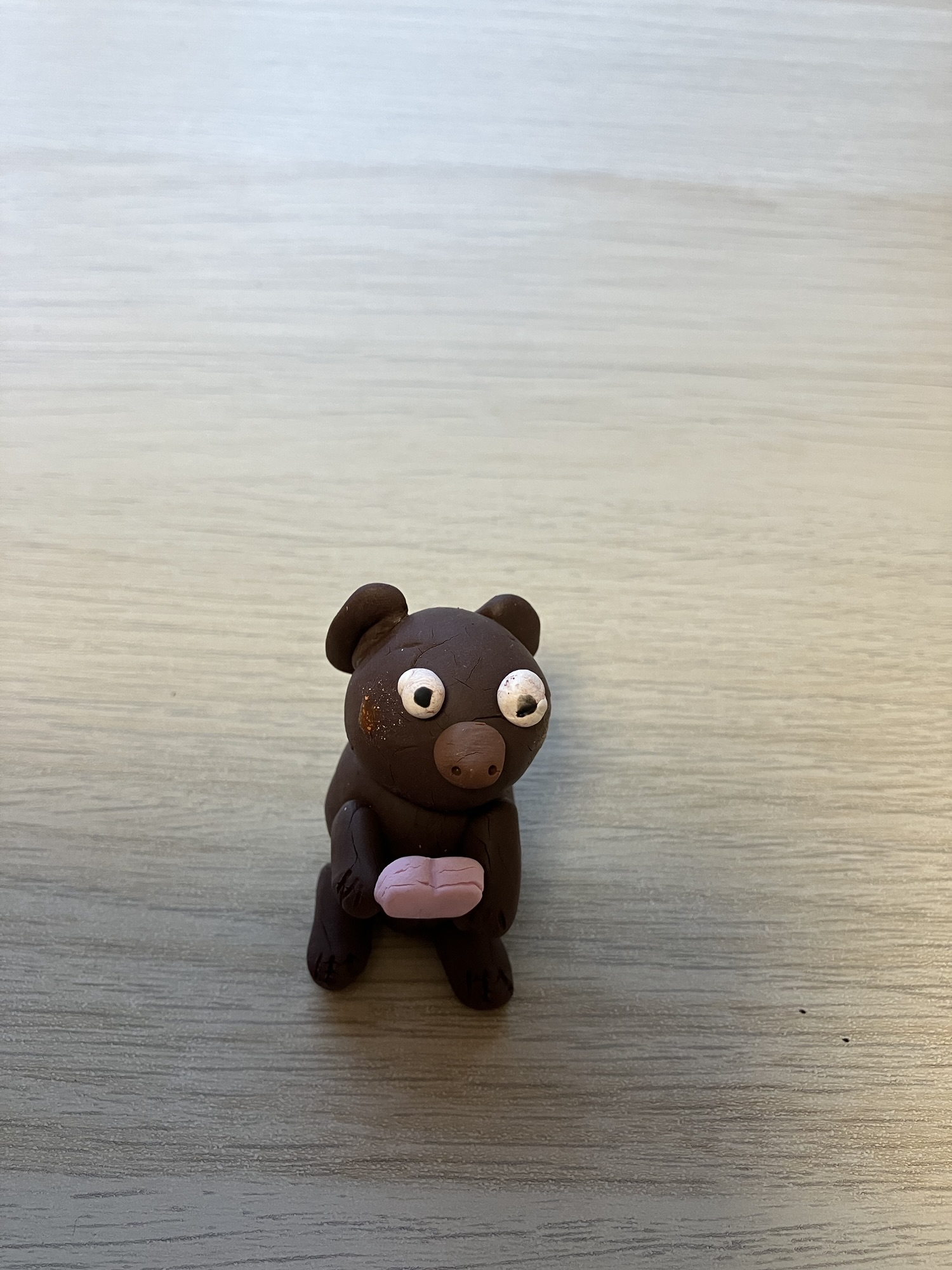
If we were having coffee, I’d share that I’ve finally been crafting again. I created a polymer clay bear holding a heart for my support coordinator, who is on maternity leave. Unfortunately, one of its ears fell off during baking, but thankfully I noticed it in time and was able to add a new ear.
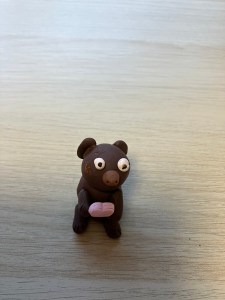
I also made another attempt at creating a polymer clay trinket dish today, but failed once again.

If we were having coffee, I’d report that I had a meeting with the intellectual disability physician, who prescribes my psych meds, on Wednesday. The good news is that I’m allowed to further taper my antipsychotic. The bad news is no answers regarding my tremors. She thinks they may be related to my spastic cerebral palsy and this means that they can get worse when I’m stressed.

If we were having coffee, I’d tell you that I had a dietitian’s appt on Wednesday too. This went well. I’m staying in a sort of acceptable weight range and not having binge eating episodes or purging. My next appt will be in three months.

If we were having coffee, I’d moan about the temp worker situation once again. On Wednesday, when like I said I had two appointments, the staff wanted to orient a new “regular” temp worker to me. As soon as they told me, I told them that this wasn’t going to work out that day, but they kept telling me to see what’d come out of my doctor’s appt first and then we’d discuss it again. Well, no-one ever allowed for any discussion after the appt and, when the time came for the worker to be oriented, the staff doing the orienting kept pushing me in overt and covert ways to accept him. Like, the temp worker was constantly sneakily, without talking, being in my presence. This gave me a horribly unsafe feeling, because I, being blind, couldn’t be sure whether he was there or not.

The staff doing the orienting at one point seemed to show some understanding and told me she was going to talk it over with the other staff. She came back to tell me that it’d been agreed between my assigned staff, the support coordinator, behavior specialist and the team manager that, if I refused him now, I’d had my chance. She never told me who’d told her that when she was “talking it over”, so I assumed it was my assigned staff. I still refused the temp worker and to this day feel horrible about the whole situation. I mean, this whole agreement among the powers-that-be is showing that they believe I refuse staff for their one orientation moment just because I feel like it. Honestly, I still disagree with that whole thing about just one orientation moment and then they’re as regular as the regular staff who’ve worked here for years.

At one point, I went into the communal room and another staff, one of my “favorites”, was there. She asked me what was up and I explained that I had two appts that originally the staff didn’t think I could handle in one day and now they added this orientation thing to it too. The temp worker was present too and I told him it wasn’t that I didn’t like him, but he hadn’t even spoken a word to me during his previous shifts here and now he was creeping up on me. He apparently had been instructed to do so. The other staff understood and I actually talked a little to the temp worker.

Unfortunately, when I read my daily log notes for the past week today, I saw there wasn’t a single word about how I’d talked to him eventually. Neither was there anything about how I’d accepted the other temp worker (who’d had her orientation moment with me last week) for my activity on Tuesday, nor that I showed the new student staff my clay yesterday on his first shift here. This is relevant because it signifies that they’re still only reporting my challenging behavior and not the things I do accomplish in spite of the stress it gives me.

If we were having coffee, I would once again end on a positive note by sharing some small pleasures of the week. First was the BBQ on Thursday. It was good. Next up is a visit to the next town’s market yesterday. My spouse was a little surprised that I didn’t buy olives, as I usually buy those when going to the market. I did buy candy. I also went to the supermarket to buy some ingredients for my smoothies. We also went to that town’s coffee shop run by disabled people and had the most delicious caramel latte.

Speaking of which, I’d tell you that I’ve been having a new interest lately: coffee brewing. I’d really like to be able to create my own coffees. Still need to look into all the necessary supplies, but it should be fun.

Questionnaires and Personality Tests for Self-Improvement and Diagnosis #AtoZChallenge

Hi everyone. For my letter Q post in the #AtoZChallenge, I’d like to talk about personality tests and questionnaires. How valid are self-report questionnaires for personal growth? Do they have any validity in diagnosis?

The short answer to these questions is that it depends. After all, many people especially those with some knowledge of the thing being tested, will answer in such a way that they’ll get the results they want or expect. Even people who don’t know how the test works, may distort their answers because they think the test works in a certain way or because they think others want them to answer in a certain way. Or sometimes even because they don’t understand the questions.

For example, when I was eleven, I was tested with this weird sentence completion test that included open-ended questions. An example I remember clearly was the psychologist asking me “When I can’t sleep, I…”. I replied “I’ll try to sleep”. I had absolutely no idea what to say, not because I thought the psychologist wanted a particular answer but because the question was far too open-ended. Similarly, my lack of emotional awareness at the time often made me choose the middle option on rating scales. This was judged to be manipulativeness, but it wasn’t.

Like I shared before, many personality tests include a “liar scale” or validity subtest. An example on the Big Five test I got in college is “I always feel equally good”. I honestly answered with “strongly disagree” and totally thought it’d make me score high on neuroticism. Instead, that particular question and others I answered honestly got me to score above-average on the validity scale. That isn’t to say I didn’t score high on neuroticism though.

I don’t personally think it matters that many self-report questionnaires can lead to a strong confirmation bias, especially if you’re using the test for personal development only. That is, if you want to hear that you’re great, you will always be able to find validation for that. Whether lying on self-report questionnaires will help you on your journey, is another thing, but if you aren’t consciously manipulating the test, chances are there’s some truth to the result anyway. I don’t recommend relying on a test alone to determine anything about yourself, but to also always do your own research. Similarly, in clinical settings, while self-report questionnaires are somewhat useful, professionals also need to rely on observations.

Positive Psychology: The Science of Optimal Wellbeing #AtoZChallenge

Hi everyone. For my letter P post in the #AtoZChallenge, I want to talk about positive psychology. Positive psychology, first developed by Martin Seligman at the beginning of this century, is focused on optimal wellbeing as opposed to overcoming mental health problems. After all, according to Seligman, curing the negative (such as depression or anxiety) does not produce the positive. As such, though positive psychology also focuses on interventions, its aim is to maximize people’s happiness rather than merely curing mental problems.

What are the main ideas behind positive psychology? First are the three types of happiness. These are hierarchical in order. Lowest on the ladder is the Pleasant Life. This refers to daily pleasures and indulgences. For example, I enjoyed a BBQ yesterday. Next up is the Good Life, which is achieved when people are engaged in their daily activities. This form of happiness is focused more on longer-term goals. For example, engagement might look like being passionate about your work, cultivating healthy relationships or pursuing hobbies. Highest up then is the Meaningful Life, which is achieved when people use their strengths and character traits to serve a cause greater than them.

I for one find myself mostly at the lowest point if even that. Occasionally, I try to work towards longer-term goals, but this easily gets overwhelming.

Next, positive psychology looks at the pillars behind happiness. These are summarized as the acronym PERMA or PERMAH. These stand for:


  • Positive emotions.
  • Engagement in activities: being truly present when doing something.

  • Relationships that are meaningful and intentionally investing in them.

  • Meaning in life: focus on a cause greater than yourself.

  • Accomplishment: achieving goals that are important to you.

  • Health, particularly physical health. This one is the most recent addition to the acronym. For physical health, research shows that three things in particular help: physical activity, healthy eating and sleep.

Like I said, in order to lead a Meaningful Life, people utilize their strengths and virtues. However, it may be hard to discover what your strengths are. To find these, researchers have developed the VIA (Virtues in Action) strengths survey. For some reason, I couldn’t register in order to take the survey.

Gratitude and grit are two more concepts in positive psychology. Grit is a focus on long-term goals. This is what keeps people going when they have temporary setbacks. Gratitude can also help people focus on the things they do have rather than the things they don’t.

Overall, though I know that positive psychology is actually science-based, it does leave me wondering how well people can actually influence their happiness. Positive psychology, though it might help people who aren’t struggling with their mental health in any major way, won’t cure significant mental distress. In this sense, the reverse of what Seligman said about curing the negative not producing the positive, is also true.

Overcoming Negative Emotions #AtoZChallenge

Hi everyone. I’m really struggling and honestly, even though it’s past 10PM, I haven’t even completely decided on a topic for my letter O post in the #AtoZChallenge. I did a quick Google search for personal growth topics and the only one with an O I found, didn’t even have an O as its main first letter. It was “Overcoming fear and anxiety”. Then I realized that “obstacle” starts with an O so if we’re rebranding it as “Overcoming obstacles to mental health”, the main word does start with an O. Let’s go!

The topic of overcoming negative emotions and moods that are obstacles to mental health, ties in with many other general self-help topics. After all, many things that help people overcome mild to moderate symptoms of anxiety and depression, also help people feel better overall. These things include:


  • Mindfulness: being aware of your thoughts, feelings and actions without judgment.

  • Gratitude: focusing on the things you do have rather than the things you don’t.

  • Physical activity, including something as simple as a walk, but also running and other more intense exercise.

  • Healthy and balanced eating habits (yes, that includes the occasional treat!).

  • Making sure you get enough proper quality sleep.

  • Spiritual or religious practices, such as prayer, spells or meditation.

  • Contributing to your community.

  • Distracting yourself by engaging in a hobby, such as reading or crafts.

More specific practices that could help according to some are sitting with feelings, putting your problems into perspective by thinking that it could be worse, and forcing yourself to smile. Yes, I seriously got these from a handout in dialectical behavior therapy (DBT), a therapy approach applied to an increasing number of mental health issues. You’d be right if you thought I don’t think highly of these ideas. That is, I either focused on the wrong aspect of the teaching and the bigger picture was different, or these people are indeed horribly invalidating.

One thing that I did get from DBT that might make a tiny little bit of sense, is opposite acting (hey, another O). This means that you do the opposite of the immediate impulse your feelings and thoughts trigger. For example, if you are feeling depressed and your impulse is to lie in bed and isolate, DBT instructs you to actually go out and meet people. This is probably where the forcing yourself to smile comes in. Facing your fears is also a way of acting opposite to the emotion and this is, when done gradually, actually effective in treating mild to moderate anxiety.

Narcissism, Narcissistic Personality Disorder and “Narcissistic Abuse” #AtoZChallenge

Hi everyone and welcome to my letter N post in the #AtoZChallenge. Today, I want to talk about narcissism and narcissistic personality disorder. I’ll also talk about the controversial topic of “narcissistic abuse”.

When looking up the definition of narcissism, several different descriptions come up, but an overarching theme is an extreme sense of self-importance. In psychoanalysis, narcissism is thought to be due to a person’s inability to distinguish themself from external objects. This is thought to occur naturally in infants but may also arise as a result of a mental disorder.

Narcissistic personality disorder (NPD) is defined by the American Psychiatric Association as a pattern of exaggerated feelings of self-importance, excessive need for admiration and a reduced capacity for empathy. Symptoms include:


  • A grandiose sense of self-importance.

  • Preoccupation with fantasies of unlimited success, power, beauty or ideal love.

  • Belief that they are special or unique and can only be understood by, or should associate with, specific people/institutions, usually those with high status.

  • Requiring excessive admiration.

  • A sense of entitlement, such as expecting especially favorable treatment or automatic compliance with their expectations.

  • Being interpersonally exploitative.

  • Lack of empathy: unwillingness and inability to identify with the feelings of others.

  • Often being envious of others or believing others are envious of them.

  • An arrogant, haughty attitude.


There is also an alternative model of describing personality disorders, which lists NPD as having two main criteria: grandiosity and attention-seeking.

There are two main subtypes of NPD: malignant and vulnerable. The malignant type is how most people see a classic narcissist, whereas those with the vulnerable type display more negative affect and shame.

As I look over the criteria of NPD, I can somewhat see why some people have called me “a little narcissistic”. I, after all, do see myself as unique and feel that I can only be understood by a handful of people. Unlike actual narcissists though, I don’t think of myself as “better” than others and, as a result, the people who will understand me are most certainly not high-status people.

Now on to “narcissistic abuse”. This is a term used to describe abuse, mostly psychological, perpetrated by people with NPD. However, it is more commonly used for any long-standing pattern of psychological abuse. As such, many people have come to call their toxic parents, partners or other abusers “narcs” even when these people don’t have a formal diagnosis of NPD. I’m not sure how I feel about this. On the one hand, it’s stigmatizing a mental disorder and also providing excuses for abusers (after all, they can’t help being a “narc”). On the other hand, well, it’s a major thing in abuse survivor circles and I need support regardless of what my abusers are or are not being identified as. I lean towards not believing in “narcissistic abuse” as its own thing.