Five Daily Actions for Wellbeing

A long time ago, I read somewhere that doing five small things for your health and happiness each day, will get you started on a journey towards the bigger goals. Today, I came across a journaling prompt that explained that not all goals have to be big and asked what small goals you’re working on right now. I’m pretty sure I listed my five daily actions already before, but cannot find it right now. In any case, if this is a repeat, I’ll no doubt have changed something from when I did this before. Here are five daily actions I can take, and in many cases am already taking, to improve my health and happiness. Most of these are focused primarily on my mental and spiritual wellbeing, but the mind, body and soul are interconnected. This means that, ultimately, I’ll hopefully feel more physically healthy too.

1. Read the Bible. I am currently on a 142-day streak in the YouVersion Bible app. It’s not always easy to commit to reading my Bible, but I am motivated by both a wish to please God as well as my stats. I have found that I don’t do well reading the Bible in order and I have no intention of reading the entire Bible in a year. Instead, I started with a Bible reading plan and, when I finished it, started another. That way, I am not just reading the Bible as if it were a novel, but truly paying attention to its meaning. I just completed my thirteenth plan on YouVersion today.

Bible reading helps me feel connected to God. I really want to connect to other people on the app too, so that we can study together. That’s my goal for the upcoming month: find people to fellowship with.

2. Pray. This is something I really need to get woven into my routine. My husband prays the Lord’s Prayer each morning as he gets up and maybe I should do the same. I do pray almost everyday, but not at set times.

3. Journal. I have the Day One journaling app and really like it. Even so, I struggle to write in it each day, even though I have two reminders on a day: one for the daily prompt and one just to write. Last week, I resolved to write at least a few sentences each day, but I didn’t really follow through. I am pretty sure though that, when the A to Z Challenge of April is over, I’ll want to continue writing everyday. Since I’m not requiring myself to blog everyday then, it’d really help if I wrote in Day One everyday.

4. Be more mindful. This is a less measurable goal, but I can include some simple breathing or body scan exercises into each day. Not doing this at the moment, as some of them feel contrary to the Christian faith. Scratch that and insert another excuse that isn’t holding God responsible. Breathing exercises and body scans aren’t anti-Christian. I guess I just feel like this, like prayer, is something I struggle to find the discipline for. It also feels kind of scary, I guess, but I trust that will get better with practice.

5. Gratitude. Another less measurable goal, but I really want to be more appreciative in life. Now that I’m going to use Day One each day anyway as I journal, I could just add a simple gratitude list (or one grateful if I can’t make a list) each day too.

In addition, I would really like to improve on my expressing kindness and gratitude towards others. I will get to thank my staff and others for what they do more.

What are some daily practices that will enhance your wellbeing?

Joining in with the Wonderful Wednesday Blog Hop and Let’s Have Coffee.

Wintergreen Essential Oil #AtoZChallenge

Hi and welcome to my letter W post in the #AtoZChallenge with my theme of aromatherapy. Today, I will be writing on an oil I don’t own, but which has fascinated me for a while: wintergreen.

When I first looked into essential oils, I saw that wintergreen essential oil is commonly sold. However, at the time, I thought it was a hazardous oil because, back then, AromaWeb had it on its list of oils you should avoid. I wondered why then it was being sold.

Indeed, wintergreen’s main component, Methyl Salicylate (which makes up at least 98% of the essential oil), is toxic with as little as four milliliters being potentially deadly. AromaWeb still advises caution when using this oil. The author also advises buying from a reputable supplier, as some vendors market synthetic Methyl salicylate as wintergreen essential oil.

Wintergreen essential oil is derived from the leaves of the Gaultheria procumbens, an evergreen shrub. The leaves are first soaked in warm water and then the oil is extracted through steam distillation. Fresh wintergreen leaves do not contain Methyl salicylate. Rather, the chemical is formed during the process of soaking the leaves.

Wintergreen’s aroma is crisp, fresh, woody and sweet. Wintergreen’s smell is similar to that of mint essential oils. For this reason, many people think that wintergreen belongs to the mint family. It doesn’t.

Like birch oil, wintergreen essential oil is used as a potent pain reliever and anti-inflammatory oil. However, it also has blood thinning properties, so should not be used if you already take blood thinners or have a bleeding disorder. The oil also stimulates the liver, resulting in possible drug interactions. I would advise against using wintergreen essential oil at all if you take any medication. Wintergreen is not safe when you are pregnant or breastfeeding. It also should not be used on children or around pets.

Vetiver Essential Oil #AtoZChallenge

Welcome to my letter V post in the #AtoZChallenge. My theme for this year is aromatherapy and today, I want to discuss the oil I most recently purchased: vetiver essential oil.

Vetiver essential oil is derived through steam distillation of the aromatic roots of the Vetiveria zizanoides plant. The aroma is strong on its own and can be described as woody, earthy, herbaceous, smoky and spicy. Vetiver essential oil has potent emotional balancing properties and is, for this reason, also referred to as the oil of tranquility. It is also sometimes called the fragrance of the soil.

Almost the entire vetiver plant has been used since ancient times. For example, in tropical countries, people used to make coolers from vetiver plants. They were woven together with coir ropes to make grass mats, which were soaked in water and then hung in doorways. That way, the warm air from outdoors would be cooled.

Since the Middle Ages, vetiver essential oil has been used for its scent. Its deep and woody aroma, its low evaporation rate and its sollubility in alcohol make it great for use in perfumes. Opium by Yves Saint Laurent, Miss Dior by Dior and Coco Mademoiselle by Chanel are some well-known perfumes that incorporate vetiver. Vetiver is also used in many if not most men’s fragrances.

Vetiver essential oil can be used on the skin to treat acne, reduce the appearance of scars, help with wound healing and lessen the effects of aging on the skin. Its maximum usage rate in a carrier oil is 15%.

However, it is even more useful in a diffuser blend. It has warming, grounding, balancing and sedative properties. It is also thought to be an aphrodisiac scent.

Vetiver essential oil blends well with many other oils, including sandalwood, patchouli, lavender and clary sage. If you happen to have rose absolute, this is also a great aphrodisiac to be used with vetiver essential oil. Some sources recommend using as many as five drops of vetiver essential oil in your blends of ten drops. However, AromaWeb’s author recommends using the oil sparingly in blends to prevent it overpowering other scents. I agree with that.

Enneagram Type Four: The Abandoned Inner Child

Over the past few days, I’ve been reading more about the enneagram. Since I figured I’m probably a type Four, I read up on that type first in Helen Palmer’s book The Enneagram.

Let me say up front that Palmer doesn’t show pity for type Fours at all. We aren’t portrayed as the special snowflakes we often see ourselves as. That hurt, but in a good way.

First, Palmer describes the typical dilemma Fours face within themselves. Many remember abandonment or loss in childhood and are constantly focusing on regaining that which was lost. As a result, they constantly find themselves second-guessing themselves.

All Fours are prone to depression, though they may handle it in various ways. For example, some accept it fatalistically and succumb to despair. Others cope by constantly being on the move. That would be me, quite literally. Still others find a type of beauty in their sadness and convert it to melancholy.

When describing the typical Four’s family history, Palmer showed a bit more compassion towards us, but it was mostly through the quotes from type Four interviewees. One of them explained that she was an incubator baby and, while she was not literally abandoned, she did feel that way. Boom, that hit. I was an incubator baby too. Even though I was never literally abandoned – my parents aren’t divorced and I lived with them till age nineteen -, I often felt like I was only conditionally loved.

When I read up on core beliefs and schemas when I did schema-focused therapy back in 2013, I most clearly related to the abandonment/instability schema. I still do. I rarely felt safe with my parents and, after leaving the house at age nineteen, I moved from one temporary placement to another until I moved into long-term care in 2019.

Indeed, like the typical enneagram Four, I keep life at an arm’s length distance. I am always on the lookout for something that’s unavailable. Not really in relationships – I have been happily married since 2011 -, but in all other areas of life, certainly. I find myself constantly looking at another place to live, even though the staff and manager of my care facility have reassured me that I can stay here for as long as I want to. I think a core misconception I at least hold is that I can find happiness by chasing what’s unavailable. That’s not true, of course, but my abandoned inner child constantly looks to be rescued in all the wrong ways.

In the book The Enneagram Type 4, the author asks us how we’ve tried to rescue ourselves and how successful we’ve been. The underlying message is that we can’t and don’t need to rescue ourselves, since God is in control. God, will you please rescue me?

Joining in with the Hearth and Soul link party.

#WeekendCoffeeShare (April 24, 2021)

Hi everyone! After writing this afternoon’s quick post, I felt I really wanted to write another post today, so I’m joining #WeekendCoffeeShare on Saturday. I’m pretty sure I’ll have something else to share with you tomorrow. Either that or I can take the day off blogging for a change. Anyway, I just had my soft drink and chips for this evening, but there is no doubt still some left. Let’s have a drink and let’s catch up.

If we were having coffee, first, as usual, I’d make smalltalk about the weather. It’s mostly been sunny and dry, but windy and quite chilly. How is yours?

If we were having coffee, I would tell you that I’ve been struggling with foot pain when walking for a while now. I don’t know why, but it seems worse when I wear my AFO (ankle foot orthosis). The physical therapist – not my usual one, since she was off sick – came by yesterday. I can’t remember all that she said, but it came down to my having muscle tension in my feet or something. Massaging my foot before putting on the AFO may work. Other than that, she basically told me that the AFO takes some getting used to. I interpreted this to mean I just need to push through for a bit. That, I think, makes little sense, since I’ve had the AFO for at least a month, probably two, and was fine most of that time.

I was pretty frustrated and depressed when I could barely walk with the AFO on yesterday evening. I immediately catastrophized that I may as well get a wheelchair. Another possibility, and I know my staff don’t buy that one, is that I just need to lose weight. I do, but my staff don’t believe that’s causing my pain. Honestly, neither do I, as I’ve been a lot heavier in the past and then didn’t have issues with pain. My foot also does stand in a weird position when not forced into a 90-degree angle by my AFO. Well, I’m not wearing my AFO for now and we’ll see what will be next.

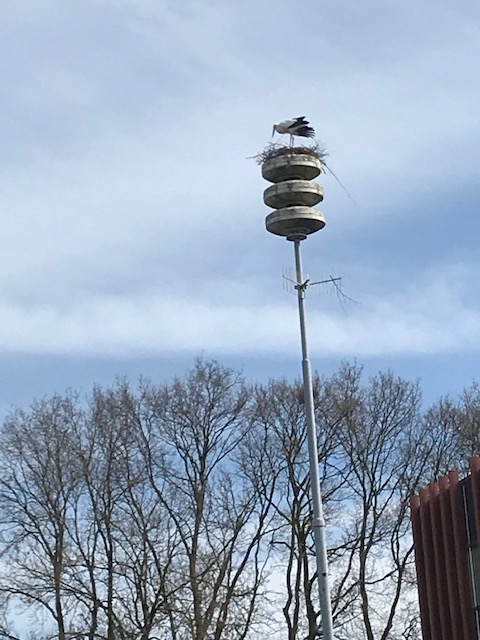
If we were having coffee, I’d share that on the walk without my AFO this evening, I heard a stork making that clattering sound storks do. We were near the neighborhood supermarket, so at first, my staff didn’t believe me and was convinced it was something else. Then she spotted a stork nest.

Stork

If we were having coffee, I would share that I’ve been reading a lot lately. Some of it involves me exploring the enneagram and other personality-related topics. I’ve also been reading a little on attachment styles and trauma. However, I’m also reading for enjoyment. I am currently reading the foster care memoir A Sister’s Shame by Maggie Hartley.

If we were having coffee, I’d also tell you that I’ve been writing a lot again. Of course, I’m still blogging everyday, but I’ve also picked up my journaling app, Day One, again, and am aiming to write at least a few sentences each day.

If we were having coffee, lastly I would share that I’m finally able to benefit fully from the YouVersion Bible App and Bible.com. I discovered the note-taking feature yesterday. Today, I finally downloaded the Common English Bible translation. This translation’s publishers require a valid E-mail address and I had initially signed up with my Apple ID and a hidden E-mail address. I thought it should be easy to add my actual E-mail address to the app, but not so. Turned out I also had an account, a different one, with my actual E-mail address. Thankfully, I was able to sort it out. I’m fully enjoying my Bible reading again.

What’s going on in your life?

Useful Resources for Aromatherapy #AtoZChallenge

Hi and welcome to my letter U post in the #AtoZChallenge on essential oils. I’ve been debating a lot what to cover for this letter, but eventually decided to do a quick post on resources for doing your own aromatherapy.

I use a number of books for my information on aromatherapy. However, the Internet is also rich with resources. First up is AromaWeb. This is one of the most reliable sources on essential oils and aromatherapy online. There are essential oil profiles and there’s information on safety, but there are also recipes for your own aromatherapy products. This site usually comes up first when I search for general essential oil information.

Next is Loving Essential Oils. This is mostly a site full of recipes for diffuser blends and other DIY products with essential oils. I also think they sell aromatherapy supplies. When I search for diffuser blends, this site usually pops up first.

I also like to get my diffuser recipes from One Essential Community. They also offer many different DIY recipes with essential oils.

Last, I want to recommend EOCalc.com. This site has never popped up in Google searches that I did before, but it was recommended in a Facebook natural soap making community. I have so far never used my essential oils in soap and I am not sure this site is useful for melt and pour soap makers like me. However, this site has a wealth of essential oil blends. I just convert the percentages to drops and then use the recipe for my diffuser.

Tea Tree Essential Oil #AtoZChallenge

Hello and welcome to my letter T post in the #AtoZChallenge. Today, I’ll discuss an oil I’ve had for some time, but which I didn’t really know much about: tea tree.

Tea tree oil (also known as melaleuca oil) is an essential oil derived from the tea tree, Melaleuca alternifolia, which is native to southeast Queensland and the northeast coast of New South Wales, Australia. This tree, to be clear, is different from Camellia sinensis, the shrub that tea leaves come from.

The common name of “tea tree” is thought to have originated with Captain James Cook, who used to make an infusion with it that he used to drink in place of tea. Commercial use of the oil started in the 1920s with Arthur Penfold, an Australian chemist, seeing its potential as an antiseptic.

Tea tree essential oil has a thin consistency and a clear to pale yellow color. Its aroma is fresh yet camphoraceous. Most people don’t like the scent at first, but are able to develop a tolerance or even liking for the oil’s smell eventually.

In aromatherapy, tea tree essential oil has a wide range of uses. For example, when used topically on the skin, it is thought to help with acne and skin infections, as well as nail fungus. A small study found that indeed, tea tree oil is superior to placebo when treating acne. It can also be used in hair products to combat dandruff and is claimed to treat head lice in children. This, however, is not supported by evidence and is not recommended, as neither its safety nor efficacy are known.

Some authors say that you can safely use tea tree oil undiluted on the skin. However, I think you should always dilute essential oils into a carrier oil when using them on the skin. Indeed, on AromaWeb’s profile, the authors recommend a maximum usage rate of 15%. This does show to me that the oil is significantly more skin-safe than other oils.

That being said, tea tree oil is toxic when ingested. The list of possible effects of poisoning is long and serious. You should not use essential oils internally anyway, but especially not tea tree oil. Do not use it in or near the mouth, ever! Tea tree oil is also poisonous to dogs and cats, even when used externally at high doses. Keep your essential oils away from children and pets.

I’m Not Broken (And Neither Is Anyone Else)

A few days ago, I got a notification on WordPress that someone had liked a post of mine called “People Aren’t Broken”. It was probably on an old blog of mine and I can’t remember exactly what the post was about. From what I remember, it was written in response to a person being officially diagnosed as autistic and seeing this as a reason they weren’t “broken”.

Indeed, before my autism diagnosis in 2007, I always thought I was “broken”. Same once my autism diagnosis got taken away in 2016. I still had a personality disorder diagnosis (dependent personality disorder and borderline traits), but I believed strongly in the stigma attached to it. That wasn’t helped by the fact that my psychologist at the time used my diagnosis to “prove” that I was misusing care. I wasn’t.

Today, I found out people applying for benefits are completely screened by some kind of information gathering agency. It made me worry that the benefits authority or long-term care funding authority will do the same, even though I already have both.

It’s probably the same internalized ableism (discrimination against people with disabilities) speaking up that tells me that, if I don’t have a “legitimate” disability (like autism) that warrants me getting care, I’m just manipulative and attention-seeking and generally broken. I am not. And neither is anyone else. Including those who actually do have personality disorders.

This post was written for today’s Five Minute Friday, for which the prompt is “Broken”. Of course, I could have (should have?) written a more spiritual post and, from that perspective, everyone is in fact broken. What I mean with this post, though, is that there’s nothing that makes certain people broken based on disability or diagnosis.

Spicy Essential Oils #AtoZChallenge

Hi and welcome to my letter S post in the #AtoZChallenge. Today, I’ll be discussing spicy essential oils like cinnamon, cardamom, etc. I really love these oils. In fact, I especially wanted to buy cardamom essential oil. Too bad it’s relatively expensive, but I eventually got it.

First off, let me discuss cinnamon. Cinnamon essential oil is steam distilled from either the bark or the leaves of the cinnamon plant. Cinnamon bark essential oil is usually preferred, but it is also much more expensive than cinnamon leaf oil. Cinnamon bark oil’s aroma is much richer than that of ground cinnamon. It can be described as peppery, earthy, spicy, bright yet slightly woodsy. The oil blends well with many different essential oils, including citrus and mint oils, as well as other spicy essential oils. Cinnamon essential oil should be used with extreme caution when you want to apply it to the skin.

Another plant in the cinnamon family of which essential oil is distilled, is cassia. This oil is very similar to true cinnamon but more affordable. I don’t own this oil as far as I know, though now that I think of it, my “cinnamon” essential oil might actually be cassia.

Another of my favorite spicy essential oils, is cardamom. This oil is steam distilled from the seeds of the Elettaria cardamomum plant. The scent is spicy, woodsy, rich and sweet.

Lastly, I want to discuss clove essential oil. When an oil is simply referred to as “clove”, it is most likely steam distilled from the flower buds of the clove plant. However, clove leaf and stem essential oil are also available.

Clove bud essential oil is very strong, so always be cautious when using it. For example, the maximum usage rate in skincare products is 0.5% (about one drop in 200ml of carrier oil). Even when diffusing clove bud essential oil, use it sparingly in blends.

Clove bud essential oil has a strong, warm and spicy aroma. It is well-known for its pain-relieving properties. Some people will use a drop of clove essential oil on a painful tooth. However, I don’t recommend using any essential oil internally. Rather, use an actual clove bud instead.

Do you like spicy scents?

Rosemary Essential Oil #AtoZChallenge

Hi and welcome to the letter R post in my #AtoZChallenge series on aromatherapy. Today, I will talk about one of the first essential oils I purchased: rosemary.

The name “rosemary” is derived from the latin term for “dew of the sea”, because it is native to the sea cliffs of the Mediterranean. The highest quality essential oil is derived through steam distillation from the flowering tops of the plant Salvia rosmarinus. This plant used to be known as Rosmarinus officinalis and you may still see this used by essential oil companies.

Rosemary belongs to a larger family of herbs that includes lavender, mint, myrtle and sage.

The scent of rosemary is fresh, herbaceous and sweet. AromaWeb reports that it smells “slightly medicinal” and I agree.

Rosemary was considered sacred by people in many ancient cultures. It was used in incense, for protection and as a reminder of the life-and-death cycle. It may also have been used to improve memory, which isn’t so far off. After all, at a 2017 conference on aromatherapy, rosemary was actually reported to help with cognitive function.

In the Middle Ages, rosemary was thought to ward off evil spirits and keep the bubonic plague from spreading. For this reason, rosemary branches were commonly spread across floors and doorways to keep the disease from spreading. In addition, rosemary was often tossed in graves to symbolize the fact that loved ones who had died, wouldn’t be forgotten.

Sixteenth-century German-Swiss physician and botanist Paracelsus recommended rosemary as a herbal treatment for all kinds of conditions.

Currently, rosemary essential oil is used in aromatherapy to relieve stress and nervous tension, to boost mental activity and to support clarity and insight. It is used to improve alertness, reduce negative moods and improve the retention of information by increasing concentration. It can also be used to combat fatigue and to promote a healthy respiratory system.

When applied topically to the skin, rosemary essential oil can reduce pain, soothe inflammation and boost the immune system. It can also be used to promote hair growth and help your hair look and feel healthy. You can also use rosemary essential oil in a massage to promote healthy digestion and relieve bloating, flatulence and constipation.

Rosemary essential oil blends well with other herbal essential oils such as lavender, clary sage, peppermint and spearmint. It can also be used in blends with citrus essential oils.

Have you ever used rosemary? If so, do you like it?