I Don’t Owe Anyone a Grateful Heart

Hi all. Today’s prompt for Reena’s Xploration Challenge is quite fitting. Reena asks us to ponder the paradox of gratitude and resistance.

Sometimes, by being grateful, we can bring about change. I am reminded of a story in one of the Chicken Soup for the Soul books in which nurses on one floor were irritated with another floor’s nurses for their constant negativity. Instead of fueling the conflict by becoming negative themselves, the nurses wrote a lengthy gratitude letter to their colleagues. I am not sure whether this was exactly what the story was about, but this was at least the message I took from it. The fact that the one group of nurses focused on the positive rather than giving in to the other group’s toxicity, turned the situation around for the better.

At other times though, particularly when there’s a power difference between two people or groups of people, gratitude becomes passive resignation. In this case, while it can be helpful in the short term to the oppressed person to keep a positive outlook, if the oppressor takes gratitude as acceptance, in the long run nothing will change.

I will give an example from my own life. Regular readers of my blog know that I’ve been accused of having a negative attitude by many people in positions of power, such as my care staff and treatment providers in various care settings. An example is being told I ought to be happy that anybody wants to work here at all. Well, no. While it’d be easier for me in the short term if I could just accept the umpteenth random stranger for my one-on-one care, in the long run it’d mean I’d always get assigned the random temp worker because regular staff would rather support the others and chill out with other regular staff while they can. Besides, even if it’d cost me less effort to resign than it costs me to rebel, I don’t owe my staff a positive attitude. If there’s anyone for whose sake I should have a grateful attitude, it’s myself.

It doesn’t mean I don’t struggle with this whole idea. I feel intense guilt whenever a staff throws some variation of “be happy anyone wants to work here” at me. I am also constantly reminded in my head of my assigned staff at the intensive support home, who was disappointed in me for never having a perfect day even when they’d followed my day schedule completely and had always assigned me regular staff. Which, for the record, never happened.

I, for clarity’s sake, don’t think violent resistance is the answer. When I have a meltdown over some rule I disagree with, being aggressive will always end in me being restrained. However, there’s a whole world between aggression and passivity. And sometimes, unfortunately, the people in positions of power are so caught up in their reality of being the ones to decide, that they (either willfully or not) ignore my less obvious attempts at resistance.

For example, last week I was trying to resist the “one chance” rule about orienting new staff. I tried going along with what the staff wanted, but this only led to further abuses of the rule. I tried talking sense into the staff, but this didn’t work either. Finally, on Saturday, I had the most massive meltdown. I am not proud of my behavior at all. In fact, I really wish I could’ve solved the issue without being aggressive, if for no other reason, then because the staff are far stronger than me and I ended up being restrained. In the end, I thankfully finally got a meeting with the behavior specialist on Monday and the rule got ditched. Now all I can hope for is that my main message, that I have to consent to every individual rule or agreement affecting me unless the behavior specialist uses the Care and Force Act, got through to everyone.

#WeekendCoffeeShare (July 26, 2025)

Hi everyone. I’m once again joining #WeekendCoffeeShare. It’s 9:45PM, so all I’ll have to drink before going to bed is water. I don’t mind though and hope you don’t either. Let’s have a drink and let’s catch up.

If we were having coffee, first I’d talk about the weather. It’s been raining all week, but temperature-wise, it’s been nice. We had daytime highs in the low 20s Celsius most days. Today, the temperature rose to 25°C. I hadn’t expected it to rain, so didn’t take a jacket with me when driving to Apeldoorn with my spouse. Thankfully, it only rained when we were in the car or somewhere else inside.

If we were having coffee, next I’d share that my spouse and I may not be divorcing after all. It’s a long story that is too personal to share on a public blog. The short version is that I sent an impulsive text last week asking my spouse to finally make arrangements, because I wanted to live independently. The reason for the text had nothing to do with my spouse, but it did get things set in motion. As it turns out though, it’s probably not practically in our best interest to divorce.

If we were having coffee, I’d go into the reason for said text: one of my “favorites” among the staff is leaving and this is at a time when I’m struggling significantly with most other staff seeming at once not to agree on any way to support me but somehow agreeing that I’m a pain in the neck. At least on a weekly basis, I hear stuff like “You can’t go anywhere anyway” or “Your spouse doesn’t want you in this state” when I’m being restrained or otherwise having my autonomy taken away.

Furthermore, it looks like my staff have decided that neither I myself nor my spouse have my best interest in mind, while in that order, we’re the ones most adamantly advocating for me. However, I saw impulsive comments my spouse made after we found out divorce may not be an option cited in my report. This wouldn’t have been such a big deal, had staff also objectively reported their own comments, like all the “You can’t go anywhere anyway” stuff. The way it sounds now, my spouse sounds like the bad one.

One of my assigned staff even got me to agree on getting more information about guardianship because she somehow feels that a person who doesn’t know me but knows the law is better able to make decisions for me. I have yet to tell my staff no on this one.

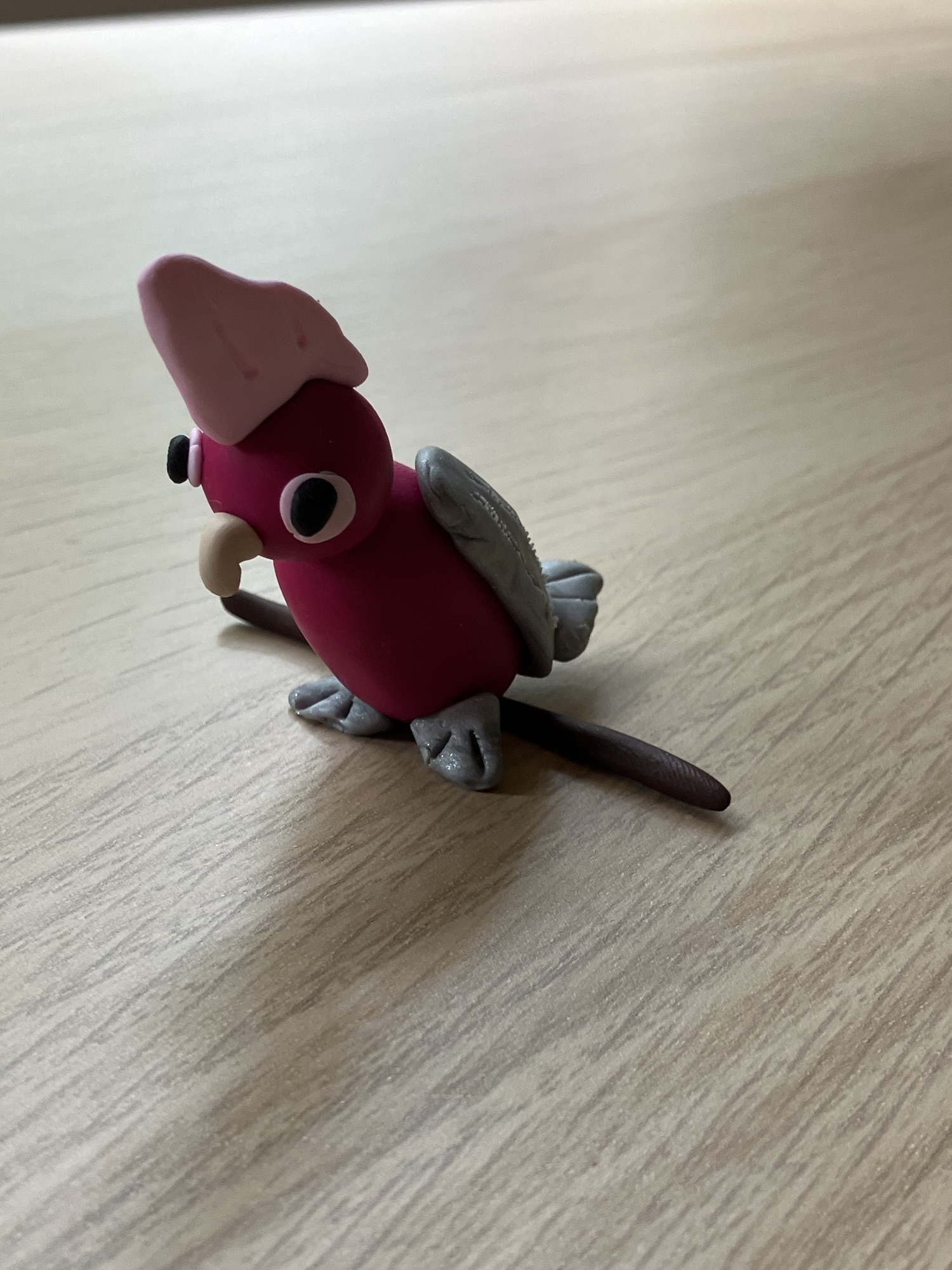
If we were having coffee, I’d share that I did finally work with polymer clay again. I made a parrot for the staff who’s leaving, because this staff has two parrots. We have plans for making her other one out of polymer clay sometime this coming week.

If we were having coffee, lastly I’d share that I’ve been obsessing over recipes and cooking again. Like I said yesterday, I made a curry for myself and my fellow residents on Tuesday. The staff who helped me with it, proposed we do cooking again this coming Tuesday. This time, I chose a pasta bake. I’ve also been making smoothies and overnight oats recently.

I have an app on both my PC and iPhone to organize my recipes. It’s called Recipe Keeper and I’m half convinced it’s spyware like TikTok. Other than that, its only drawback is the fact that somehow I can’t have my password manager remember the password. This has me paranoid too. However, it’s the only app that’s available on both iOS and Windows that is remotely useable for me.

Some Might Say It’s Wrong to Be Angry

Some might say it’s wrong to be angry. I was actually told when I was in fourth grade that I was “angry too quickly”. What my parents and the professionals meant is that my expression of my emotions, whether I was actually feeling angry or not, was wrong given the situation.

That’s not the same. An emotional expression isn’t the same as the emotion that someone is actually feeling.

Besides, I strongly disagree with the idea that emotions can be “right” or “wrong” even given the circumstances. I have always felt that the idea behind dialectical behavior therapy of deciphering whether an emotion you’re feeling is justified in that situation or not, and, if not, acting opposite, is incredibly invalidating.

It’s never wrong to feel angry. Or sad. Or happy for that matter. Yes, it can be wrong to express your emotions in a certain way, such as when you become disproportionately aggressive. Even then, your emotions aren’t wrong. And, at least in my case, the emotion I’m actually feeling isn’t usually anger.

Like, when, last week, I became physically aggressive towards a staff by trying to hit him, I wasn’t angry. I was panicking because the staff was restraining me for the relatively minor offense of trying to grab a small object that he thought I was going to throw to the ground. That assumption may’ve been correct, but that doesn’t mean my feeling of utter panic when grabbed by both arms, was wrong. For what it’s worth, I feel that restraining someone for fear of them damaging an easily replacable object, is out of proportion.

It’s easy to say that people are wrong for being angry, when in reality you can’t know what’s in their minds, so whether they actually feel anger at all. It’s also easy to think that a person trying to throw objects is disturbing the peace for the other people around so you, as a staff member, are justified to do whatever it takes to prevent them. However, just because it’s easy doesn’t mean it’s right.

I’m sharing this post with Missy’s MAD Challenge for this week. The prompt is the phrase “Some might say it’s wrong to…”.

Book Review: Will You Help Me? by Maggie Hartley

Hi everyone. As regular readers of this blog will know, I love memoirs. I particularly love books about fostering and special education. I however hadn’t read such a book in a few months, but last week, I decided to buy Will You Help Me? by foster care memoirist Maggie Hartley. Here’s my review.

Book Description

‘Please help me,’ he said in a small voice. ‘Will you help me?’

Six-year-old Ralph has only been in the care system for three days and has already been rejected by three different foster carers. After hitting a teacher at his school and causing mayhem since he arrived four months ago, staff are unable to get a hold of his mum and her partner.

Social Services are called and when Ralph turns up at Maggie’s house, she knows immediately it’s going to be a challenge. Within a couple of hours, Ralph has trashed Maggie’s house and spit on her face. After a nightmare first day though, Maggie notices that Ralph is limping and a hospital check reveals broken limbs and several injuries that are months and years old. Can Maggie help this troubled little boy who has been rejected by everyone in his life find his forever home?

From Britain’s most-loved foster carer, a new powerful true story of abuse, family and hope.

My Review

Most foster care memoirs I’ve read are on the predictable side and this one isn’t terribly twisty either. However, it’s less predictable than other memoirs I’ve read.

This book also made me feel a rollercoaster of emotions. I could relate to Ralph in some ways and this made me root for him even more than I otherwise would have. The book describes Ralph being restrained (in a cuddly way) several times. This triggered me, because I too have experienced being physically restrained. It was, however, good to feel the feels when it’s someone else being talked about.

This book reminds me of the time I read Who Will Love Me Now?, also by Maggie Hartley, which I (reviewed in 2020. I think I love both books equally.

#WeekendCoffeeShare (March 22, 2025)

Hi everyone. It’s nearly 10PM here. I really wanted to write today but, for reasons I’ll explain in a bit, didn’t get to it. I’m joining #WeekendCoffeeShare. No more drinks for me except maybe some water, but if you’d like to, feel free to grab your favorite beverage.

If we were having coffee, first I’d talk about the weather. It’s been absolutely delightful. Yesterday, the daytime temperature was as high as 22°C and I wore a skirt. I usually don’t wear skirts in colder weather because I don’t like wearing tights. It felt so good to be able to wear a skirt. I also loved the sunshine.

If we were having coffee, then I’d tell you that I got in a lot of walking again over the past week. I really liked being active.

If we were having coffee, next, however, I’d share that I’ve been struggling badly again. I had an unannounced visit from the behavior specialist on Monday. My initial question was whether any progress had been made in involving the Center for Consultation and Expertise on my care. The answer to that was “No” and the behavior specialist didn’t offer any clarity on when she was going to get the ball rolling. My feeling is it’ll be 2034 by the time they get involved.

She did, however, have a lot of new so-called “agreements” (I’d call them executive orders) on my care. She pretty much ignored my input and there’s nothing about the things I said in the bullet points my assigned staff wrote in my records. Some of the new rules include:


  • New staff get only one chance to be oriented to me for each task (activity, morning routine, meal) and then they’re supposed to be “regulars” and can be assigned to me whenever the staff want. If I am not accepting them for their orientation time, it’s a missed opportunity on my part. I didn’t find out about that last bit until today.

  • I can be physically dragged to my room if I’m having a meltdown in the communal areas.

  • Staff will no longer be forced to rotate almost each support moment. Sounds good and it was what I wanted, but now they’re supposed to decide at the end of each moment who will come for my next moment, giving me only half an hour to adjust.

If we were having coffee, I’d tell you that the staff tried to orient three new “regular temp workers” (that’s an oxymoron in my opinion) to me within the next three days. I didn’t accept two of them. One because it was the evening after the meeting with my behavior specialist and a relatively new staff would be orienting her colleague. The other, I never said I wasn’t accepting but I was in a lot of distress and somehow my assigned staff made up that it was because of the new one.

The third one, I accepted without protest for my morning routine even though I later found out staff are supposedly first oriented to an activity. The staff being oriented kept asking me whether I’d explain things to her if she forgot. Well, actually, no, since I’m pretty easily overloaded by lots of questions. “She does pay attention, don’t worry,” the regular staff told me. Well, I do worry.

Unfortunately, I got a lot of negativity in my records for my behavior and yet there wasn’t the slightest acknowledgement of the fact that I’d accepted the third new staff without protest. That feels intensely unfair to me.

If we were having coffee, I’d share that the support coordinator did, for some reason probably only he knows, decide the new “regular temp workers” can’t be assigned to me yet even though by the behavior specialist’s rules, I’ve had my chance with all three. I am grateful for this, although I do understand I’ll need to accept them soon enough. That, hopefully, will go okay.

If we were having coffee, lastly I’d share that I’ve been writing up positives and negatives of the day each day for a few weeks now. Looking over these, it shows that I do appreciate small joys.

For example, there’s a new sensory room on the other side of the home and I’ve been eager to use it. I’ve also donated some stuffed animals and cushions to it.

Friday Feels (September 13, 2024)

Hi everyone. Today I’m participating in Friday Feels. The idea is to answer three questions about the past week and share an F word related to it. The questions are:


  1. What made me happy?
  2. What made me sad?
  3. What made a difference?

F word

My F word for this week is “fall”. Last Saturday, it looked like summer wasn’t going to end anytime soon, since the daytime temperature reached 27°C. From this past Monday on though, the weather’s been considerably chillier and rainier. On Wednesday, the temperature didn’t even get above 14°C. Today is slightly less chilly, but the nights are truly getting colder.

What made me happy?

First, Chinese takeout for dinner on Monday to celebrate a fellow client’s birthday.

Second, a treat of one of my favorite biscuits with my afternoon coffee today.

Third, the fact that I was able to get the WiFi on my iPhone to work properly again here. It turned out that turning off a privacy setting on my phone for this particular network, solved the issue.

Last but certainly not least, swimming! On Wednesday, I heard that two of my fellow residents were going swimming at the institution pool that evening. Usually, about seven or eight residents go and it’s too overwhelming for me, but since there was another activity too, just these two guys were going. I took up the courage to ask my staff whether I could go too. It was amazing!

What made me sad?

I experienced a slight increase in bad memories over the past week. Mostly, they were manageable, which is why I’m not using the word “flashback” to describe them.

What made a difference?

There are several things that made a difference this week. First, the fact that one of my trusted staff returned from vacation this week. Most are still on holiday, so the next few weeks will be somewhat difficult still, but I managed this week.

Second, the weather, like I said, is very different and it made a difference, in that I could sleep under my weighted blanket without sweating excessively. This is important, because until now I thought something might be wrong with me. I guess not.

Third, the new agreement that staff will no longer unlock the door for me when I want to elope and will physically restrain me if necessary to keep me from for instance climbing over the fence. I saw the agreement on Tuesday and, though I still have some questions about it, I am for the most part relieved about it.

A Good Meeting With My Support Coordinator and Behavior Specialist

Hi everyone. I really want to write more about what’s on my mind and, after a few months of struggling, I finally have some good news. I just saw in my private journal in the Day One app that it was a year ago when I heard my moving date to this home. I moved two weeks later. How time flies! After a meeting with the behavior specialist and my support coordinator on Monday, I can safely say that, if the things we agreed on will actually happen, I’m going to have a pretty good life here.

I had requested this meeting a few weeks ago and it was originally scheduled for the 17th of September, but thankfully there was time to do it on Monday. We mostly discussed a document I’d written sometime in early August detailing my care needs (as I see them). Thankfully, most were things the behavior specialist and support coordinator could agree with me on. Here are the things we’ve decided.

1. Less staff switches and more clarity about who will be supporting me during the day. Currently, it’s only clear who will do my two-hour-long activity in the afternoon and the rest is guesswork. I wrote that I can’t help trying to figure out in my head who will be supporting me for which of my eight or so support moments during the day. The support coordinator and behavior specialist came up with a schedule for who will support me when based on what times each staff comes on. This, and all other agreements, won’t take effect until sometime in late October.

Staff will also get designated time to write up their daily notes about me. I also requested staff do a short handover (like, two minutes on how I’m generally doing) when they switch. I can’t remember what was agreed upon about this, but it should be relatively easy with the fact that I’ll have mostly no more than four staff supporting me over the course of the day.

2. My day schedule for weekends will be changed to be the same as my weekday schedule. Currently, there’s a fifteen to thirty-minute time difference, which is confusing. I originally proposed to remove an activity time slot from my one-on-one on weekends, so to make it very different, but that didn’t seem to be a good idea. I honestly mostly said this to stick to my allocated one-on-one hours. After all, the other support coordinator used to be really strict on these.

They’re going to try to get me slightly longer staff support in the evenings. Currently after 7:15PM, I’m supposed to be by myself except for a few two-minute check-ins.

They were also very clear that appointments with the physical therapist, play therapy etc. are not dependent on my day schedule. What I mean is, if they happen to be during a support moment, fine, but if the therapist’s most suitable moment is outside of my one-on-one, that doesn’t mean I’ll need to compensate or go to therapy without staff support. The other support coordinator had been shoving my day schedule into the physical therapist’s face before she could even pull out her calendar, which led me to say that PT isn’t day activities so shouldn’t be during my activity time slot and I’ll go alone if this means no support.

Finally, it was agreed upon that, if I come out of my unsupported time in distress, staff will help me and this does not need to be compensated for (unless it takes so long that staff’s other tasks will suffer).

3. The support coordinator will be advocating for there to be a trusted staff for me at least part of the day most days. The other support coordinator is the home’s planner and he’s been really tough to get along with, so we’ll see where this goes.

The support coordinator did say that she and my assigned staff will try to see me regularly too. I can also ask one of my trusted staff whether I can talk with them (support coordinator or assigned staff) about something.

4. I asked for recognition of how far I’ve come over the years with respect to for instance accepting temp workers, accepting unexpected staff changes, etc. This was quite a hard one to explain, but it eventually made sense.

5. I asked to no longer be let out the door when in distress. I agreed to be physically restrained and led to my room if necessary too. This is going to take effect sometime next week, since I felt really let down when the staff opened the door for me.

I later realized that this is really already in my crisis plan, but it contradicts the support agreement that I’m free to leave the home as I please and as such staff unlock the door when I want to leave. How this will all be put down on paper, is not fully clear with me, but I’m confident it will work out.

Overall, I’m really pleased with the outcome of this meeting. The only problem I can foresee is the other support coordinator, who is really coordinator for my side of the home, discarding everything as unworkable.

It’s Just Us, Or Is It?: Power Dynamics in Care

I am currently reading a book called The Dark Side of the Mind by Kerry Daynes, a memoir by a female forensic psychologist in the UK. In her first chapter, Daynes writes about how her college date tells her there’s no justice, it’s just us. Then she goes on to talk about her first job, which is really an unpaid position, at a correctional facility called Wakefield. There, the philosophy is “us vs. them”, “us” being the “good” guys (or girls), ie. the staff, and “them” the inmates, who often committed horrific crimes, such as rape, murder or both. This “us vs. them” mentality was often used to reinforce a rather exaggerated power dynamic, to say the least. As it turns out, it’s not that black-or-white, in that, several years later, a staff member Daynes worked with was given a long sentence for similar horrific crimes.

I want to use this example to talk about power dynamics. Not in the prison system, as I have no experience with that, but in the care system. In a sense, in care, at least as much so as in prison, there should not be “us” and “them”, since we’re all people first. The mere fact that I am disabled and my staff are currently non-disabled, shouldn’t make a difference. Neither should it when it comes to my fellow residents who are deemed unable to make their own decisions.

I just had a discussion with one of my staff about this. This person maintains that she’s in fact at my service, almost like I’m her employer. When I pointed out that she gets to decide when it’s necessary to physically drag me to my room (not that she personally ever has), she said this is because I live with nine other people. Yes, but if I lived with nine other people without staff, such as in student accommodation, no-one would be dragging me to my room for yelling and, if the situation did escalate too much, the police (who everyone except for maybe the police themself admits have a position of power) would be called.

I also mentioned some situations from the intensive support home. For example, staff grabbing a large cookie while giving us a tiny biscuit. “Who’s boss here?” one of the staff once actually asked one of my similarly opinionated but unfortunately less eloquent fellow residents. She named the names of the support coordinators. “And when they’re not here?”, he continued, clearly wanting to hear that the available staff are. I pointed out later that no-one is boss here, only to be told that this was a simplified way of explaining this to my fellow client.

When I told my current staff about this and other examples, I was told this is the way the intensive support home works and that she doesn’t agree with it. At the same time, she told me that, if I want a large cookie, I can get it because I’m capable of making my own decisions, while my fellow residents can’t. While I understand this, on a large scale, may be so, it isn’t necessarily true: I don’t technically follow my agreed-upon food plan either and that’s considered my responsibility, while if a fellow client points to a single extra cookie, that’s denied because their family (or the staff) agreed on a food plan. However, if I have an extra cookie, it will do the same for me as it will for another person (unless said cookie has allergens in it for the other person or whatever). I wanted to raise awareness of how, on a micro level, staff, including the staff who believe they’re at our service, are exercising their power more than they should be.

Power dynamics, for clarity’s sake, cannot easily be eradicated. Nor am I absolutely sure they should be. However, those in positions of power should be extra conscious of their position. And especially when it comes to situations in which they believe they have every rhight to make decisions for another person, such as when I got dragged to my room and when the staff decide another resident cannot have a large cookie (but said staff and I can).

Opening Up About My Trauma

Last Monday, I was going for a walk with my one-on-one for the moment when we saw a few clients and staff she knew (she’s a temp worker). She wanted to “say a quick hi”. That turned into a fifteen-minute conversation between her and one of the other staff, which eventually turned to clients with severe challenging behavior being taken on outings off grounds and then, when they act out, staff being filmed by bystanders when restraining the client. This discussion triggered me, because it led to flashbacks of the times I’ve been “guided” (as staff call it) to my room. More like physically moved by several staff at a time, and the fact that I wasn’t officially restrained (because that probably only counts when you’re pinned down to the ground), is solely due to my lack of physical strength.

I asked the staff, admittedly more curtly than I should have, to not have these discussions in my presence in the future, as it was triggering me. She told me I was making it all about me and if I wanted to offer an opinion I should’ve made sure I listened to the whole thing because now I was twisting the truth. I told her about the time I was shoved to my room and staff threatened to lock me up in there. “You probably deserved it,” was her response.

This led to a whole chain reaction of triggers, in which I started to doubt the validity of my trauma-related symptoms. Didn’t I deserve the harsh punishments my parents gave me? I know at least back in my day an “educational spanking” was legal. In some U.S. states, child abuse isn’t even child abuse if it’s used as punishment.

I can’t go into the details of the punishments I endured as a child, and I’m pretty sure they’re not necessarily illegal. Does that mean they can’t have caused me PTSD?

That evening though, I was having intense flashbacks and decided to open up to my staff for that moment. She happened to be one of the staff who’d shoved me to my room on Friday and threatened to lock me in there. I had to admit – even though I don’t believe it – that I deserved to be physically moved to my room. I mean, the reason was my dropping the F-bomb while in the communal room (and then refusing to go to my room on my own when told to), which, well, truthfully staff do all the time.

After I’d given examples of the way my parents treated me, my staff seemed quite shocked. I honestly don’t understand this, as she restrains clients everyday and never even cares about the impact this has on them. I mean, I know, staff restraining clients is legal, but then again does something have to be illegal to be traumatic? And if so, where’s the boundary between an “educational spanking” and child abuse? Or does it have to be unwarranted? In that case, I must say, my parents acted out of a need to show who’s boss because they’d felt powerless over my behavior. I did, indeed, try to excuse my parents’ actions by explaining about my own behavior. The staff didn’t seem impressed.

I know, in my heart, that the truth is that restraints can and do traumatize clients too. I know I experienced trauma while in the psychiatric hospital because of being locked up in seclusion against my will. I know I still experience emotional trauma. And, of course, I’m more sensitive to this due to the trauma I endured as a child. But it isn’t black-or-white. And this is confusing.

Restraints and Other Restrictive Measures in the Dutch Care System #AtoZChallenge

Hi everyone. Today, it’s time for my letter R post in the #AtoZChallenge. I didn’t know what to write about for this post, so I looked at some books for inspiration. Then, the topic of restraints came up. This is quite a controversial one and sadly restraint and other restrictive measures are still commonly used here in the Netherlands. At least here at my current care home.

In the Netherlands, in 2020, the Care and Force Act replaced the law on exceptional admissions to psychiatric hospitals that previously regulated restrictive measures. Under the old law, only those involuntarily committed to care facilities or psychiatric hospitals could be subjected to restrictive measures against their will. This was not to say people weren’t pressured into consenting to restrictive measures. For instance, when I had been at the locked psych unit for a few months in early 2008, I was significantly dysregulated. My doctor told me she was implementing seclusion and, “if it doesn’t work, we’re going to file for involuntary commitment”. She should have said “if you don’t consent”, but I had no idea I even had a right to consent.

Under the Care and Force Act, anyone receiving care can be subjected to restrictive measures, which are euphemistically and rather incorrectly called “involuntary care”. Yes, even people receiving care in their own homes. And like I said “involuntary care” usually isn’t care at all, but are measures to restrict someone’s freedom, often in the absence of appropriate care. For instance, if a person with dementia lives independently, they can be involuntarily prevented from entering their own kitchen if they’re a risk of leaving appliances on.

I don’t know the exact criteria for people to be subjected to restrictive measures. It has to do something with risk of significant detriment to the client or others. I was, at my old home, subjected to some restrictive measures. For instance, several doors were locked at night because I would enter those areas (eg. the kitchen) and be a danger to myself there. Here at my current home, the door to the living room and all entrances are locked at night anyway and have been from before I came here. I do know at least one fellow resident is locked up in her room at night. This, to me, feels a bit unfair, particularly because there’s no night staff directly available and the ones in the main building usually just tell us to go back to sleep when we press the call button.

Restraint specifically – restricting someone’s physical movement – is also commonly used here. I, thankfully, have only been physically dragged by several people a few times and was never shoved to the ground or forcibly held in position.

The author of the book I read, which is a parent’s guide to autism, recommends not reacting to a disabled person’s meltdown at all unless in such a way absolutely necessary to keep them and others safe. I am not sure I agree, since honestly I don’t feel that many people with developmental disabilities do have the self-regulation skills necessary to calm themselves. In my experience, “crying it out” will not teach them those skills, but will teach them that you’re not available. In the same way, I honestly don’t feel that someone will actually have a meltdown just so they can be restrained, as the author claims. I, honestly, have never felt that having my movement restricted was comforting.