Pandemic Positives

Today, Fandango asks in his weekly provocative question wehther the need to quarantine as a result of COVID-19 has made you a better person.

Lockdown here started in the middle of March with restaurants acutely closing their doors, school closures and, a week later, a no-visitors policy in nursing homes and care facilities. I couldn’t see my husband for nearly three months. Then we could see each other, but we had to keep our distance as much as possible.

Life more or less returned to some sembleance of normal at the end of June. Still, people are scared. I, not so much, though I do take COVID-19 seriously. There are still certain restrictions, most of which don’t affect me too much.

The main thing affecting me was not being able to see my husband. This certainly made me appreciate our very special relationship even more than I appreciated it already. I mean, I chose to go into long-term care last year, of course not knowing that this would mean not seeing my husband for a few months. However, I doubt most marriages would survive even that decision, let alone the consequences. I attribute the success of our marriage mostly to my husband’s everlasting love, but I do deserve some credit for it too.

In general, too, the pandemic has made me more appreciative of what I do have. I am physically healthy and so are my loved ones. In April, a man at the home below me died of coronavirus. Though he was in his 70s, this shocked me a little. My father is in his 70s too, so I’m all the more grateful to still have him.

Other than gratitude, I think the pandemic taught me some level of creativity. Before the lockdown, I found it hard to connect to my husband when I didn’t see him. Now we call each other multiple times a week and text multiple times a day. Of course, I could’ve done that before too, but out of need grew the solution.

I also read somewhere that some people are particularly happier now than they were before the pandemic. I have to say so am I. The reasons may not be related to the pandemic at all, as I’ve also finally settled into the care facility and such.

In general though, I think the pandemic has had and continues to have negative effects on the world, of course. However, if it affected me personally at all, it’s positively. By this I don’t mean my economic, social or health status, of course. Though I’m still financially secure and healthy, no-one knows whether this will remain this way given the huge economic costs of the pandemic. I’ve just become a more positive (or should I say less negative?) person.

Home Sweet Home

This week, Eugi’s weekly prompt is “Home sweet home”. I’ve never participated in this prompt before, but I thought I’d now.

Two weeks from now, I’ll be living in the care facility one year. It feels closer to home than any of the homes and facilities I’ve lived in before did. That feels weird. My parents’ house felt like home, but that’s just because I knew nothing else. My parents felt as safe as possible, but again that was because I knew nothing else.

Then I went into the training home. That was temporary, as you were supposed to live there for at most two years while training for independent living. That’s what I did eighteen months later. I cried my eyes out the first day, in front of my mother, who got angry with me.

It felt horrible to know that this was it forever. I mean, for at least the duration of my university studies, so four years, I’d live there. Then I’d live in a rented house on my own. It completely overwhelmed me.

As regular readers know, it didn’t last. Three months in, I landed in a mental crisis and was hospitalized. Though I stayed in the psych hospital for 9 1/2 years total and for over four years on one ward, it never felt like home. I knew it was temporary, after all.

And then I got kicked out. I lived with my husband in our rented house in the tiny village for 2 1/2 years. Even though I got by okay, it never felt good.

And now I’m here. I got that overwhelming feeling that this is it forever in the first weeks too, but this time, it was good.

I struggle to believe that this is not yet another temporary living arrangement or one in which I cannot cope. I act in and out a lot, probably to somehow “prove” that I’m not suited to this home. That I’m not suited to any home in the world. That there is no home sweet home for me.

Yet my staff so far say that I can stay here for the rest of my life. That, too, feels kind of overwhelming, but like I said, in a good way.

I also of course have my and my husband’s home in Lobith. That one still feels a bit odd to me. I never really lived in it, since we bought it two days after I moved into the care facility. In fact, I struggle to consider it my house too. When I write about it, I often write that it’s my husband’s house, then correct myself and add “and my”. I want to keep a connection to that house too, but it doesn’t feel like home.

COVID-19 Reality Check: It’s Still Not Over

So like I said earlier today, I had a low-grade fever yesterday. I didn’t think much of it. I guess the reality that COVID-19 is far from over yet, hasn’t hit home yet. My husband was immediately worried. I may’ve worried him too much by my wording. I mean, there’s a word for a low-grade fever that I should have used, but I said I had a slight fever instead.

I asked my husband whether he could come tomorrow, now that I no longer have a fever. He said no way and got a little annoyed with me for even raising the issue again. He said if I do have COVID-19 and infect him and then his father, my father-in-law could die. Or if I do develop symptoms again when at my husband’s and my house in Lobith, I won’t be allowed to come back to the care facility. I understand, but it’s hard.

At the beginning of the COVID-19 pandemic having hit the Netherlands, I was somewhat optimistic about its progress. I mean, I predicted that, by September 2020, vacations would still be discouraged but the virus would pretty much have left anyway. It hasn’t.

Then in mid-May, life more or less went back to normal within the care facility for me. At the end of June, the restrictions on visitors were practically lifted altogether. I mean, I’m supposed to call the facility after having been in Lobith to make sure I’m still symptom-free and so is the care home, but I don’t.

In early August, my mother-in-law came by and we went to sit outside of a restaurant for a cup of coffee. No-one asked for our contact details or checked that we met the 1.5m distance requirement. I later heard the rules were made stricter again at the end of that week, but I still am not seeing much of a difference.

My care facility went mostly back to normal over the summer. I mean, the home a floor below me got infected with COVID-19 in late March. After that, staff were not allowed to work on multiple units and the night staff were to keep their distance as much as possible. After all other homes stayed clear, staff are now allowed to work on multiple units again, even in the same day. Staff, except for the night staff, never stopped hugging clients or holding their hand. Some staff wear face masks some of the time. Most don’t.

My husband commented earlier this evening on terraces being packed full of people in Elten, Lobith’s neighboring town across the German border. He sarcasttically wondered whether they had the vaccine already. They don’t.

My husband is scared. He may be more cautious than most, or at least than me. That’s a good thing though. He wants to protect himself and his loved ones. I understand.

Meanwhile, I want to go back to normal – the old normal. I saw a writing prompts book on coronavirus today in Apple books and decided to get it, even though in my mind, COVID-19 was in March, not September. Yet it is.

Mama’s Losin’ It

PoCoLo

My Daily Routine (Or Lack Thereof)

And still it’s incredibly hot here! It did start to rain last night, but it’s not cooled down much in my room. It’s already past 9PM here and I don’t feel like writing. Or doing anything else. But I bet I cannot sleep either. Therefore, I blog.

Today’s #FDDA prompt is “your daily routine”. My daily what, I ask?

Unlike many other autistics, I am not one for clear routines. In the mental hospital, I would just lie around and do whatever, just like I see many people do now during the COVID-19 lockdown. I didn’t have a set time I’d go to bed or get up. I didn’t have a daily personal hygiene routine, as I hated most personal care tasks and there was no-one to say I needed to do them. Well, there was the staff, of course, but it was their view that I was responsible enough to decide these things for myself.

Once I lived with my husband, I did go to a day center each weekday morning. This meant I did have to get up at the same time each day. I did have an okay morning routine back then, as my husband had instilled the importance of personal care into me.

Then I went into long-term care. Pre-COVID, I still had somewhat of a routine, as I was expected to go to the day center each weekday (except for every other Friday). I tried to maintain such a routine when the day center closed, but I cannot seem to really.

Still, I have some set activities I do each day. I go for a walk in the morning and one in the afternoon too. We also have coffee, lunch and dinner at the same time each day. Now that it’s hot though, I don’t go for walks and often skip coffee break too.

These last few weeks, the days have truly been merging into each other like time didn’t really matter. I do still try to blog most days, usually around the same time.

Sometimes, I wish I had more of a strict daily routine. That’s not really possible though and I’m not sure it’s really what would be best for me.

What about you? Do you thrive on routine?

#WeekendCoffeeShare (July 26, 2020)

Hi all on this summerly late Sunday evening – or should I say early night, as it’s actually past my bedtime right now? I’m still wide awake though, so thought I’d join in with #WeekendCoffeeShare. It’s too late for me to grab a coffee, but if you’d like one, I can make you one.

If we were having coffee, I would share that we were supposed to get heavy rain here today. We got some light rain in the morning and did get rain at night, but overall, it’s been a pretty rain-free day. I got to take an evening walk at 9PM. That suited the staff, as most other clients are in bed by then.

If we were having coffee, of course I’d share that I got approved for a higher care profile last Thursday. This means that the facility gets more money for me and they might be able to get some extra staff hours in. I found the letter detailing the decision in my government inbox on Friday. It was a bit hard to read how challenging my behavior really is. This care profile is called “living with very intensive support and very intensive care” and is the highest care profile for people with visual impairment.

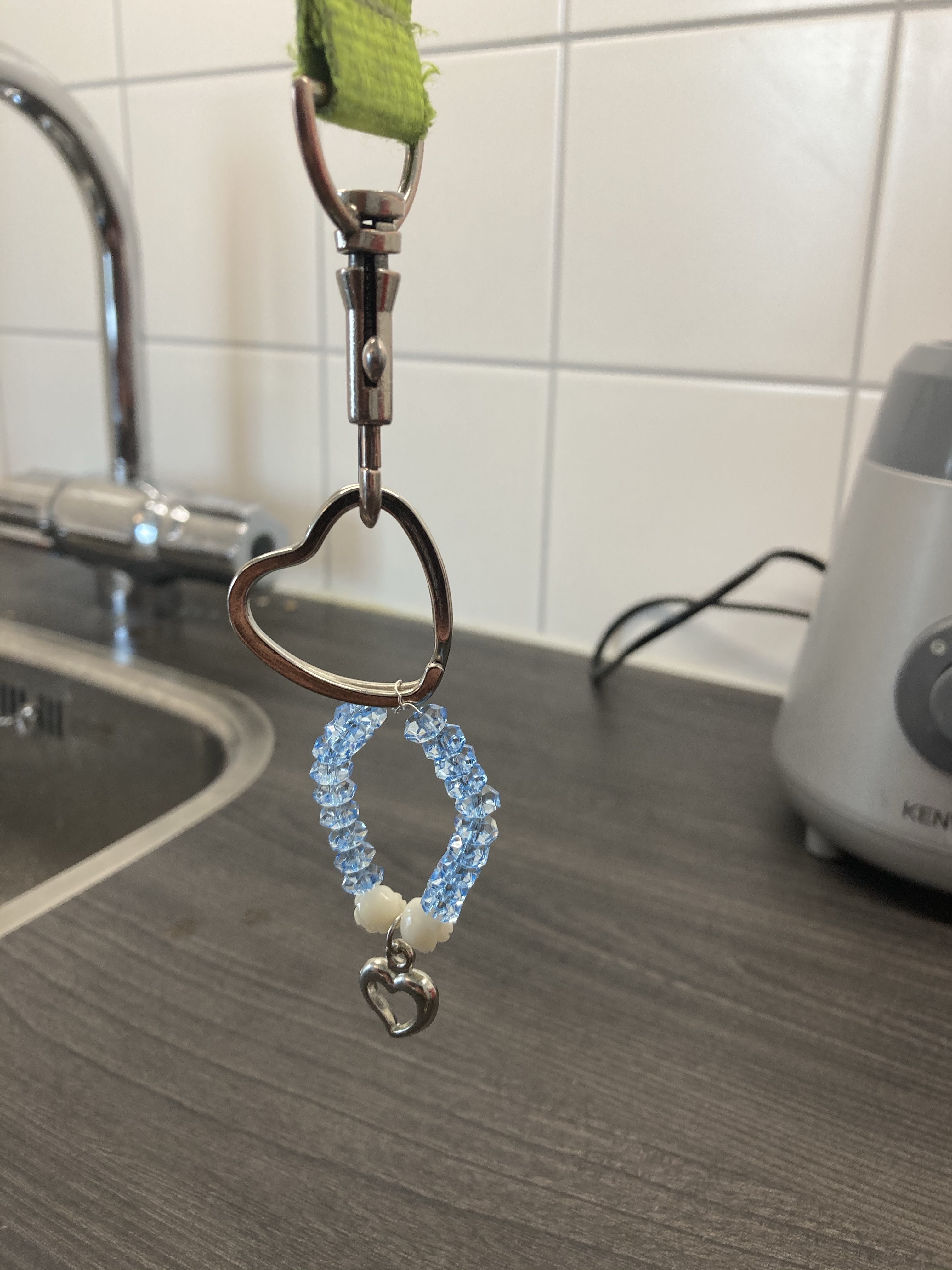
If we were having coffee, I would tell you I made another keychain, this one for my husband. I like this one more than I do the one I did for my sister-in-law. My staff got the heart-shaped keyrings at a budget store.

If we were having coffee, I would tell you that after Tuesday’s appt with my nurse practitioner, I’ve been feeling at the same time more out of sorts and more feisty than ever. I do know there’s a great risk that, if I get assessed for trauma-related symptoms, the assessor will deny I have them because I’m too open about my trauma. However, a lot of people in dissociative disorder groups have been validating my experience. Of course, I’ll need a diagnosis of at least (C-)PTSD to get treatment and the prejudices among professionals suck in this respect. However, I’m feeling more and more that I may’ve found a community I belong to and find that I can access support from them.

If we were having coffee, I would tell you that I’m feeling similarly about my body and food. I mean, I at once feel very disorganized and disordered, and at the same time I’m trying to do something about it. Not that it’s any more than just trying at this point. I mean, I just noticed how my jeans fit a little better around my waistline, and that’s not a good thing, as they were rather loose. This upsets me, but it’s quite a challenge getting all of me to agree on how to change it.

If we were having coffee, lastly I would share that this week-end wasn’t quite the healthy food week-end. On Friday, we had French fries and snacks and ice cream for dessert. I also ate a whole bag of sweet liquorice between Thursday and Saturday. That though is a win, in that I’d normally have eaten it all in one sitting. I guess I’ll need to dialogue with myselves to get us on the same page re healthier living.

How have you been?

Something I Struggle With

A few weeks ago, Marquessa over at The Next Chapter started a writing challenge to get herself motivated to write everyday. Yesterday, I saw that Cyranny had joined in. Cyranny started with the first prompt. That one didn’t appeal to me, so I will go to the second. It is to share something you struggle with.

Regular readers may be able to guess what I’m going to share. It wasn’t the first thing that came to mind, but I got inspired by Marquessa’s post. She shared that she struggles with being called “pretty”. She then goes on to say that brains matter more to her than beauty. Well, I wouldn’t exactly say I’m the opposite, but I do struggle with being called “intelligent”.

As a child, I was often called intelligent. My parents loved bragging about my so-called genius. After I had an IQ test at age twelve, this became even worse. The IQ test, though not the first one administered to me, was the first one about which the assessor actually told my parents the exact IQ outcome. My performance IQ can’t be measured because I’m blind, but my verbal IQ was identified as being 154 on the Wechsler scale. This means I was supposedly within the highly gifted range.

As a preteen and early teen, I didn’t mind my parents bragging about this three-digit number as much. I was proud that, according to my mother, I had the same IQ as my father. Now the only time my father had an IQ test administered, he at least told me that was in the pub with a psychologist friend and he was rather drunk. I’m assuming his real IQ may be higher.

As I grew older though, my apparent high IQ more and more stood in the way of my being myself. It was frequently used by my parents and professionals to “prove” that I should be capable of solving my own problems in social situations. This got me interested in the concept of giftedness as asynchronous development. Later, I was diagnosed with autism. Still, my parents reasoned that I was just extremely intelligent.

The reason I struggle greatly with being called “intelligent” is the assumption that I am smart enough to solve non-intellectual problems. This may be so in most gifted people – I think I remember recent research disproves the theory of asynchronous development -, but it isn’t the case for me. Like I mentioned a few weeks ago, my emotional level is equivalent to someone approximately 18 months of age.

Last year, my IQ was used against me to deny me long-term care. I mean, due to my multiple disabilities and low emotional functioning level, I do best in a care setting normally catering towards severely intellectually disabled people. Because of my IQ though, I can’t get funding based on developmental disability. I am lucky that I’m blind in this respect, because I ultimately did get funding based on that.

Contrary to Marquessa, I do not struggle with compliments about my intelligence because I don’t agree with them. I mean, the IQ test I took at age twelve is rather outdated now and I scored much lower when I took another one in 2017. However, I still know I’m indeed intelligent. That being said, that’s not all I am. In the future, I’d like to be able to take pride in my intellectual abilities without them triggering the fear that I’ll need to be good at other things too.

Thankful Thursday (July 23, 2020): My Care Team

Hi everyone! How are you all doing on this warm Thursday evening? I’m doing a lot better than I was earlier this week. I could actually do an early gratitude list, as there’s more than one thing I’m grateful for. A simple list wouldn’t do justice to how huge these gratefuls are though. Let me share. I’m joining in with Thankful Thursday.

First, I still need to update you all on my appt with my nurse practitioner and CPN on Tuesday. It went better than I expected. The outcome is that my nurse practitioner is going to talk to the psychiatrist and see if he can find us a psychologist to do trauma therapy and work on our emotion regulation issues. I don’t remember all the details of the meeting, but at one point, I/someone in me blurted out that we’re in Facebook groups for dissociative disorders. I quickly added that really that’s none of my nurse practitioner’s business, but still we feel a lot of shame surrounding this.

Then on Tuesday evening, a discussion erupted on Twitter about the ISST-D’s guidelines for diagnosing and treating people with dissociative disorders. There’s this article from 2001 that’s still being used to weed out alleged fakers. It uses such things as being open about your DID or trauma to people other than a few close confidants, showing no obvious shame when talking about your trauma, being in support groups for DID, etc., as apparent proof that you’re fake. Now I must say I’m still conflicted about going the actual trauma/DID assessment route, but this did trigger us. However, my support staff are on my side.

We were still recovering from the shame about all this when we heard the main good news I was planning to share here. I got a higher care profile allocated to me by the long-term care funding authority. I still can’t quite believe it, but I’m so happy. The application hadn’t gone out till last week, but this afternoon, my staff got a call that it’d been approved. I’m still waiting on the letter in my government inbox confirming it, but this is really good news. I now have the highest care profile for blind people in the long-term care system.

I was feeling a bit disconnected when I heard the news. Like I said, I still can’t quite believe it, but it’s such amazing news. I’m so glad my staff were so perseverant that they actually applied for this.

Looking forward to hearing what you all are grateful for today.

Yet Another Night-Time Crisis

Honestly, I don’t know why I want to share this. It’s late Monday evening here and I’m feeling okay’ish. Tomorrow, I’ll have another meeting with my CPN and nurse practitioner to discuss my treatment. This got us worrying a lot last night, so much so that we ended up in crisis.

As I probably said a few weeks ago, my nurse practitioner wants me to try acceptance and commitment therapy. This wasn’t what we’d expected at all and honestly I still don’t understand how he thinks it’s a good fit for my issues. I mean, it’s evidence-based for depression, anxiety and OCD, none of which we deal with to a significant degree.

He was also pretty dismissive of my trauma-related symptoms. Obviously he doesn’t believe we’re plural. Fine by me, though not by some of the others. But somehhow he seemed not to believe I suffer with any type of trauma-related condition at all. At least, he didn’t feel that trauma treatment could or should help us.

This got us worrying last night, as we really have no idea how to advocate for ourself without coming across like a malingerer. It got so bad that we ended up impulsively leaving our room.

After our last case of elopement, the staff decided to lock the door to our home, so I couldn’t go outside. The night staff though hadn’t come to my room to check on me yet. It was 11:10PM. The night shift normally starts at 10:30. Eventually, a substitute night staff came by, saying he had to do one-on-one with another client, that the real night staff was delayed and he was really busy so could I please go back to my room? That upset us greatly, so even though we went back to our room as requested, some of us started self-harming.

About twenty minutes later, the real night staff came to check on us. We were upset, so told her to leave. She left and we cried and self-harmed some more because we were still very upset. Our signaling plan says staff are to stay with us if we’re upset even if we tell them to leave, but I don’t know whether the night staff have access to this plan.

Finally, we left our room again and waited, still panicked, for the night staff to be alerted and to come check on us. She was distraught at seeing us so upset. It makes me feel shame and guilt for making her feel this way. She got us a PRN lorazepam, which calmed us slightly. Still, we didn’t sleep till 2AM.

Now I’m feeling okay again, but I’m still not sure what to do with tomorrow’s appt. I mean, after each crisis, my mental health team say I somehow managed to get out of it. They probably mean it as a compliment, but it doesn’t feel that way. Today, I didn’t even care to call the mental health team. I’m still shifting between wanting to give up mental health treatment altogether and demanding trauma therapy. After all, the reason the appt upset me so much is that it triggered my feelings of being unseen, unheard, unsupported. Then again, maybe we’re not worth being seen, heard or supported.

A Year Ago

One of Mama Kat’s writing prompts for this week is to look back at a year ago. Where were you then? What has changed and what hasn’t? Let me share.

A year ago yesterday, I had my intake interview and tour of the care facility in Raalte. We visited the sensory day activities group and snoezelen® room, as well as the home selected for me. At the home at the time was a respite placement for a man I knew from the day center I went to at the time. He greeted me excitedly: “Astrid!” He then went on to babble “respite fun”, “Mommy and Daddy vacation”, etc. I was shown around two rooms, one this man’s room at the time and one another client’s room. I think that client got moved to another room when I came and I now have his room.

Even though I had been invited on a tour of the facility, I didn’t know for at least another month that I had actually been accepted. The reason was that the staff all had to agree they could provide me adequate support and care, given that my needs are in some ways very different from the other clients’. They, after all, all have severe to profound intellectual disability.

Now, a year on, I’m settled nicely into the care facility. I didn’t get to attend day activities at the group they’d shown me. Now though, and for at least another two months, we get day activities at the home.

I think also around a year ago today, my husband had first seen the house in Lobith we ended up buying. I ended up moving to the care facility in the same week we got the keys to our new house. As such, a year ago today, I still lived in the tiny village rental house with my husband.

As I look back, I keep praising God that this whole COVID-19 thing didn’t happen last year. Even though the day center I attended at the time is slowly opening its doors again, community support is still mostly phone-based. I am forever grateful I got my long-term care funding approved last year.

In other news, the weather is drastically different now from last year. Last year, all weather records were broken with temperatures rising to 40°C. Now we’re lucky to reach 20°C and have a few hours of no rain each day.

How is your life different now from last year?

Mama’s Losin’ It

Adult Separation Anxiety

One of the consultant’s comments in my emotional development assessment was that I have a lot of separation anxiety. The rest of my care plan is also full of how I’m afraid to be alone. A little over three years ago, my psychologist at the psych hospital said basically the same by diagnosing me with dependent personality disorder (DPD). Then, I vehemently disagreed. It wasn’t just out of anxiety that I needed lots of care, after all.

Another reason I was in denial of my separation anxiety/DPD, is the judgmental way in which my psychologist approached the matter. She felt I just needed a good kick in the behind and for this reason discharged me from the mental hospital almost with no after care.

Of course, that’s not the way to treat dependent personality disorder. Besides, one of the main features of DPD is not physical dependence, but unquestioning compliance, which I certainly don’t display. I don’t lack assertiveness at all.

I want to clarify here that, at least in my case, I’m not unwilling to be alone. I’m alone right now as I type this blog post. When I’m mentally well, I can be quite happy being alone, as long as I know there’s someone available if I need them.

It’s all too easy to judge people with adult separation anxiety disorder or DPD. Usually though, it’s much more helpful to approach them from an emotional development angle than from a character flaw angle. I again at least don’t want to ask for attention all the time. The things that I get help with from my staff, even though I can sometimes do them myself, I don’t ask for help with because I’m just lazy. In fact, it’s often easier to do some self-care tasks quickly by myself than to ask for help, but then the tasks don’t get done thoroughly.

I have for the majority of my life figured out how to care for myself alone. That’s because, despite all the independence training I got, no-one started with the very basics. Besides, like I said yesterday, I don’t usually distinguish between feelings of hunger, pain, etc. Isn’t it a bit odd then that you’d expect me to remember to do the day’s self-care tasks (which are many!) and actually do them all by myself?

I am so glad my current care facility isn’t as judgemental as my former psychologist was. My current staff don’t assume unwillingness, like she did. We may not find out soon yet what will turn out to have been the best approach. It will also probably depend on what measure of success you use for the outcome: independence, mental wellbeing, cost-effectiveness, etc.