If You Aren’t Prepared For an Imperfect Child…

Yesterday someone on Reddit’s Childfree sub asked why many parents-to-be have this idea that they’ll get the perfect child. You might say that having dreams for your unborn child is normal, and it is. Having this clear-cut image of what your child will (that is, should) achieve in life, is not.

Of course, there are thankfully many parents who are able to adjust their image of their child if (or rather, when) said child does not conform to their initial expectations. My parents, unfortunately, are not among them.

Like I’ve probably shared on this blog before, when I was a baby and sustained a brain bleed due to premature birth, my parents were concerned for my quality of life. This is more or less normal, although it wasn’t back in the ’80s. In fact, the doctor flat out told my parents not to interfere, since they were keeping me alive period. I am forever grateful for this, despite the fact that the same doctor admitted in 2004 that he sometimes meets former preemies he’d been keeping alive that he now thinks of: “What have we done?!”

At that time, I thought he would not mean me. I was still passing for “just blind” and, though blindness is considered a major disability, it’s one that by itself does not prevent someone from living independently and going to university.

That was the exact same reason my father, when talking about euthanasia of severely disabled babies in 2006, didn’t mean me. He did, however, mean those with intellectual disability and those with severe mobility impairments (the case at hand involved a baby with severe spina bifida). And I’ll never forget that he added to his statement that he didn’t mean me, “because you’re training to live independently and go to university”. As you all know, that didn’t work out.

My parents did find a workaround to the problem of my not being the perfect child they’d envisioned: they decided that my landing in the mental health system and now in a care home for those with intellectual disability, is my choice rather than a necessity. I haven’t fully processed all the ways in which this attitude, which some of my care professionals took over, has impacted me. It hurts though.

Now back to the idea of a perfect child. Even when disability isn’t involved, a child is their own unique individual, with their own strengths, weaknesses, wants and needs. When a parent decides that their child should go to university at eighteen even though they are still in Kindergarten, like my parents did, that doesn’t just impact a disabled child. It impacts any child for whom for whatever reason university isn’t the best place to go at eighteen. Such as, for instance, any child with an average or even slightly above-average IQ. Or any child that is more capable of practical jobs than of academic ones. And any child who, God forbid, doesn’t want to go to university.

If you aren’t ready for a disabled child, a child who isn’t a top achiever, a child who might I say has their own personality, by all means don’t become a parent. You don’t know what your child will be like, after all. Having dreams is alright, but be ready to adjust your image of your child when the need arises. And for goodness’ sake, don’t guilt trip your child for being themselves.

I’m linking this post up with this week’s #WWWhimsy.

Parenting Advice From a Childfree Survivor of Childhood Trauma

Hi everyone. Today’s RagTag Daily Prompt is “parenting”. Since I’m currently recovering from meeting my parents for my birthday, I’m going to make a list of parenting advice my parents should’ve received. I realize their inability to love me unconditionally wasn’t unwillingness. In fact, the fear that I may have this same inability is one reason I’m childfree. This post is a random list and may come across a bit harsh, but so be it.

1. A family is not a business. It doesn’t have to be run efficiently. Yes, I understand you get impatient with your child’s struggles at times, but this isn’t their problem – it’s yours.

I was constantly shamed for needing too much help and my parents gave up on teaching me basic skills of daily living because I got frustrated and the task didn’t get done efficiently.

2. Challenging behavior does not make the child (especially young child) bad or manipulative. Behavior is communication, yes, but to search for hidden motives behind it, is actually quite arrogant.

I was told by my parents that, by age seven, I had come up with some idea to manipulate everyone into thinking I was different in all kinds of other ways besides blind because I didn’t accept my blindness. News flash: I am those other things.

3. Children are incredibly loyal to authority figures, be it their parents, teachers, or others. When you fight the school or healthcare system over something rather than trying to be cooperative, the child will experience a conflict of loyalty. This means that, just because they side with you eventually, it isn’t necessarily in their best interest.

My parents were constantly fighting the school over my needs, because the school denied my intelligence. Then again, my parents minimized my emotional difficulties. When an educational psychologist who saw both my intelligence and my emotional issues, nonetheless advised special education for me, my parents still weren’t happy even though they’d chosen this ed psych, because they were dead set on me being mainstreamed.

4. Your child is not an extension of your ego. For this reason, they do not have to follow an educational or career path you like. It isn’t their job to make up for your lost dreams.

See also above. From the time I was a young child on, it was clear that, by age eighteen, I’d live on my own and go to university. Interestingly, neither of my parents have a college degree and particularly my mother feels “dumb” for it even though she worked herself up to a management position that usually requires a college degree.

5. Your child doesn’t need to prove their value. They do not need to prove they were “worth raising” by being anything, be it independent, successful, or whatever. If you don’t want a disabled child, a child of a certain gender, or whatever, you shouldn’t have a child.

I have probably said this before, but my parents, particularly my father, seriously think that a child needs to prove they were worth raising by being successful in life as an adult. He didn’t mean me when he said this, “because you’re training for independent living”. Well, now that I’m in an institution with seven hours of one-on-one a day, he obviously does mean me, since the few times I’ve seen him since he’s barely acknowledged me.

6. Love your child unconditionally. This does not mean agreeing with every single decision they make, but it does mean being there for them when they need you. And this doesn’t end when they turn 21. With a few exceptions (an adult child becoming a criminal, for example), parenting is a lifelong commitment.

I am linking this post up with #WWWhimsy as well.

The Downside of Praise

As a child, I was often praised excessively for my achievements. I remember one day, when I did calendar calculation at a family get-together, calculating what day of the week May 3, 1327 (for example), was, my mother exclaimed: “She’s sublime, she’s a genius!” For those who don’t know, many autistic or otherwise developmentally disabled people, including those with lower measured IQs, have this skill as what is stereotypically called a “splinter skill”. Now don’t get me started on the ableism of the term “splinter skill” when applied to people with lower measured IQs, but calendar calculation alone definitely doesn’t make someone, anyone, a genius.

And just so you know, it’s incredibly counterproductive to praise a person for who they are rather than what they do. It is usually better to praise someone for their achievements by naming those achievements as well done rather than praising the person themself. Moreover, any excessive praise, even if you say “you did an awesome job calendar calculating”, can be taken the wrong way.

Besides, many people feel they are praised for something that doesn’t reflect their personal values. For example, when I am praised for completing a personal care task, all I see is pressure to be able to do it independently the next time too. When, however, I am praised for creating something nice out of polymer clay, for my writing or the like, I feel like I’m valued for my contribution to the world.

There is, or so I’ve read, some school of thought that says any praise, whether person-centered or accomplishment-based, should be avoided by parents or carers. This doesn’t mean parents or carers should completely ignore their child’s achievements. Rather, simply pointing them out and engaging with the child about their achievements, will, according to these people, help the child develop a healthy sense of self. Honestly, I am inclined to agree with this.

The Wednesday HodgePodge (May 25, 2022)

Hi everyone. How is it the last Wednesday of May already? I seriously can’t believe it. Anyway, I’m joining in with the Wednesday HoddgePodge again. Here goes.

1. It’s National Wine Day (May 25)…do you like wine? Red or white? Dry or sweet? Do you have a favorite? Have you ever been to California wine country? Or any other wine region? What’s a dish you make that calls for wine?
I can’t stand wine! One day, when one of our staff was retiring and had a little leaving party at my care home, somehow we had white and red wine (don’t ask me how we got it, as normally we aren’t allowed alcohol in the care home). Some staff convinced me to try a little of the white wine. I took a sip and blurted out: “Ew, this is gross.” Then they gave me the red wine. When I took another sip, I yelled: “Yuck, this is even worse!”

I don’t think I’ve ever been to any wine region. Not consciously at least and I don’t care to go there either.

2. What’s something you’ve whined about lately?
The staffing shortage in health care and particularly my care home. Literally half the team left within the past year or so and, this past Monday, the manager informed me that they may need to get temp workers to do my one-on-one shifts too rather than just the general shifts. I know rationally that the manager can’t help the staffing shortage, but emotionally, well, I feel rather overloaded.

3. Last time you were “wined and dined”? Tell us about it.
I honestly can’t remember. My husband and I haven’t been eating out since before COVID, I guess.

4. Three cheers for_____________________.
Care workers, of course. I know the workload is crazy. I can be a pain in the butt at times, but I do appreciate their work.

5. This will be the last Hodgepodge in the month of May. Somehow next Wednesday the calendar rolls into June. Before we go though, sum up your May in twelve words or less.
Eventful, an emotional rollercoaster ride.

6. Insert your own random thought here.
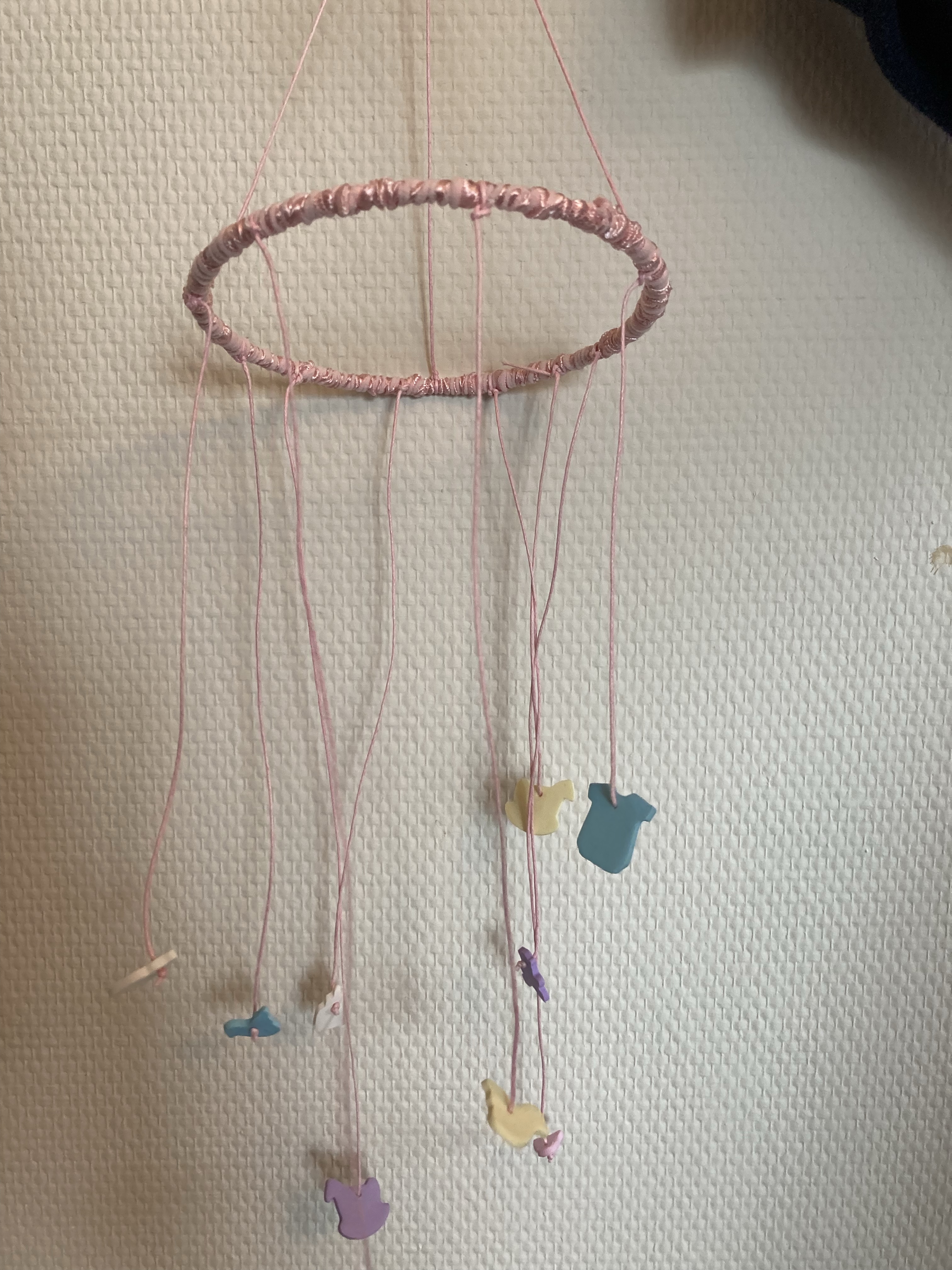
I have been busy with preparations for visiting my sister and her family so I can see my new niece. She was born last Thursday. As regular readers of this blog know, I created a sort of mobile for my baby niece. Here is the picture (I’m holding it in my hand because I had nothing to hang it onto).

I wanted to gift my sister something for her birthday (which was on May 13) too and saw she wanted a membership to a positive parenting website. I am positively surprised (no pun intended) that she’s interested in that approach, as it’s vastly different from our parents’. I didn’t end up buying the membership for her, but hope she does keep this mindset.

I also am happy to share that the handheld drill and drill bits I wanted for drilling holes in my polymer clay pieces for jumprings finally arrived. I had ordered them last Wednesday and the website said handling and shipping would take up to three business days. Apparently they took three business days before they started collecting my order. I need to drill the holes so that I can attach jumprings to pieces in order to make earrings. Since the gift I did buy for my sister, is a pair of earrings, I intend on making her another pair out of polymer clay just for fun.

I also intend on making one more unicorn, because my older niece also deserves a little present when her baby sister and mother both get something.

A Favorite Childhood Gift

One of Mama Kat’s Writer’s Workshop prompts is to share about a favorite Christmas gift you received as a child. Here in the Netherlands though, Christmas isn’t that popular for gift-giving. Instead, we celebrate St. Nicholas on December 5. I can’t remember that many gifts I received for St. Nicholas and the entire celebration was one big stressor once I no longer believed in St. Nick. We celebrated it until I was 20 in 2006. Then in 2007 I was in the psych hospital and my parents didn’t want to risk inviting me. That’s how the tradition ended.

The other major gift-receiving opportunity was and still is, of course, my birthday. It is on June 27, so pretty much as far from Christmas as you get it. Still, I’m going to share about a favorite gift I received for my birthday as a child. Mama Kat twisted the prompt too by listing several things, so oh well.

I can’t remember whether I had invited anyone to a birthday party when I turned eleven. After all, I was pretty much friendless at the time. However, I did celebrate it with my family. The main gift I remember getting was a Barbie doll with aerobic attire. I named her Teresa. I loved the doll, even though I knew already that eleven was a little old to play with it.

Later that summer, my mother took me on a “mother-daughter walk”, which was mainly an opportunity for her to tell me the school had recommended I go residential there. She claimed the reason was that I had behavior problems, which she attributed to my having too many toys. I can’t follow that train of thought other than through some idea that I was so spoiled I somehow felt entitled to have tantrums. That wasn’t true, for clarity’s sake. In any case, my mother regretted having given me the Barbie doll.

I cherished Teresa even more from that moment on. When, during the following school year, I’d have a meltdown, my mother would often pack a random number of toys and claim to throw them out. (In reality, she hid them in her room downstairs.)

The followign year, when I turned twelve, I felt so ashamed for still playing with Barbie dolls that I claimed they’d aged with me, so it was okay. Most of the dolls are still with my parents, I think. I think at one point I broke Teresa’s leg though and had to actually throw her out.

Mama’s Losin’ It

Kids: Being Childless Sort Of By Choice #AtoZChallenge

Welcome to day 11 in the #AtoZChallenge. For those who followed me on my old blog last year, I chose “children” for the letter C post then. I can’t remember what I did my K post on and am too lazy to look it up, so I’m just taking the opportunity to talk about children again. I hate the word “kids”, but oh well.

You see, I have no kids. At 32, this is a bit abnormal already and it’s becoming more so as I age. The reason I don’t have kids, is complicated. Let me explain.

As a child and teen, I always thought I’d have children as an adult. Even during the time, in my mid to late teens, when I thought I was a lesbian, I thought it would be a given that I’d have children. I didn’t imagine a man in my life, nor did I think of how else I’d conceive, but I always knew I would have kids.

This changed after my major psychiatric crisis when I was 21. For the first year or so, I was busy with merely surviving and getting to see a future for myself other than suicide. Then, my post-traumatic stress symptoms started to emerge.

When I was 27, I made the conscious choice not to try to conceive. I had in the meantime met and married my husband and he agreed. He would even support me if I’d want to get sterilized and said I would most likely have no problem geting the procedure done, given that I’m multiply-disabled. He’s likely right, even though this is extremely ableist.

I know I, personally, couldn’t care for a child. This doesn’t say anything about other people with my combination of disabilities, but it is true in my case. Having made this decision puts me somewhere on the fence between childless and childfree. I am in communities for both on Facebook and find that I’m a little out of place in both. Over the years, I’ve moved more towards the childfree side, as I am realizing I don’t experience my biological clock ticking. Rather, my wish to be a parent is more based on societal expectations. As I once said, I’d want to be a Mommy blogger. Well, I guess that’s not the right reason to try for kids.

Dear Autism Parents: On Unconditional Acceptance

I just read an essay in What Every Autistic Girl Wishes Her Parents Knew and it touches home with me. In it, the author, Haley Moss, mainly describes how she feels parents need to ucnonditionally accept their autistic daughters. She particularly emphhasizes the need to support the girls’ special interests even if they’re not age-appropriate or girly. Boy, do I want to tell my parents this. It’s too late now, as I’m 32 and have half a lifetime of conditional love behind me already.

Moss herself too was encouraged to develop age- and gender-appropriate interests as a child. She recounts a fourth grade memory of being advised to trade her rare cards for Bratz dolls. I have no idea what they are, but I remember in fifth or sixth grade also being encouraged by my mother (in not so subtle ways) to trade my Barbie dolls for pop music CDs. After all, Barbie dolls may be girly but they’re not deemed appropirate for an eleven-year-old.

The negative effects of one such incident, like Moss experienced, can be undone by a greater occurrence of open acceptance of the autistic’s special interests. For example, Moss’ paretns eventually affirmed her interest in video games. In this respect, I felt generally okay about my interests in fifth and sixth grade, because, though my mother did not support my playing with Barbie dolls, my father did support my drawing maps.

As a general rule though, I have commonly felt only conditionally accepted by my parents. This is reflected in constant victim-blaming when I was bullied. They were at least somewhat consistent in that, in that at least my father spoke negatively about the intellectually disabled girl whom I bullied too. Of course, he set an example of ableism by doing this as much as my parents did by victim-blaming me.

When I went into college to major in applied psychology, I still got my parents’ reluctant approval. After all, though my major wasn’t that well-liked by them and my college wasn’t as prestigious as they had wanted for me, it still was college. Since having experienced my breakdown in 2007, it’s pretty clear my parents are not there for me anymore. That’s sad, but it’s true.

The saddest part about What Every Autistic Girl Wishes Her Parents Knew is, unfortunately, that those parents who most need to hear the messages in it, will not read it. My parents don’t even think I’m autistic despite my having been officially diagnosed half a dozen times. Other parents may’ve gotten the diagnosis but choose to join the likes of Autism Speaks and shout “You are not like my child!” at every autistic adult trying to educate them about acceptance. That’s so sad. However, if some parents are helped by this blog post or by the book in showing unconditional acceptance to their children, that’s already good.