IQ Tests and Final Exams and Psychological Assessments, Oh My!

Hi all! Today, Esther’s weekly writing prompt is “tests”. Oh my! This made me think of so many things. IQ tests: I’ve had half a dozen or more during my life. Final exams: so glad they’re over with and it’s been twenty years since I graduated high school. Psychological assessments: I still have a love-hate relationship with those. And that goes for tests in general, I guess.

After all, as a child, I didn’t mind taking IQ tests. When I was twelve, I got the infamous Wechsler IQ test, well, the verbal part of it, since I’m blind and the performance part isn’t accessible. I got a score of 154, which, according to the psychologist, indicated giftedness. I’m pretty sure there were all sorts of things wrong with that assessment though.

When I was 30, I got another IQ test, Wechsler again but the adult version and now they removed the clear distinction between verbal and performance IQ so the report just said I got “parts” of the test. My overall IQ score had dropped to 119 I believe. That’s still above-average and I’m pretty sure that’s correct. However, I wish there were a performance IQ test for blind people, because I am pretty sure that’d show where my real limits are. Not that I’m proud of being disabled, but I am and if it could be proven on a test, that’d be much better than an ever-changing psychiatric diagnosis.

Final exams. Like I said, I’m glad it’s been twenty years since I graduated high school. My final exams were quite frustrating, as not only was I horribly nervous, but my computer crashed once in the middle of the test. I graduated from what in the UK is called grammar school and honestly I have no clue how I did it. I mean, well, I know, sort of: the same way I “passed” my IQ tests, ie. being a pretty above-average memorizer. Too bad that a good memory and decent academic skills don’t get me far in life. It takes more than test-taking abilities to be successful, after all.

#WeekendCoffeeShare (February 17, 2024)

Hi everyone. I’m joining #WeekendCoffeeShare today. Like most times, I’ve already had my last cup of coffee for the day. I hope we still have apple and peach-flavored Dubbelfrisss, my favorite soft drink, though. We’re permitted a soft drink each evening as opposed to just on weekends as of this week, but I haven’t had it each day and I’m pretty sure I’m the only one who drinks this particular soft drink, so I’m optimistic there’s still some left. Anyway, let’s have a drink and let’s catch up.

If we were having coffee, first, I’d talk about the weather. It’s been a rainy but mild week. In fact, on Thursday (if I’m correct), the daytime temperature climbed to 15°C. Today was the best day of the week as far as it not raining goes, but we did get a few drops here and there.

If we were having coffee, I’d share that I taught myself and subsequently my staff a new dice game called Centennial. It is a welcome distraction from the usual Yahtzee. I have also been playing Mexican, which is supposedly a drinking game but it can be fun without the beer too.

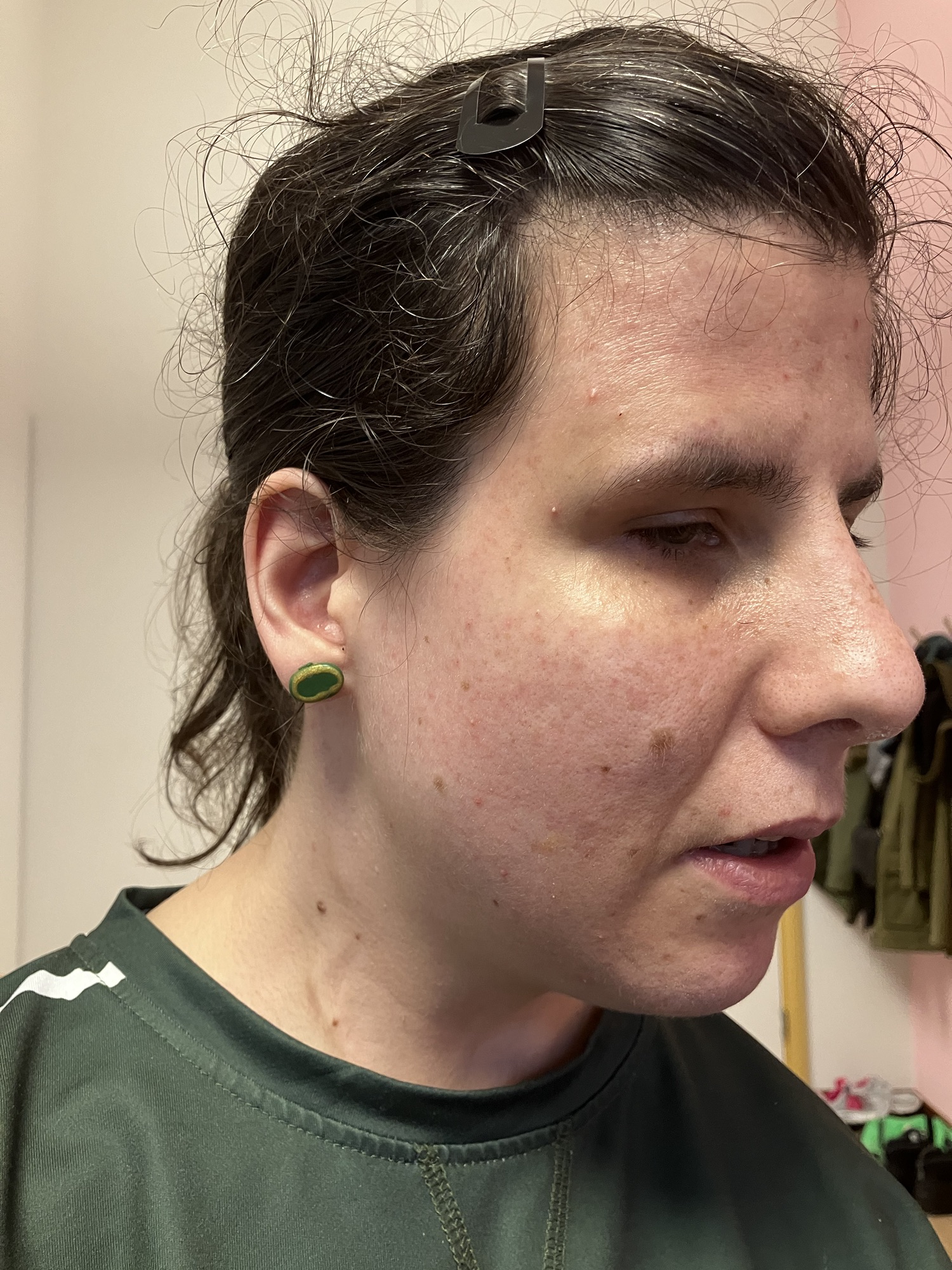
If we were having coffee, I’d tell you that, on Thursday, I finished the first pair of polymer clay earrings I can actually wear. The previous pairs of earrings I created had been hooks, which I can’t yet wear due to not having had my ears pierced long enough. I finally found an easy-to-follow YouTube tutorial on how to embed earring posts into polymer clay. Even though I could only do a small part of the work myself, I am quite satisfied with the result. And, of course, I did create the original earrings myself. These are a simple design of leaf green Fimo ovals with gold Fimo liquid around the edges for decorating. In the future, I really hope to create more earrings.

If we were having coffee, I’d share that I rewrote my care plan together with my support coordinator. I’m still unsure as to what I think of it.

Particularly, I feel rather stressed out about the portion about my emotional functioning. I had an emotional developmental assessment done in 2018, which determined I function in most areas comparable to a child age 6-18 months. In some areas, it estimated my functioning to be much higher than I would estimate my own, such as in object permanence, while in others (such as handling unfamiliar material), it estimated me to function at a much lower level. I mentioned this to my support coordinator, who proposed the assessment be repeated. Since my one-on-one is largely based on my poor emotional functioning and the discrepancy between this and my IQ, this stresses me out. This especially since my assigned staff, who will likely be asked to complete the associated questionnaire, grossly overestimates my capabilities based on my verbal skills.

On a positive note, my previously assumed exact IQ score, which dates back to a test done in 1999, was finally removed. Yay, I am no longer 154. Instead, I am said to have an “above-average IQ”, which is more in line with a more recent IQ test (also a little dated, but at least not 25 years).

If we were having coffee, lastly I’d tell you all that, next week, I’ll finally be taking my next step in tapering my antipsychotic, Abilify. I took two tiny steps back in 2022, but remained at my current dosage ever since August of 2022 due to never having stabilized in the intensive support home. Now I’m not sure it’s the right time either, but then again I doubt it’ll ever be the right time, in that I’ll probably never be fully stable. I will go from 25mg to 20mg a day. I will stay on this new dosage for at least six weeks, unless of course I’ll spiral out of control to the point of necessitating we return to the old dosage. Wish me luck!

The Downside of Praise

As a child, I was often praised excessively for my achievements. I remember one day, when I did calendar calculation at a family get-together, calculating what day of the week May 3, 1327 (for example), was, my mother exclaimed: “She’s sublime, she’s a genius!” For those who don’t know, many autistic or otherwise developmentally disabled people, including those with lower measured IQs, have this skill as what is stereotypically called a “splinter skill”. Now don’t get me started on the ableism of the term “splinter skill” when applied to people with lower measured IQs, but calendar calculation alone definitely doesn’t make someone, anyone, a genius.

And just so you know, it’s incredibly counterproductive to praise a person for who they are rather than what they do. It is usually better to praise someone for their achievements by naming those achievements as well done rather than praising the person themself. Moreover, any excessive praise, even if you say “you did an awesome job calendar calculating”, can be taken the wrong way.

Besides, many people feel they are praised for something that doesn’t reflect their personal values. For example, when I am praised for completing a personal care task, all I see is pressure to be able to do it independently the next time too. When, however, I am praised for creating something nice out of polymer clay, for my writing or the like, I feel like I’m valued for my contribution to the world.

There is, or so I’ve read, some school of thought that says any praise, whether person-centered or accomplishment-based, should be avoided by parents or carers. This doesn’t mean parents or carers should completely ignore their child’s achievements. Rather, simply pointing them out and engaging with the child about their achievements, will, according to these people, help the child develop a healthy sense of self. Honestly, I am inclined to agree with this.

I Am (Not!) 154

Hi all. Today’s topic for Friday Faithfuls is IQ testing. This topic is very dear to my heart, as IQ tests have often been used and even more often misused to determine my entire life path.

When I was twelve, I had an IQ test administered to me. It was the verbal half of the Wechsler intelligence scale for children (the performance half can’t be administered to me because of my blindness). On this verbal IQ test, I got an overall score of 154. According to the educational psychologist writing the report, this is a sign of giftedness.

There were several problems with this assigned IQ score. For one thing, like I said, it’s just a verbal IQ score. The year prior, another ed psych had tried an intelligence test for visually impaired children which utilizes non-verbal components, but had given up on the test midway through because I got too frustrated. This ed psych had also administered the verbal half of the Wechsler scale, but her report doesn’t give an IQ number.

Another thing, which you might figure out from my previous paragraph, is the possibility of a retest effect, since I took the exact same test twice in a year. The ed psych that labeled me with an IQ of 154 did try to find out whether this had actually happened. He asked me whether I had been told when taking the test the last time which answers were correct and which weren’t. I had, in fact, with some, and besides, my father had given me extensive advice on how to answer some questions even more cleverly than I had done. However, I knew the purpose of this assessment: to get the green light for me to go into mainstream, high level secondary education rather than special ed for the blind. I wasn’t at the time really sure whether that’s what I wanted, but my parents did and I, being twelve, didn’t question their authority. So I said “no” and the ed psych concluded there was no retest effect.

I don’t doubt that I have an above-average verbal IQ. But 154, in my opinion, is probably too high. Besides, verbal intelligence is what you need to succeed in traditional schoolwork. What you need to succeed in life, is more related to performance IQ, if you ask me.

Even now though, nearly a quarter of a century later, the number 154 pops up here and there and everywhere with regards to me. Professionals keep assigning new dates to the original IQ score, calling it a total rather than verbal IQ, and making more nonsense out of these ever-intriguing three digits.

I have tried to talk to the behavior specialist about this. What I really want is to be re-evaluated. Not just with respect to (verbal) IQ, but with respect to other things too. She for now only agreed to write a note by the IQ score of 154 saying that it dates back 25 years.

You’d assume that, in intellectual disability services, it wouldn’t matter whether your IQ is 100 or 150, since it means no intellectual disability regardless. However, several of my current staff have admitted being wowed at my IQ score before they got to know me. I hate that the most, being reduced to being 154.

IQ As It Relates to Intellectual and Developmental Disabilities #AtoZChallenge

Hi everyone and welcome to my letter I post in the #AtoZChallenge. Today, I want to write about IQ. IQ, a measure of intelligence, is one of the determining criteria for intellectual disability. So how is it measured in the general population and in people with an intellectual or developmental disability?

The concept of IQ dates back to the 19th century, when early psychologists first started developing tests for measuring intelligence. These were based on the idea that intelligence increases as a child grows up, so they were based on skill sets a child of a certain age should be able to master. IQ was then decided to be intellectual age divided by chronological age multiplied by 100 (to get the idea that a normal IQ is 100). For example, if a child aged five masters the skills of a three-year-old, their IQ was 3 / 5 * 100 = 60.

This is problematic, because among other things it does not allow for testing of adults and does not allow for variation on different skill levels. It was therefore abandoned in favor of a norm-based IQ testing system. Both the Wechsler scales (most commonly used in Europe) and the Stanford-Binet test (which is used more often in the U.S.), are norm-based, with an IQ of 100 being average and standard deviations of 15 (Wechsler) or 16 (Stanford-Binet) determining differences such as intellectual disability and giftedness.

I am familiar only with the Wechsler scales. There is a preschooler, a children’s and an adult version of these. The children’s and adult versions at least contain non-verbal as well as verbal tasks. Until some years ago, these were divided into categories of verbal and performance IQ. I, for one, can only have my verbal IQ tested. This refers to skills such as math, vocabulary, working memory, information (general knowledge questions), etc. The performance/non-verbal tasks include patterns, object recognition (where you see an object with part of it missing and need to identify it), etc. I am pretty sure that, if my performance IQ could ever be tested, it’d be significantly lower than my verbal IQ, as is commonly the case with verbally capable autistics.

On the other hand, nonspeaking or partly verbal autistics often find their intelligence being underestimated because they struggle on verbal IQ tests or cannot take them at all. For this reason, for nonspeaking autistics, a non-verbal IQ test may be more appropriate.

I did honestly find that the adult Wechsler scale was quite difficult even for me, a person with a high level high school and some college education. I honestly doubt those with a moderate intellectual disability will even be able to answer the simplest of questions on it. For example, the first math question was something like: “John had six apples, Peter had two apples, how many apples did the two of them have combined?” Interestingly, the first vocab question was to define “apple”. And no, in Dutch, there is no ambiguity (in case people are thinking “the brand that makes iPhones”). However, the correct answer was “fruit”, which I struggled to come up with, as that’s not a definition, more like a categorization.

Functioning Levels, Support Needs and Other Ways of Classifying Intellectual and Developmental Disabilities #AtoZChallenge

Hi everyone. For my letter F post, I am going to talk about functioning levels and related ways of classifying the severity of intellectual and developmental disabilities. Most of these are highly controversial within the developmentally disabled community itself.

First are functioning levels. These can be described in several ways. With respect to autism, there is of course high-functioning and low-functioning. The distinction between these is not at all clear: does high-functioning mean an at least average IQ, the ability to speak or the presence of relatively few autism symptoms? In any case, these are often very confusing.

An alternative approach suggested by some autistics is to speak of high, moderate or low support needs. I, according to this classification, would be considered as having high support needs even though I’m considered “high-functioning” in at least two of the aforementioned ways (speech and IQ).

Some people have proposed yet another classification, not based on support needs or apparent functioning, which are after all based on a (presumably neurotypical) professional’s assessment, but on masking. Masking is the ability to hide one’s disability-related symptoms from the public. In this sense, “high-functioning” individuals are considered high-masking.

In intellectual disability without co-occurring autism or other neurodivergencies, functioning levels are slightly more useful than in autism, in that they are based on IQ and level of adaptive functioning. In this classification system, someone with an IQ between 50 and 70 (or 85 in some countries, such as the Netherlands) is considered mildly intellectually disabled. Someone with an IQ between 35 and 50 is considered moderately intellectually disabled. An IQ between 20 and 35 puts someone in the severely intellectually disabled range, and an IQ below 20 puts someone in the profoundly intellectually disabled range. That being said, having had my IQ tested many times, I wonder how well IQs below like 50 can be measured on standard intelligence tests. I guess for more severely disabled people for this reason, professionals prefer the term mental age. Like I said yesterday, this is considered discriminatory.

Good Enough

Today’s optional prompt word for #LifeThisWeek is “Good”. Denyse takes on a cynical approach to the word, which reminds me of the many degrees of being called “good” I experienced.

In my elementary school years, my parents were in a constant fight with the schools for the blind I attended about my educational needs and my potential. According to the school, I was a good enough student. That’s the literal translation of the words that appeared on my report card often. Sometimes, when I was better than average, just “Good” appeared.
My parents thought I ought to get some more recognition. They thought I was excellent, sublime, a genius.

My schools thought I should be going to their secondary school program, which at the highest level catered to average students. My parents believed I could do far better.

I doubt, to be very honest, that my teachers truly didn’t see that academically, I was above-average. At least some of my teachers must have seen this. However, socially and emotionally, I was significantly behind. This was probably the real reason my schools recommended I continue in special education. My parents disagreed. They felt that I would be overprotected and underestimated in special ed. They might’ve been right. We’ll never know, since my parents took me from educational psychologist to educational psychologist until they had the recommendation for mainstream high level secondary education in their hands.

What I do know, is that I ended up being overestimated and underprotected. My parents would love to deny this and blame the staff in independence training for essentially setting me up for long-term care. Agree to disagree. Then again, we’ll never know, because I didn’t go into independent living and on to university right out of high school.

Sometimes, I wish I was just the average, good enough student that some of my teachers saw me as. Then at least I wouldn’t have to face the enormous challenge of both a high IQ and an emotional level comparable in many ways to an 18-month-old child. Then, I might not be writing blog posts in English, but I also might not need 24-hour care.

Then again, I enjoy writing blog posts. I like my care facility. Life is good enough for me.

#WeekendCoffeeShare (October 11, 2020)

It’s Sunday and I’m in definite need of some coffee. For this reason, I’m joining in with #WeekendCoffeeShare. It’s not time for my evening coffee yet, but maybe I can enjoy a virtual cuppa.

If we were having coffee, I’d share that the weather is gloomy. It’s been raining almost the entire day and it’s cold enough that I could use my winter coat.

If we were having coffee, I would tell you that I’m struggling quite a bit. Yesterday I landed in crisis. I didn’t sleep all night and was still feeling very tense by this morning. A walk didn’t even help, because I felt cold and was very tired and overloaded.

I am also struggling with what to tell my husband. The crisis was quite bad and I really want to be open to my husband. However, I fear he’s going to be angry with me for it, because in other places, this could’ve led to me being kicked out. In fact, I’m still worried that the staff are going to decide to kick me out after all.

It makes me feel sad that I, being of above-average IQ, am expected to make my own decisions regarding this stuff and make sure my family is informed.

I mean, of course it has its pros that I’m intelligent. If I had an intellectual disability, I wouldn’t be able to blog, for instance. I also wouldn’t have my husband. However, this discrepancy between my IQ and my ability to cope emotionally, is weighing me down quite a bit.

If we were having coffee, I would tell you that, as unlikely as it may seem now, the rest of the week was pretty good. I made some soap and experimented with baking soda modeling clay. I removed some of the figures from their molds today, but I think they hadn’t fully hardened, as they were still pretty brittle.

If we were having coffee, I would share that I’ve been loving browsing Amazon’s Kindle collection for books to get. I don’t want to buy them yet, but I did download a few free books.

I also finally got Listify on Apple Books. This is a book of journaling prompts (yes, again!) but most are list-based.

What have you been up to lately?

Something I Struggle With

A few weeks ago, Marquessa over at The Next Chapter started a writing challenge to get herself motivated to write everyday. Yesterday, I saw that Cyranny had joined in. Cyranny started with the first prompt. That one didn’t appeal to me, so I will go to the second. It is to share something you struggle with.

Regular readers may be able to guess what I’m going to share. It wasn’t the first thing that came to mind, but I got inspired by Marquessa’s post. She shared that she struggles with being called “pretty”. She then goes on to say that brains matter more to her than beauty. Well, I wouldn’t exactly say I’m the opposite, but I do struggle with being called “intelligent”.

As a child, I was often called intelligent. My parents loved bragging about my so-called genius. After I had an IQ test at age twelve, this became even worse. The IQ test, though not the first one administered to me, was the first one about which the assessor actually told my parents the exact IQ outcome. My performance IQ can’t be measured because I’m blind, but my verbal IQ was identified as being 154 on the Wechsler scale. This means I was supposedly within the highly gifted range.

As a preteen and early teen, I didn’t mind my parents bragging about this three-digit number as much. I was proud that, according to my mother, I had the same IQ as my father. Now the only time my father had an IQ test administered, he at least told me that was in the pub with a psychologist friend and he was rather drunk. I’m assuming his real IQ may be higher.

As I grew older though, my apparent high IQ more and more stood in the way of my being myself. It was frequently used by my parents and professionals to “prove” that I should be capable of solving my own problems in social situations. This got me interested in the concept of giftedness as asynchronous development. Later, I was diagnosed with autism. Still, my parents reasoned that I was just extremely intelligent.

The reason I struggle greatly with being called “intelligent” is the assumption that I am smart enough to solve non-intellectual problems. This may be so in most gifted people – I think I remember recent research disproves the theory of asynchronous development -, but it isn’t the case for me. Like I mentioned a few weeks ago, my emotional level is equivalent to someone approximately 18 months of age.

Last year, my IQ was used against me to deny me long-term care. I mean, due to my multiple disabilities and low emotional functioning level, I do best in a care setting normally catering towards severely intellectually disabled people. Because of my IQ though, I can’t get funding based on developmental disability. I am lucky that I’m blind in this respect, because I ultimately did get funding based on that.

Contrary to Marquessa, I do not struggle with compliments about my intelligence because I don’t agree with them. I mean, the IQ test I took at age twelve is rather outdated now and I scored much lower when I took another one in 2017. However, I still know I’m indeed intelligent. That being said, that’s not all I am. In the future, I’d like to be able to take pride in my intellectual abilities without them triggering the fear that I’ll need to be good at other things too.

Emotional Development

Last Tuesday, I discussed my care plan with my support coordinator. She needed to update it because the facility is going to apply for a higher care profile for me. Besides, it needed to be made current for my living in the facility rather than at home anyway.

My care plan is divided into several sections, including general health, diagnoses, intellectual, emotional and social functioning. The part about my intellectual functioning unfortunately still lists my IQ as measured 20 years ago. Since it according to the test dropped some 35 points between 1999 and 2017, I’ve wondered whether this is merely due to Flynn effect or something or I’m actually experiencing cognitive decline. Still, my IQ as measured in 2017 was above-average, so it doesn’t really matter for long-term care funding anyway.

In the part about my emotional functioning, I saw for the first time the results of the emotional development impression the consultant from the Center for Consultation and Expertise had written in 2018. This was a bit shocking to be honest. I knew I’m thought of as functioning at an emotional level equivalent of a toddler. It was difficult though reading that in several areas, i’m supposed to function at a level of less than 6 months. This wasn’t surprising though.

For instance, one area in which I function at a level of 0-6 months, is body awareness. The reason the consultant listed was my inability to make contact when overwhelmed. I would add to that my inability to distinguish different bodily sensations, such as hunger and pain. I tend to react to everything that’s physically overwhelming by acting in a self-stimulatory way. The consultant also listed my craving physical stimulation such as rocking as a reason for this.

I also apparently function at 0-6 months with respect to differentiation of emotions. In other words, I don’t do that. The consultant explained that I have a lot of distress and am hardly ever relaxed. While this is true, I’d like to add that I don’t generally distinguish between different strong emotions. Like, at all. Each strong emotion feels equally overwhelming to me, even strong “positive” emotions.

With respect to verbal communication, my level is 3-7 years. Because this scale was developed for people with intellectual disability, the highest level is 7-12 years and I in some ways expected to be qualified as functioning at that level. I do with respect to handling familiar tools, such as my computer. However, the consultant apparently recognized my less-than-great (understatement!) language comprehension.

It was rather interesting to read this assessment, even though of course the concept of mental age used here is a bit off to say the least.