#WeekendCoffeeShare (November 15, 2025)

Hi everyone. I’m joining #WeekendCoffeeShare again today. I’ve just had my last cup of coffee for the day. We didn’t have large biscuits that we are usually allowed to have on weekends, so I had a mini Mars candy bar. Let’s have a drink and let’s catch up.

If we were having coffee, first I’d talk about the weather. During most of the week, we’ve had unusually mild temperatures for November. We had some rain too, but not a huge amount. Today, the daytime temperature didn’t get above 9°C, which I consider cold but is actually normal for this time of year. According to my wife, the weather forecast predicted 27mm of rain today. We did get rain indeed, but not nearly that amount.

If we were having coffee, then I’d share that I did meet my movement goal on my Apple Watch each day this week. However, I’m pretty sure my 90-day average will soon be lower than my 365-day average, as I just barely met my goal most of these days and it’s been this way for a month or so already. My movement streak is somehow still stuck on 33 days.

If we were having coffee, then I’d update you all on my struggle re orienting new staff. The new staff, last week when being properly introduced to me finally, said this would be the actual (re)start of her orienting. Not so. She did get one more chance to be oriented to my morning routine, but not another to the activity time slot. I feel this was unfair, as during her original orientation to the activity, we only went for a walk because I, not having properly been introduced to her, didn’t feel like being vulnerable with her with a more difficult activity, such as polymer clay.

On Tuesday, this staff was assigned to me for my morning routine, but this one was different than the one she’d been oriented to. She asked me a ton of questions even though I’d told her during our introductions not to do this. Then, on Thursday, she got assigned to me for my activity. I was pretty angry about this, but several staff including the new one herself claimed she’d had her chance to be oriented and I just had to deal with it. I feel this is the world turned upside down, giving me responsibility for the success or lack thereof of her orientation. One staff went so far as to tell me that because I have one-on-one, staff need less orienting to me. In all honesty, I think the opposite is true, because when you’re supporting the group, you can always fall back onto a coworker. This same staff also said, when I said that they don’t expect my fellow residents to explain their routines to new staff, that I’m very different from the other clients and have a totally different diagnosis so not to compare myself. That triggered me to no end, because not only do I get told this nonsense in intellectual disability services, but also in psychiatric settings. And what I mean by nonsense is the assumption that I, because of my diagnosis, can deal with whatever the staff throw at me and just choose not to, while other people can’t help their behavior. I mean, of course I have an at least average IQ, but I am not in the care system for the fun of it.

Thankfully, it looks like my support coordinator is not in full agreement with the one chance rule at least when it applies to regular staff. Too bad the damage has already been done with this particular staff.

If we were having coffee, then I’d share that, on Wednesday, it was my wife’s birthday. I took a ParaTransit taxi to our house and we had lunch together, then chilled out and got pizza takeout. I gave my wife a handmade necklace with a skull pendant.

If we were having coffee, lastly I’d tell you that we had a dance party at the home yesterday. This time, I was too stressed to play DJ myself, but I did suggest a few songs to the staff.

Do I Have a Mental Illness?

Hi everyone. Several happenings today, including my reading today’s Friday Faithfuls post, made me think about the question whether I have a mental illness. Or should I say mental health condition? Is there even a difference?

People who know me, may be surprised at the fact that I even ask this question. I mean, of course! I spent nearly a decade in a psychiatric hospital. Then again, when I was first admitted, the psychiatrist deciding to admit me made it very clear that she wasn’t diagnosing me with a serious mental illness. I had a diagnosis of autism, of course, which though it is in the DSM and though here in the Netherlands it falls within the realm of psychiatry, isn’t technically speaking a mental illness. To be added to this diagnosis was adjustment disorder, which in short means an inability to cope with the stressors of daily life. Nowadays, people with this diagnosis alone don’t qualify for mental health services, let alone admission to a psychiatric hospital.

But once I was in the system, numerous mental health diagnoses which may fall under the realm of mental illness, were added. My first was impulse control disorder not otherwise specified, which I’m pretty sure was just a way of explaining away my meltdowns without admitting they were due to less than adequate care. I often wondered why they singled out impulse control as the only issue on which they gave me the vague “not otherwise specified” diagnosis. I guess it’s because, unlike my anxiety, depression, disordered eating, etc., my meltdowns did bother other people.

Then, several years later, came (complex) PTSD and dissociative identity disorder. These are mental illnesses, but they are caused by overwhelming circumstances, just like adjustment disorder.

Later came borderline and eventually dependent personality disorder. Finally, I was diagnosed with recurring depression in 2017.

All this to say, whether I have a mental illness or not, isn’t as straightforward as it may seem. I do know that my current care plan lists “mental health problems” as a general “diagnosis”. I honestly try not to care about the specifics of my diagnosis, but I’ve learned the hard way that the specifics can be used against me. For example, when I had the personality disorder diagnoses, I was kicked out of the psych hospital with almost no aftercare because of allegedly misusing care. I wish the higher-ups would look beyond the labels and at the individual.

Questionnaires and Personality Tests for Self-Improvement and Diagnosis #AtoZChallenge

Hi everyone. For my letter Q post in the #AtoZChallenge, I’d like to talk about personality tests and questionnaires. How valid are self-report questionnaires for personal growth? Do they have any validity in diagnosis?

The short answer to these questions is that it depends. After all, many people especially those with some knowledge of the thing being tested, will answer in such a way that they’ll get the results they want or expect. Even people who don’t know how the test works, may distort their answers because they think the test works in a certain way or because they think others want them to answer in a certain way. Or sometimes even because they don’t understand the questions.

For example, when I was eleven, I was tested with this weird sentence completion test that included open-ended questions. An example I remember clearly was the psychologist asking me “When I can’t sleep, I…”. I replied “I’ll try to sleep”. I had absolutely no idea what to say, not because I thought the psychologist wanted a particular answer but because the question was far too open-ended. Similarly, my lack of emotional awareness at the time often made me choose the middle option on rating scales. This was judged to be manipulativeness, but it wasn’t.

Like I shared before, many personality tests include a “liar scale” or validity subtest. An example on the Big Five test I got in college is “I always feel equally good”. I honestly answered with “strongly disagree” and totally thought it’d make me score high on neuroticism. Instead, that particular question and others I answered honestly got me to score above-average on the validity scale. That isn’t to say I didn’t score high on neuroticism though.

I don’t personally think it matters that many self-report questionnaires can lead to a strong confirmation bias, especially if you’re using the test for personal development only. That is, if you want to hear that you’re great, you will always be able to find validation for that. Whether lying on self-report questionnaires will help you on your journey, is another thing, but if you aren’t consciously manipulating the test, chances are there’s some truth to the result anyway. I don’t recommend relying on a test alone to determine anything about yourself, but to also always do your own research. Similarly, in clinical settings, while self-report questionnaires are somewhat useful, professionals also need to rely on observations.

Codependency and Emotional Dependence #AtoZChallenge

Hi everyone. For my letter C post in the #AtoZChallenge, I wasn’t really sure what topic to pick. I could go with cognitive functions, but without explaining personality typologies first, this wouldn’t make sense. Since I chose the broad topic of personal growth for my theme, I could however choose a topic that isn’t necessarily related to personality. IN this post, I’m talking about codependency.

What is codependency? In a narrow sense, it refers to certain behaviors exhibited by individuals in a close relationship with an addict. The addict is, in this sense, dependent on a substance (or behavior) and their partner is codependent, as in “second-degree dependent”.

I used to understand codependency as involving just enabling behaviors. For example, a codependent person might be manipulated into giving the addict access to their drug of choice. In this case, a person buying alcohol and giving it to an alcoholic, is codependent.

Actually though, codependency isn’t just the direct enabling of an addiction. It also happens in abusive relationships in which neither of the parties involved is an addict. For example, a person staying with their partner in spite of domestic violence, could also be seen as codependent.

Codependency, as such, is more related to being emotionally dependent on someone else despite them being in some way toxic. It could also be seen as compulsive caregiving.

For clarity’s sake, though their are certain individual traits that make someone more susceptible to becoming codependent, codependency is at least as much an attribute of the relationship as it is of the individual.

How can you heal from codependency? The first step is to set healthy boundaries. This means that boundaries are not so weak that they allow others to use you as a doormat and not so rigid that you end up self-isolating. Of course, what boundaries you set, depends on the person you’re setting boundaries with. For example, you may want to go no-contact with an abuser, but keep a supportive friend close by.

Another step in the healing process is to recognize yourself as a unique individual separate from the addict or abusive person you’re codependent on. And, for that matter, separate from everyone else in the world. This means learning about and validating your own preferences, wants and needs. As you learn to be more aware of your own individuality, you’ll start to develop greater emotional independence.

Healing from codependency will ultimately help you have healthy relationships with the people around you.

I am not currently in an abusive relationship and don’t have any close relatives who are addicts. As such, I am not really codependent on anyone at the moment. However, being that I grew up in a dysfunctional family, I do share some traits of emotional dependency. I was at one point also diagnosed with dependent personality disorder (DPD), even though my psychologist at the time only chose that diagnosis to make it look like I was misusing care. She actually claimed that I was perfectly capable of asserting myself, which people with DPD definitely aren’t.

Like I said, codependency is at least in part defined by the relationship, whereas DPD is a diagnosis meant for an individual. It doesn’t, however, take into account the fact that many adult children of dysfunctional families will end up showing (co)dependent behaviors in other relationships too.

Brain Injury As It Relates to Intellectual and Developmental Disabilities #AtoZChallenge

Hi everyone. We’ve arrived at my letter B post in the #AtoZChallenge. I struggled with what topic to choose for this letter, but eventually settled on brain injury. As you will find out, this type of disability has a kind of controversial relationship to intellectual and developmental disabilities. After all, many people view an intellectual or developmental disability as necessarily present from birth. The American Association on Intellectual and Developmental Disabilities (AAIDD), however, considers an intellectual disability as having originated before the age of 22. In the Netherlands, the age of onset cut-of for an intellectual disability care profile in the Long-Term Care Act is 18. As such, people who acquired a brain injury in childhood affecting their ability to learn, are diagnosable as having an intellectual disability.

With respect to other developmental disabilities, such as autism, the diagnostic waters get even muddier. I, for one, was diagnosed as autistic at age 20 despite having suffered a brain bleed as an infant. Then, ten years later, the diagnosis was removed again because apparently a brain injury no matter how early on precludes an autism diagnosis. However, I could not be diagnosed with acquired brain injury-related neuropsychological or behavioral difficulties either, because these would have required a clear before/after difference. Besides, I am blind too, so most neuropsychological testing isn’t possible on me. As a result of this, I ended up with just a regular personality disorder diagnosis. Now I’m not 100% sure I don’t have a personality disorder, but it’s certainly not all there is to me diagnostically.

In the Dutch care system, people with acquired/traumatic brain injury usually fall under physical disability service providers, unless they have really severe challenging behavior. In that case, they usually either end up in an intellectual disability facility or a psychiatric hospital. There are a few specialist mental health units for people with brain injury, but these are treatment-based, not living facilities. There are also nursing home units for people with brain injury, but these cater towards people over 65.

Confronting My Dependent Shadow Side

This afternoon, I downloaded a small collection of shadow work-based journaling prompts. One of them is to write about the time I felt most offended by someone. What did that person say or do? And more important, what was my reaction? I am encouraged to focus mostly on the emotions involved rather than the mere facts.

The first thing that came to mind, was my former psychologist diagnosing me with dependent personality disorder. This, though, didn’t really offend me: it scared me. After all, she claimed not just that I was being passive and clingy, as people with DPD often are, but that I was misusing care. I, obviously, disagreed and feared losing my care because of her diagnosis. This, indeed, did happen about six months later.

The moment I felt most offended though, was the moment in June of last year when my husband said he thought I might have DPD. He may’ve forgotten that this was the exact diagnosis my psychologist had given me in order to kick me out of the psych hospital, since he did not propose I move back in with him. His reasoning was, however, the fact that, even with one-on-one support for most of the day, I still struggle.

I felt intensely triggered and scared again, but also angry. However, I wasn’t necessarily angry with him, but with my own dependent side. After all, maybe, just maybe, he is right indeed.

Deep down, I do know it is crazy to want – to feel I need – one-on-one attention all of the time. I don’t even want it, truthfully. Right now, I’m very content being by myself. But then again, why do I feel so anxious some of the time when my staff leave? Why can’t I make simple choices? Why do I need my husband to take responsibility for any major parts of my life? These are telltale DPD criteria!

I am not even scared of the diagnosis itself. Diagnoses are just labels. But I am scared of losing the care I have now, like I did in 2017. And then the little voice, my independent part, is telling me that I coped just fine. I mean, I know I took two overdoses of medication during my first six months of living with my husband, but wasn’t that just manipulation?

Couldn’t I have a much better, much richer life if I unlearned this intense fear of needing to fend for myself? Yes, yes, yes, I could! But does unlearning this fear mean being given a kick in the behind and being forced to live with my husband again? Maybe there are steps in between. Like, today I poured myself a glass of fruit-infused water, spilling a little over myself, but I did it anyway. I felt intense anxiety, because I knew my staff noticed and maybe she’s going to expect me to always be able to do this independently. Then again, so what? Then the worst thing that could happen is I can’t get fruit-infused water if this staff is working my shift and I don’t feel like pouring it myself. Is that so bad after all? And just to say, the staff didn’t even tell me to pour the drink myself. I just noticed the bottle was in front of me and I decided to try to do it. I could’ve asked her to pour the water for me, in which case she’d likely have done so. She is a staff who generally encourages independence, which sets off my demand avoidance. However, the fact that I not only did something independently I wouldn’t normally have done, but took the initiative rather than being encouraged (read: pushed), gave me a confidence boost.

Rebirth

I remember reading a story some years ago in the book Preemie Voices by Saroj Saigal. This is a collection of autobiographical letters from people who were once premature babies in the university hospital NICU Saigal worked for. I, like the contributors, was a preemie.

In this particular story, the author shared how she felt she has three birthdays: one, her actual birthday, the second, her original due date, and the third, the day of her rebirth. In this author’s case, her rebirth meant being diagnosed with Asperger’s Syndrome (her choice of words).

I haven’t experienced one such pivotal moment in my life. I mean, I too could choose the day I was diagnosed as autistic (March 16, 2007). Then again, my diagnosis has been removed and reaffirmed so many times that I could just as easily choose the last time I was diagnosed (May 1, 2017). Besides, self-diagnosis is valid too.

I could choose the day I was given long-term care funding (June 4, 2019). Maybe that is the most pivotal moment in my life, but it didn’t exactly mean I was reborn.

I could, of course, choose the day I became a Christ follower (December 7, 2020). Many people in the Evangelical Christian community say they are Born Again and indeed, rebirth in Christ is a common Biblical concept. However, I am more of the opinion that, as Christians, we are on a continuous path towards God. I believe that, each time I consciously pick up my Bible, or the cross my husband gifted me and which I use for prayer, or each time a message from God truly enters me, I am transformed a little bit. I don’t believe that I will be made fully new until the day of Jesus’ return.

All that being said, I do believe I am not the exact same I was a year ago. I am not even the same I was yesterday. Or when I started writing this post. In my view, every single moment is an opportunity for rebirth. Every second we are given is another second chance.

This post was written for Reena’s Xploration Challenge, for which the prompt this week is a theme: rebirth.

Because I’d Had a Stroke…

I couldn’t possibly be autistic, my psychologist said, because I’d had a stroke as an infant and that somehow precluded a diagnosis of autism. Never mind that autism is genetic and said stroke supposedly didn’t change my genetic makeup to make me neurotypical. I, however, had to be diagnosed with acquired brain injury-related behavior change instead, but then again I couldn’t either, because I was too young when I sustained the stroke for my behavior to be considered as having changed either; after all, a six-week-old infant hardly shows any behaviors that would be considered significant in an adult. For this reason, I ended up with just some regular personality disorders, specifically dependent and borderline PD. Never mind that these have their onset in early adulthood and I’d shown symptoms since childhood. As it later turned out, my psychologist’s reason for changing my diagnosis had nothing to do with logic and everything with her wish to kick me out of care.


This post was written for the Six Sentence Story link-up, for which the prompt word is “stroke”. It isn’t completely factual, in the sense that, though my psychologist kept referring to what happened to me at six weeks of age as a stroke, it was actually a brain bleed. That doesn’t change the rest of the story though.

#WeekendCoffeeShare (February 19, 2022)

Hi everyone on this gloomy Saturday evening. I’m joining #WeekendCoffeeShare today. I’m right between my dinner and my evening coffee and I cannot offer you a drink other than water right now, as my staff is busy and I don’t want to leave my room. I’ll get to that bit later. So, can I get you a drink of water? Otherwise you’ll have to wait until my staff returns. Anyway, let’s have a chat.

If we were having coffee (or water, in this case), I’d share that we’re quarantining right now, as four or five of my fellow clients are positive for COVID. Four are confirmed and the fifth one can’t be tested but is treated as having COVID too. I took a lateral flow test right after dinner this evening and so far I’m still negative, as are the four other clients supported by the same staff as me outside of my one-on-one hours.

This is the reason the staff are busy, with the staff who care for the COVID-positive clients having to wear PPE and the other staff having to remain out of these clients’ way. It is all rather chaotic.

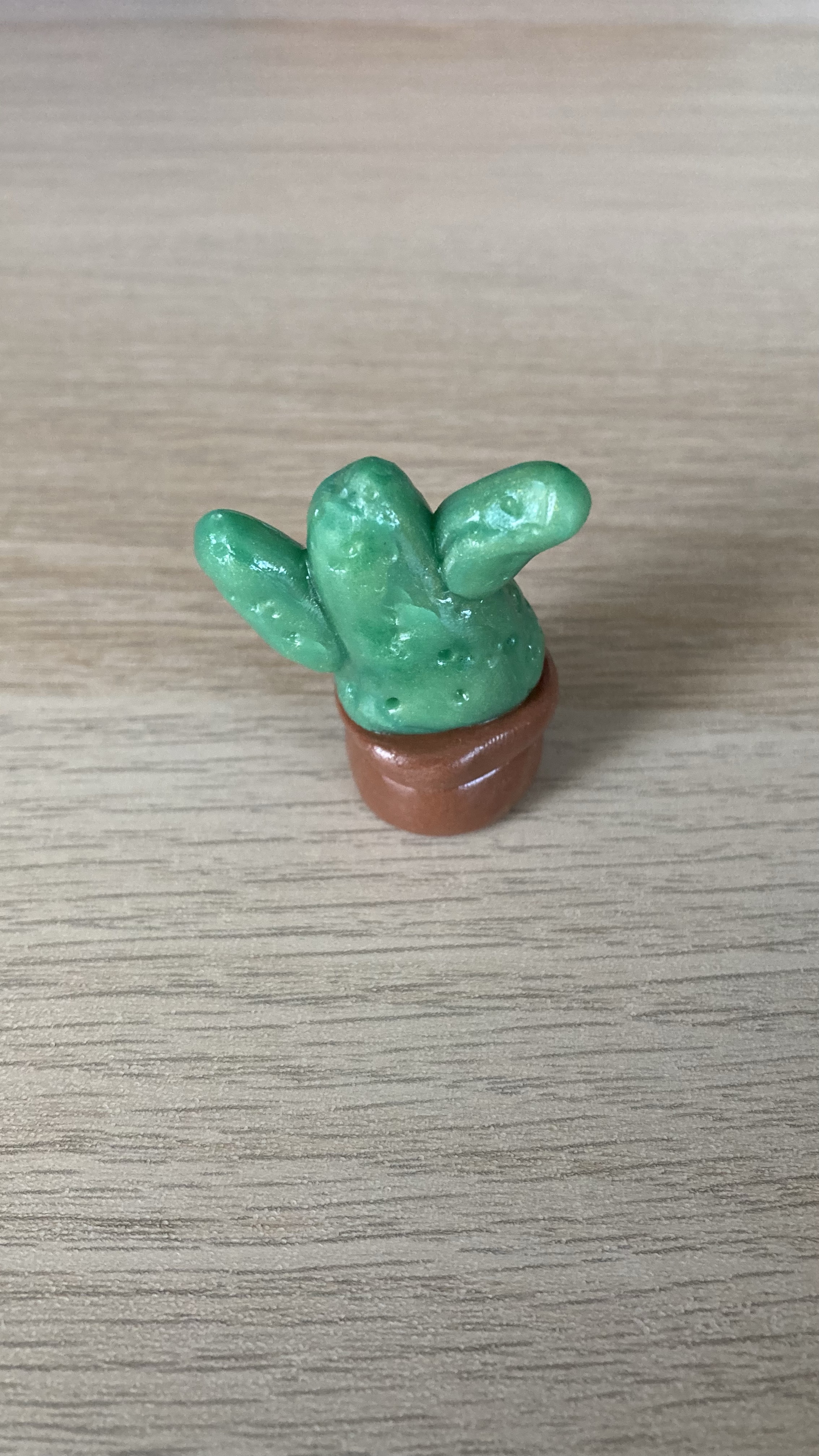
If we were having coffee, I’d share some of my new clay creations with you too. Like I think I said yesterday, I finally created a cactus on Monday evening.

Polymer Clay Cactus

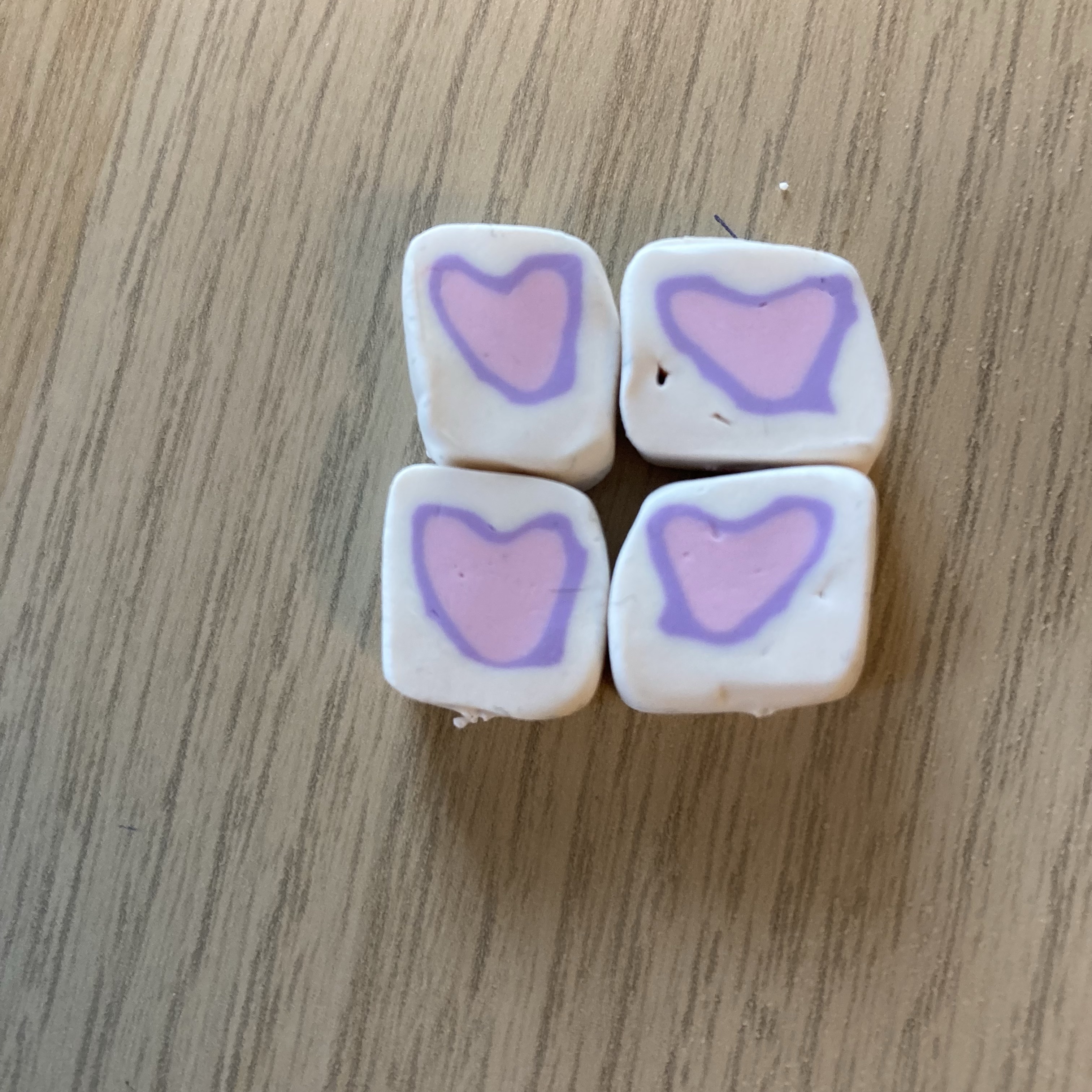
Then on Wednesday, I created my second-ever polymer clay cane. This one I did using a heart-shaped cutter for the image. I managed to do the reducing all by myself! Then I had my staff cut it into slices, which we then made into beads.

I also created several possible charms to go with these beads. One is a heart which I do kind of like. The other was a unicorn, but I threw that one away. I now only need to make more beads, because, even though I have more than just the four beads shown in the picture above, I don’t have enough for a necklace.

If we were having coffee, I’d share that, this afternoon, I have been experimenting with photo editing and meme making again. I didn’t have any success, of course. I mean, I found a photo editing app called Snapseed, which is relatively accessible with VoiceOver, but the one thing I wanted to do, ie. add text to an image, was not. That is, I couldn’t for the life of me figure out how to enter the text I wanted to add onto the image.

The result of all my experimenting is that now I have eight apps in my Photography folder on my iPhone rather than the four I used to have. And those four already seemed excessive, being that, besides the camera and default photos app, I only use one out of the two image recognition apps I have. Oh well.

If we were having coffee, I’d share about my nurse practitioner’s appointment on Thursday. I am so thankful we were still allowed to leave the home back then, because the appt was really productive. With respect to my new medication, the pregabalin, my nurse practitioner recommended I wait and see another two weeks before concluding it’s ineffective for my anxiety. We discussed my anxiety in a little more depth and also for the first time in a long while went into my diagnosis. He actually said he believes my diagnosis is DID (dissociative identity disorder) or at least some variation of it (ie. other specified dissociative disorder). I quickly talked over it saying it doesn’t really matter, as I know firstly he can’t diagnose me (but then again the psychiatrist can) and secondly I still haven’t had the extensive assessment required for a DID diagnosis in most places here in the Netherlands. That being said, it felt so good to be validated like this! My nurse practitioner also finally will make room for us to discuss my flashbacks at a later appt. He said the reason he didn’t go into it right then was the limited time left in our appt, but he’d definitely like to discuss it with me. That feels kind of weird, but in a good way.

If we were having coffee, lastly I’d share that I’m so glad the storms are finally over. Last Wednesday night, I hardly slept at all due to the high winds. Thankfully, last night and the night before that were better. My husband’s and my house did suffer some damage to the roof though. Hopefully insurance will be able to cover the cost of getting it repaired.

How have you been?

Autism Diagnosis and Rediagnosis: Do Labels Matter?

Earlier today, I saw a blog post about adjusting to a late autism diagnosis. The author didn’t receive her diagnosis till her mature years, while I was 20 when first diagnosed as autistic. Still, I could relate to some of the things she discusses.

Particularly, I related to the fact that diagnosis changed my perspective in quite a radical way. I was no longer just a bad, difficult person. I was autistic. Always had been.

As regular readers of my blog might know, I have had multiple autism assessments since my first diagnosis in 2007. The reason for this is complicated and mostly related to the fact that professionals kept questioning my diagnosis and wanting further testing. At one point, the records of my most extensive assessment disappeared due to a change of electronic record keeping systems and this led to my then psychologist jumping at the opportunity and removing my diagnosis altogether.

Most autism support groups online are open to self-diagnosed individuals. The main one I was part of at the time, however, I found out, was not. I was heavily criticized and distrusted by the other members after I’d lost my diagnosis. They thought my psychologist had finally unmasked me as someone with a personality disorder rather than autism.

Of course, I also needed an autism diagnosis in order to get the right support. With just borderline and dependent personality disorder on my file, I would be treated much differently by the mental health agency than with autism as my diagnosis. I wouldn’t be able to get support from the intellectual disability services agency either. Thankfully, I got my autism diagnosis back.

Interestingly, the psychologist who removed my autism diagnosis, always said that diagnoses didn’t matter, yet she was the one constantly throwing around new diagnostic labels at me. In a sense, an official diagnosis doesn’t matter, in that self-diagnosis is valid too, at least outside of the need for services. For instance, I self-identify with a dissociative disorder even though I haven’t had this official diagnosis in over eight years. However, to say that labels don’t matter and that all that matters are the symptoms, as she said, is quite frankly wrong. Especially in the context of the need for services.

After all, I am the same person with the same symptoms whether I am diagnosed as autistic or as having borderline and dependent personality disorder. The treatment approach is quite different though. With autism, I need structure and a fair amount of support. With BPD and DPD, I mostly need to be taught to self-regulate by being made to take responsibility. Of course, in an ideal society, services aren’t rigidly based on someone’s diagnosis, but in our current healthcare system, they are. Because of this, I am so glad I currently have a well-established autism diagnosis and that my current support team at least don’t question it.