Neurodivergence and Emotional Dysregulation

Hi everyone. On Monday, I listened to an episode of the Navigating Adult ADHD podcast. It was on emotional dysregulation and it’s been on my mind ever since.

I don’t have a diagnosis of ADHD, but have wondered for years whether my emotion regulation issues are “just” autistic meltdowns, whether I have borderline personality disorder like my psychologist in the psychiatric hospital used to believe, or whether something else is going on. So far, I haven’t found a satisfactory answer and, with that, I have not found something that helps.

I tried a ton of medications but none truly helped me, except for maybe my antidepressant. That is, obviously my antipsychotic did lessen my emotional outbursts, but it didn’t do so in a pleasant way. In fact, I only felt irritability or I felt nothing. That’s not emotion regulation but being numbed down too much.

I tried dialectical behavior therapy, which I still believe could’ve been helpful if the clinician hadn’t been so horribly invalidating. I mean, there’s quite a world between going along with every single emotion I describe without question (which I realize could be counterproductive) and telling me, albeit implicitly, that my entire way of experiencing things is invalid. I haven’t been involved with DBT for long enough to know whether it in itself is invalidating or whether it was just the clinician being judgmental.

In the podcast, the speaker described six ways in which emotional dysregulation can show up. I related to all of them, though some more than others. For example, my low frustration tolerance is truly debilitating. So is my inability to calm down. I literally still fret over things that happened at the intensive support home and these influence how I react to my current staff. My spouse and I also regularly fight over both of our (but more so my) inability to let go.

The things I relate less to, interestingly, are things I see as relatively “positive”. For example, I do get slightly over-excited at times, but not to an extreme degree. Then again, the fact that I don’t experience it to an extreme degree, is probably why I see it as “positive”: after mulling over negative things for weeks, I’d love something to get overly enthusiastic about. In reality though, finding a new hobby and buying all the “needed” supplies within hours, isn’t actually good for me financially. I just wish I’d experience that rush of excitement. Then again, when, rarely, I do, it often leads to even lower lows afterwards.

I’m joining in with #WWWhimsy.

Neurospicy Burnout

Hi everyone. A few days ago, I listened to a podcast episode on autistic burnout. It’s the most recent episode of Beyond Chronic Burnout, a podcast for autistic women (and other marginalized genders, I hope) and their helping professionals. It discussed the Spicy Pepper burnout questionnaire, which apparently is a questionnaire to determine your level of burnout. I got overloaded trying to find the actual questionnaire amid all the ads etc. and it looks like the website it was published on, isn’t particularly screen reader friendly, so I wasn’t able to take the test. However, from the descriptions discussed on the podcast, I believe I’m in quite a significant burnout and have been for, well, years.

What is autistic burnout, you might ask? Autistic burnout is like regular burnout from being overworked, but it is really more like being overworked living life in a world not designed for autistics. As I have said for many, many years, just living in a neurotypical world is hard work for me.

I want to clarify that autistic burnout is often amplified by co-occuring conditions such as ADHD. In fact, writing this just reminds me of something I read several years ago that said that having fibromyalgia, which is often agravated by stress, is often correlated to ADHD. This is why I refer to neurospicy burnout.

The podcaster claimed that the first signs of burnout in autistics usually appear between the ages of four and six and many autistics experience their first actual burnout between the ages of six and ten. This was hugely validating. I, at age five, fell ill with what my parents claim was the flu, but it did lead them to get me into special ed quicker than originally intended. Age seven is always when my parents claim I changed from a cheerful, happy child to angry and depressed. This correlates with my having to start learning Braille, so according to my parents I then became aware of my declining vision. This is probably correct, but it doesn’t mean that my difficulty accepting my blindness was the only or main problem.

The first warning sign of autistic burnout, the podcaster says, is suicidal ideation. Oh my, can I relate! I honestly always thought that the first sign of burnout, whether neurospicy or work-related, was exhaustion. That with the fact that I react to overload with overactivity and irritability, always made me believe I’ve never had “real” burnout symptoms. Now I realize that I may not have fully collapsed (yet), but I do certainly experience burnout. And have for, well, my entire life since I was seven, I guess.

Therapy, Counseling and Coaching for Mental Health and Personal Growth #AtoZChallenge

Hi everyone. Today for my letter T post in the #AtoZChallenge, I want to talk about therapy and other forms of support when you’re dealing with mental health problems and/or when you want to grow as a person.

Generally speaking, therapy isn’t for personal growth, although as a person you may grow when overcoming mental health problems. What I mean by this, is that your therapist isn’t just a sounding board and they aren’t your friend. If you’re feeling pretty good overall, formal therapy at least here in the Netherlands isn’t what you should be looking for. After all, therapy is aimed at helping you, in as little time as possible, to overcome your mental health problems. Here in the Netherlands, in fact, there’s a limit on the number of psychotherapy sessions you can get covered by health insurance. Of course, you could pay out of pocket for more, but if you’re reasonably well-adjusted, why should you?

Coaching and counseling are much more affordable and accessible because anyone can call themselves a counselor or coach. This also means that you’ll find coaches or counselors who align with almost any spiritual or psychological teaching. There are Enneagram coaches, for example, even though the Enneagram is actually nonsense. Did I, a person who frequently writes about herself as an Enneagram type 4, just say that? Yes, I did.

There are, of course, also coaches or counselors who do work within the framework of science-based psychology and education. For example, many people call themselves ADHD coaches and they do (I assume) have some knowledge of the current ideas surrounding ADHD.

Psychotherapy is, here in the Netherlands, often heavily protocol-based depending on your diagnosis or main problem. This is also what I’ve often found frustrating. Like, when I was diagnosed with borderline personality disorder, my psychologist wanted to do schema-focused therapy, but the modes and all that didn’t fit in with my experience of being plural.

At other times, therapy didn’t suit me because, while I sort of understood the theory, I wasn’t able to apply it in practice. This is why I eventually stopped doing dialectical behavior therapy.

I personally don’t do well with therapies that are merely focused on skill-building or that are primarily verbal (talk therapy). I have had the most success with art and movement therapies. I currently do movement therapy based on the Sherborne method. This is a sensory and attachment-based therapy approach. For example, today my therapist brought a multisensory tool called CRDL. When both of us touched the tool with one hand and touched each other’s hands or arms, the CRDL made different calming sounds. This is helping me regulate far better than any DBT skill helped me.

Keirsey and Others on Temperaments #AtoZChallenge

Hi everyone. I had it in mind to discuss David Keirsey’s temperament sorter for my letter K post for a while, but when I discussed him with my spouse, my spouse pointed out all sorts of things about Keirsey that make him a rather dubious person. Then again, there’s hardly any topic in this challenge that I haven’t been critical of. So Keirsey it shall be for my title, but I’ll talk about temperaments more broadly.

The first person to describe temperaments was Hippocrates in ancient Greece. He believed that health is based on a balance between the four major bodily fluids and that each person has a dominant personality type based on which fluid is more present. These types are sanguine, choleric, phlegmatic and melancholic. I looked them up and am definitely a melancholic type.

This idea, though it was used in medicine and psychology for many centuries, was eventually rejected in the mid-1800s. That being said, in anthroposophy and Waldorf/Steiner-based schools, variations are still used.

This brings me to Keirsey. David Keirsey (1921-2013) revised the ancient temperaments and connected them to the Myers-Briggs personality types, which I’ll get to in a few days. He first published his Keirsey Temperament Sorter in his book Please Understand Me (1978). The four Keirsey temperaments are the Artisan, the Guardian, the Idealist and the Rational. I honestly think these names are more positive than the classical ones. At least, I’d rather be called an Idealist than melancholic. That being said, according to Keirsey, the Idealists are not primarily melancholic but hyperesthetic (overly sensitive). Oh, I guess Keirsey didn’t solely think positively of the types.

There’s more controversy associated with Keirsey. At one point, he claimed that ADD/ADHD is a hoax and that children with this diagnosis should not be medicated but instead treated through “logical consequences”. I can understand the idea of not medicating children for a disorder that at this point is still solely diagnosed based on behavior, but I do not agree that the disorder is a hoax.

How Sensory Seeking Manifests in Me

As those who visit my blog regularly will know, I am autistic. My assigned staff put “highly sensitive” rather than autistic on my basic info sheet. This isn’t necessarily incorrect, but it is definitely incomplete. Not just because autism encompasses more than sensory processing challenges and because the hyped-up term of “highly sensitive” doesn’t come close to describing my level of overload, but also because in certain ways, I am not hypersensitive at all. Today, I want to talk about the ways in which I am, in fact, a sensory seeker.

The main aspect in which I’m a sensory seeker, is reflected in the way I approach food. I love love LOVE spicy food. I also love crunchy food. I can’t stand mash, because that is about the polar opposite of both. Honestly though, I find the texture matters more than the flavor, since mash didn’t get better with lots of black pepper on it and I can handle bland yet crunchy foods.

I also chew on hard candy. Like, I’ve tried sucking on it, but I really can’t manage to do that for more than a few seconds before I need to break the candy. Another example, but I’m not sure whether this is sensory seeking or lack of proprioception and/or coordination, is the fact that my staff tell me my spoon always clanks against my teeth quite loudly. I also realize now that drinking my coffee quite hot is probably a sign of being a sensory seeker.

With the sense of smell, I have a love/hate relationship. I love my essential oil diffuser, but don’t usually wear perfumes and can’t really stand anyone else wearing them.

In the tactile sense, I’m definitely a sensory seeker. This doesn’t mean I like all kinds of touch. I mean, I can’t stand it when people unexpectedly pat me on the back. Truthfully though, it should really go without saying that you should never touch another person without asking them first.

However, I love tight hugs, or used to before I broke my collarbone in 2019, which never properly healed. I also love to be rough when brushing my hair and am probably a bit rough when brushing my teeth too. When I wear my hair in a ponytail, it has to be tight too. And my shoelaces can’t really be tied too tightly. And yes, my spouse took up the challenge, only to tell me that, even though I didn’t think they were too tight, they actually were.

I of course need to mention my weighted blanket here too. It is 12kg, which is between 20 and 25% of my body weight. That’s on the heavy side as far as I’m aware. Of course, I got it when I still weighed nearly 20kg more than I weigh now, but then I’d often end up adding another weighted blanket on top of it.

Another aspect of sensory seeking I need to mention is being in constant motion, even if it’s small movements with my fingers or toes. I am not diagnosed with ADHD, though sometimes I think I could have it. I wasn’t extremely hyper as a child – in fact, my parents would describe me as a quiet child. However, I was definitely jumping onto lots of things. I no longer do this, but mostly because I can’t due to my decreased mobility. Now that I think of it, honestly I’m pretty sure that my need to walk a lot, is also a sign of sensory seeking and/or hyperactivity.

With respect to the sense of sound, I’m not generally a seeker. I do listen to soothing music on my music pillow when trying to get to sleep, but that’s it. I can’t stand background noise. Like, some staff suggest we have music on in the background while we play games, but I really can’t concentrate then.

Lastly, of course, is the sense of sight. I’m blind now, obviously, but when I was younger, I still had some sight. I definitely was a sensory seeker when it came to the visual modality. The most striking example is the fact that I’d often make shadows on my desk with my hands and look at them.

There are many other ways in which I express sensory seeking, but you get the idea. All this being the case, don’t discount my sensory overload just because I can be a seeker in other circumstances.

My Random Musings

Also linking up with Senior Salon Pit Stop.

Hyper #WotW

Hi everyone! I haven’t felt like writing over the past few days because I’ve been perseverating on polymer clay. Today, I thought I’d write a post after all to sum up my week and my word for this week is “Hyper”. After all, I’ve not just been perseverating on a special interest, but it’s been costing me my sleep too. I was almost going to choose “Manic”, but that would be appropriating the bipolar community, as I doubt my episodes are bad enough to qualify even as hypomanic. They’re more like autistic or ADHD (not that I have that last diagnosis either) hyperfocus. So yeah, hyper.

I’ve been literally working with polymer clay for hours everyday except today for the past week. I’m improving, but not as fast as I’d like.

And it’s not even that I’ve created anything worth mentioning really. I mean, yesterday I decided to bake a project, but it didn’t turn out as good as I’d hoped.

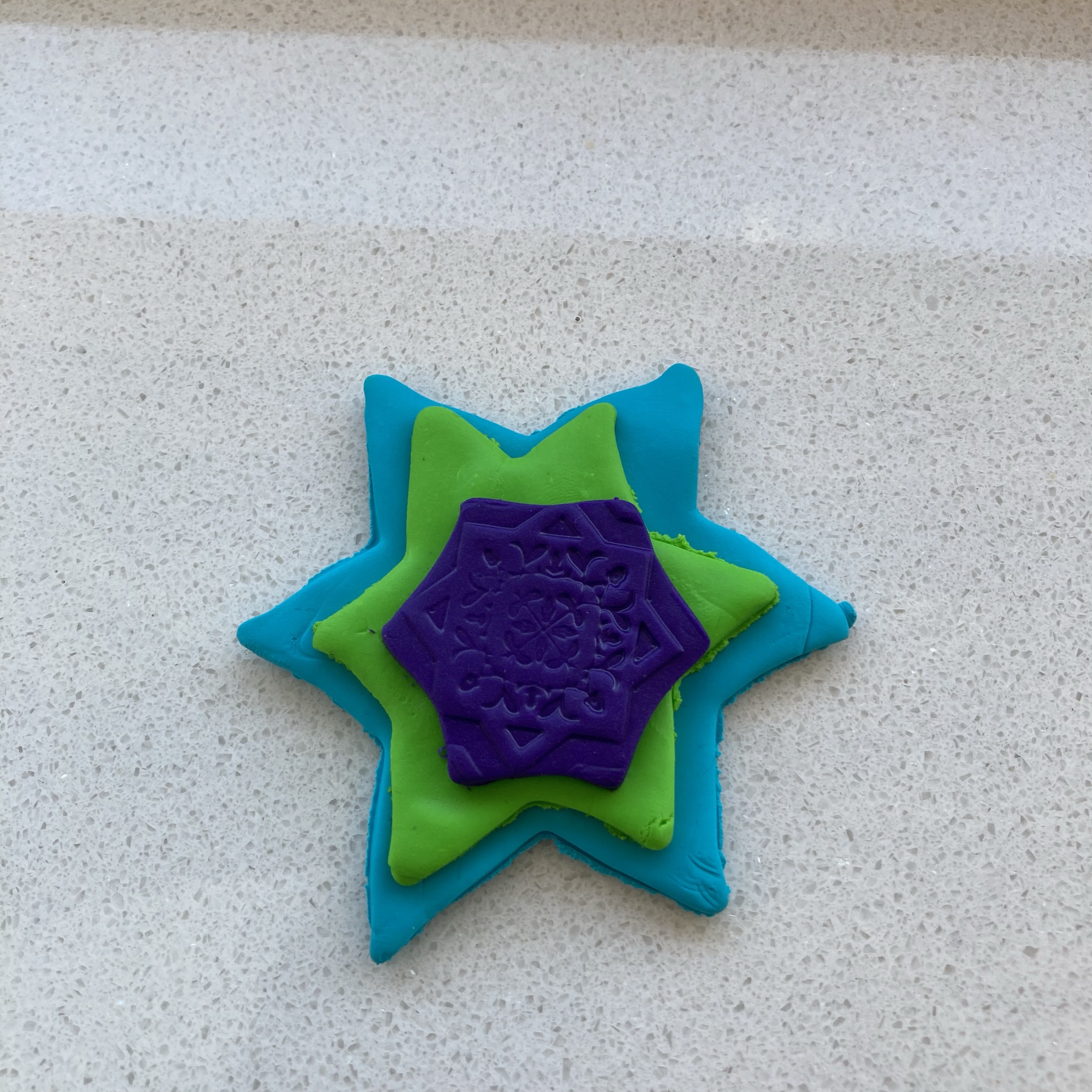
Multi-Layered Polymer Clay Star

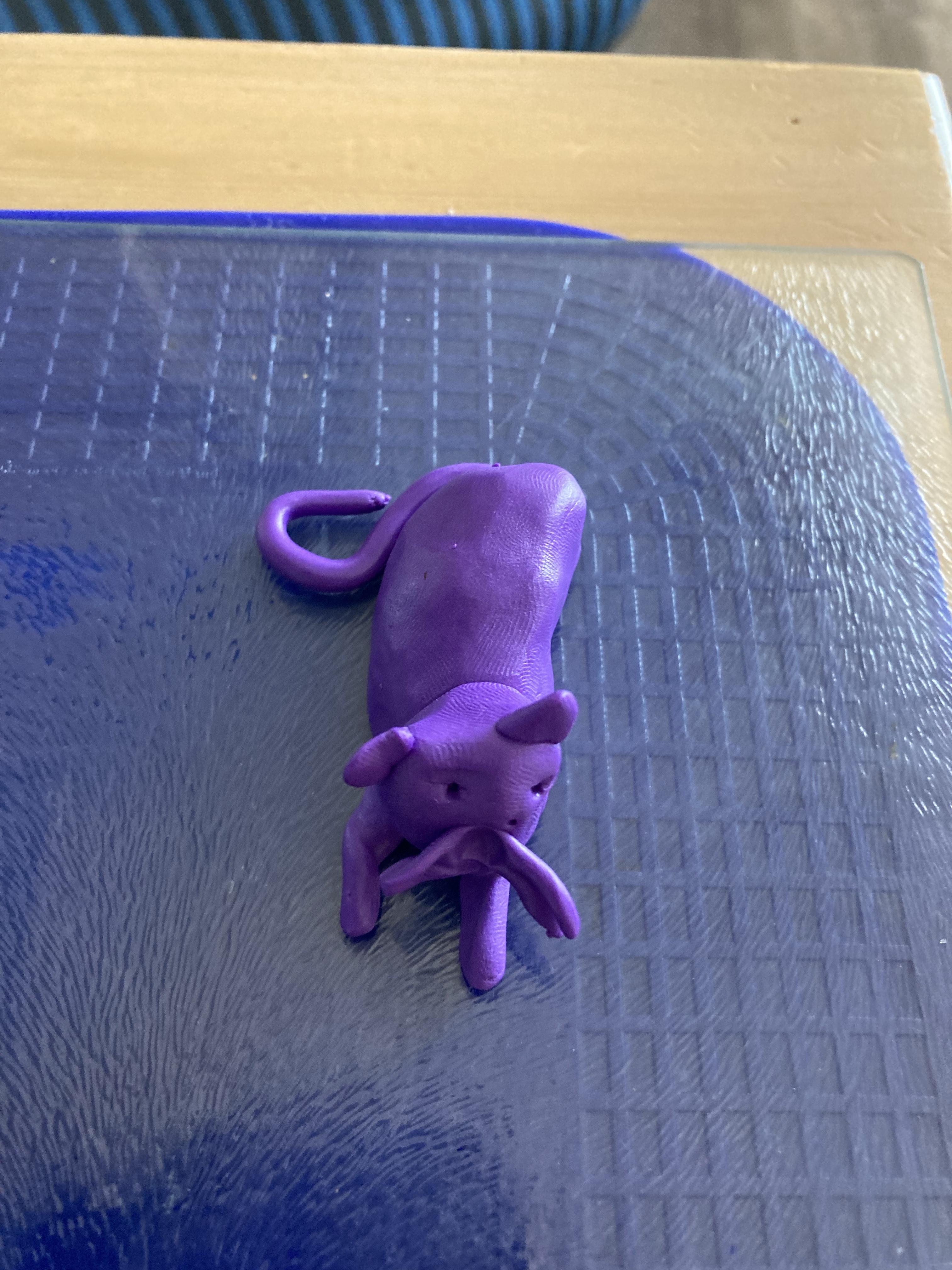
Okay, I did create a purple cat on Wednesday, because my husband had been asking for it everyday for a week. Purple because it’s the least ugly color for a cat out of the ones I currently own. My husband said it was pretty well-proportioned except for its whiskers, but then again that’d be practically impossible to do with actual polymer clay. I didn’t bake this figurine though.

Purple Polymer Clay Cat

Yesterday, like I said, I did bake something, but I was quite disappointed in its outcome. For this reason, I was up late ruminating about how to prevent it from getting ugly again. As you might see, it is a multi-layered star, so I figured if I baked the bottom layer first and then attached the unbaked second layer, baked again and so forth, it should work. I also figured I’d create my piece directly on the baking surface as to not have to move it too much. Well, there I made a mistake, because the baking surface I normally use is an oven dish normally also used for food. I until now figured it wouldn’t be a problem since I lay parchment paper under my polymer clay. Until today, that is. So now I promised my staff a new oven dish.

After this happened, I decided to give up polymer clay until I can go to the hardware store to get myself a tile to bake on.

In addition to hyperfocusing, I’ve also been spending more money than may be considered sensible. I mean, like I said a few times before, I won’t go broke anytime soon with my current spending habits, but with the fact that my special interests tend to be short-lived, it may not have been wise. On Thursday, I ordered some cookie cutters and an alphabet clay stamp set at an online store, only to be told yesterday that not everything is in stock and hence my order would probably be processed a week later. Then in the evening, I impulsively bought a whole lot of polymer clay supplies, including cookie cutters, from someone on Facebook. It seems to have gone alright, both the paying and the actual supplies being on their way. I decided to cancel my store order that evening. I might order the stamp set separately later.

Overall, though my perseverating might be a little worrisome, I’m trying to reason that I’m not getting into trouble yet and won’t in the foreseeable future even if my state of hyperfocus continues for a while. And it most likely won’t. The only thing I can hope for is that I won’t give up on the craft entirely then.

Word of the Week linky

Working On Us Prompt: ADHD

It is Wednesday and that means Beckie has launched another topic in the Working On Us Series. I badly wanted to participate last week, when the topic was (complex) PTSD. However, I felt too low on energy then. This week, the topic is ADHD.

I was never diagnosed with ADHD, so in this sense I have little to add here. I, however, do experience many symptoms that could be signs of particularly inattentive-type ADHD. They overlap a lot with autistic symptoms though, which I do have a diagnosis of. At this point, I don’t think it’s necessary for me to get an official ADHD assessment. Most groups for adult ADHD/ADD welcome self-diagnosed individuals and those who are questioning, like me.

Symptoms I relate to include restlessness, both physically and mentally. I’m not necessarily hyperactive in that I blurt out random things, but I do fidget like all the time and my mind is usually racing. That is, it is either racing or completely shut off, like when I’m low on energy.

The same really goes for impulsiveness: I’m not impulsive in the typical way, but I am in less typical ways. For example, every need feels urgent to me. This applies to basic human needs like eating – when I feel hungry, it feels as though I’m literally starving -, but also to other wants and needs. This could be related to autistic sensory processing issues, but I believe it’s more than this, especially since it doesn’t just apply to sensory or bodily needs.

As for inattentiveness, I can’t usually pay attention to something unless it really interests me, in which case I hyperfocus and become totally absorbed to the exclusion of other activities. I know this is an ADHD trait, but it is also common in autistics and I’ve always wondered whether everyone doesn’t have this issue to an extent.

Lastly, my executive functions seem to suck. My memory for random words or digits is about average and used to be above-average, but for everyday life experiences (particularly others’ experiences) and daily tasks, it’s pretty bad. I was told when I did a behavioral memory test (where you have to retell a short newspaper story) as part of my autism assessment, that my memory is detail-oriented.

With respect to planning and organizing tasks, I suck at those and always have. I used to do pretty well when faced with a deadline, but even then I struggled to organize tasks. I recently read that ADHD children often learn to do tasks on high adrenaline. The reason is often that neurotypical adults assume that, if a child is capable of something relatively difficult once, they must be able to do it all the time and must be able to do all assumed-to-be-easier tasks in that category. For this reason, neurotypical adults often force ADHD children into doing tasks they cannot yet do, assuming they can, and as such cause the child high anxiety. This causes an adrenaline rush, which temporarily increases the child’s ability to perform.

When I read this conversation on Facebook (it was originally posted to Tumblr but I don’t know where), so many bells rang in my head. Like many people referred to in this conversation, I can sometimes do seemingly more complex tasks while not being able to do simpler tasks in that same category. I am also very inconsistent in my abilities, usually being able to perform a task under pressure better, but with less pleasure. For clarity’s sake, this conversation was meant to explain the harmful effects of forcing children to do tasks they feel they are not capable of.

Since I do not have an ADHD diagnosis, I’ve not had any treatment specific to it. I’m also not on ADHD medication. I, however, find that some coping strategies that work for ADHD individuals, do work for me.

Autistic: Living Life on the Spectrum #AtoZChallenge

Welcome to day one in the #AtoZChallenge, in which I’ll share a collection of miscellaneous musings. For my first post, I’d like to talk about a topic people who used to follow my A to Z posts on my old blog, are thoroughly familiar with, since I chose it for my theme in 2015 and 2017: autism.

I was first diagnosed with autism at the age of 20 in March of 2007. The clinician who diagnosed me, didn’t give me an Asperger’s Syndrome diagnosis, like my support staff at the time had wanted. I didn’t care, as I at the time already didn’t subscribe to the rigid subtypes of autism, be it Asperger’s, PDD-NOS or classic autism, or high-functioning and low-functioning autism for that matter. I believe autism is a spectrum condition presenting differently in every affected person.

Later, in December of 2007, I was diagnosed with Asperger’s after all. This remained my diagnosis, along with a few mental health conditions, until the summer of 2016. Then, my autism/Asperger’s diagnosis got taken away. The psychologist who changed my diagnosis, claimed that my premature birth and the brain bleed I suffered as an infant, preclude an autism diagnosis. As if those genetically wired to be autistic are somehow exempt from being born prematurely or suffering brain bleeds. I know that, because the exact cause of autism is still unknown, it may be hard to differentiate autism from the mental effects of brain injury. However, since said psychologist couldn’t diagnose me with acquired brain injury either, because I sustained the brain bleed before age one, I ended up with no diagnosis at all that could explain my social cognitive differences.

I sought an independent second opinion and, on May 1, 2017, was rediagnosed with autism spectrum disorder under DSM-5. I am diagnosed with level 1 ASD, which is the mildest kind. I am pretty sure that, if the psychologist had taken the opportunity to assess me in a more natural environment, I’d be diagnosed as level 2.

Autism is still diagnosed based on the presence of social communicative difficulties and repetitive behaviors and interests. As of the release of DSM-5 in 2013, sensory issues are finally part of the diagnostic criteria. In my opinion, they aren’t given nearly the amount of attention they deserve. Neither are executive functioning difficulties. This is a term which describes organizational skills. I scored high for ADHD on the initial screening tool, but couldn’t be further assessed for it. Though I’m pretty sure I have some ADHD-inattentive traits, they could just as easily be part of my autism.

Autism, like I said, presents with social communicative differences. These include, in my case, difficulty making and keeping friends, difficulty interpreting non-literal language and tone of voice. Of course, because I am blind, I cannot read body language. My conversations also tend to be one-sided, in which I’m either the listener or the talker.

The other criterion of autism is the presence of repetitive behaviors and interests. I engage in near-constant stereotypical, self-stimulatory movements (or “stimming”). My language can also be repetitive, but this is particularly clear when I’m overloaded. As for special interests, I don’t have a lifelong obsession, like Temple Grandin does with animal behavior. Rather, my interests, though they change often, can be obsessive in intensity and focus. For example, I used to have an obsession with calendar calculation (calculating what day of the week a certain date falls on).

My main autistic trait though is overload. This is also a common brain injury symptom. In that sense, I’m doubly blessed.. I tend to be both sensorially and cognitively very easily overloaded. This then causes me to stim more, use echolalia (repeat other people’s words) and may lead to meltdowns or shutdowns.

Something interesting about overload is that it rarely occurs when I’m engaging with my special interests. This may make you think I’m just lazy, but I’m not. For one thing, my special interests involve little offline interaction. For another, they are my special interests because I’m good at them.

I hope that through this post, you’ve gotten a little glimpse into my life with autism and learned something new. For those not aware, April is autism awareness month. I encourage you to read other blogs by autistic people. You will find that most have a kind of difficult relationship with autism awareness month. I, like them, prefer autism acceptance.