Coming Out Day 2025

Hi everyone. It’s once again been more than a week since I last touched the blog. I keep telling myself that I should write only to be distracted by other things once I feel able to write. I’m struggling badly, but I know my blog helps me feel connected to the world too. I originally intended to look at today’s prompt for #SoCS or to write a post for #WeekendCoffeeShare. Then my best friend pointed out that it’s coming out day today.

Though I was open about being queer when I first started writing online in 2002 and I was advocating for trans rights on my first blog on WP, I haven’t been very clear about my identity over the past fifteen years or so. Part of the reason is the fact that I’m still figuring things out even now that I’m 39. Is that even possible? Part of the reason though is also fear. I know some of my regular readers are Christians and I don’t want to elicit negativity from them. Then again, is having to deny part of myself in order to please others, actually a wise choice? I remember first starting this blog with the intention of writing from the heart and now I’m not doing that.

So, let’s get into it. With respect to sexuality, I’m mostly asexual but have experienced attraction to women. When I was a teen, I met a girl and felt the butterflies in my stomach, but I never met her again and honestly am to this day clueless as to whether my attraction to her was sexual. I’ve had other fleeting crushes but nothing that indicated I felt like I wanted to be intimate with anyone.

My partner and I are more best friends than lovers and neither of us ever felt any attraction to the other one. In fact, I remember letting her wait for four months when she disclosed she had a crush on me. A lot of our earlier “love” was based on societal expectations. Now that we’re clear about our queer identities, we’ve also decided we will no longer do anything we don’t feel comfortable with. That’s one reason we considered divorcing.

I knew I was asexual for many years, but felt like hiding it because of societal expectations too. Who cares about labels, I sometimes thought. Who’s going to check whether my partner and I have sex? Obviously, no-one is, but it often did feel like I was denying part of myself when I was pretending to be in a sexual relationship. In truth, I’m probably never going to be in a sexual relationship and that’s fine by me. Being emotionally very vulnerable, I sometimes even feel that I can’t maintain the expectations of a friendship. That’s probably why my wife is my only friend. I sometimes try to expand my circle of connections, but it’s really hard.

I do consider myself to be on the aromantic spectrum too, though that’s more complicated than the asexual part. I, after all, did and to an extent still do enjoy giving my wife heart-shaped polymer clay creations. It makes her feel uncomfortable, so I don’t do it anymore.

I still sometimes consider myself a lesbian based on the attraction I can experience. Because one of my fleeting crushes in high school was on a boy, I have considered that I might be bisexual or pansexual, but I’m heavily lesbian-leaning if that’s the case.

With respect to gender identity, I’m cis but somewhat gender non-conforming. I strongly identify with being a woman, which is clear from the fact that most of my online nicknames were/are gendered. I however don’t know how much of this is societal expectations once again and I do find my gender expression isn’t all that feminine. Honestly, in this case, I’ve stopped caring about labels, but then again I realize that’s a privilege too as I’ve learned to deal with the dysphoria I do experience. For example, I don’t have to worry whether my discomfort with my cycle is due to sensory issues, feeling too vulnerable or is actually related to my gender, as I take the birth control shot so no longer menstruate.

All this being said, being queer isn’t a strong part of my identity, but it is a part of it. I am glad I’m able to be open about it now, if for no other reason, then because it felt like I was constantly jumping through hoops trying to avoid being too open about the realities of my marriage.

Romantic?

Daily writing prompt
What’s your definition of romantic?

Well, this is an interesting question. One could define romantic as a form of attraction, ie. being in love or having a crush on someone. In that sense, I would say I rarely if ever experience it. I mean, I had childhood crushes, but the reason I called these crushes was more because that’s what everyone else called them. You know, when a girl and a boy hang out, they are almost automatically assumed to be in love. And even when I found out I liked girls more, I still said I was “in love” because everyone my age had a boyfriend or girlfriend.

When I met my now best friend, both of us probably had similar thoughts of what sharing our life was supposed to mean. We now realize we weren’t looking for a romantic partner but for a best friend. So that’s what we are. We are technically still married, but we aren’t in love. Honestly, never were.

Then, “romantic” can refer to an expression of thinking someone is special. In this sense, I am quite romantic. I am a sucker for hearts even though they make my best friend feel slightly uncomfortable now that we’ve clarified to each other that we aren’t in love. In this sense, the feeling of having a crush on someone, for me, is quite different from feeling that they’re special. I must admit I’m still figuring these things out though.

#WeekendCoffeeShare (April 27, 2025)

Hi everyone. I really wanted to write a #WeekendCoffeeShare post yesterday, but was dealing with neck and shoulder pain and was quite tired, so I lay in bed by 9:30PM. I originally intended this to be a quick lie-down and planned to write my post after my music pillow had auto-disconnected after thirty minutes. Well, before those thirty minutes were up, I set the pillow to keep playing until I either manually turned it off or its battery was empty. Guess what? I know for a fact that the latter happened sometime during the night, because the pillow was no longer connected when I woke up at 8:30AM, but I swear I didn’t hear its pretty loud sound indicating it needs charging. I slept like a log!

Anyway, all this to say I’m doing my coffee share on Sunday evening. I’ve just had my last cup of coffee for the day, but I can serve you some soda or tea. Let’s have a drink and let’s catch up.

If we were having coffee, first as usual I’d talk about the weather. We’ve had some rain, some sunshine and some clouds. Today, the daytime temp was 19°C. We’re supposed to get almost summerlike temps of 23-24°C this coming week.

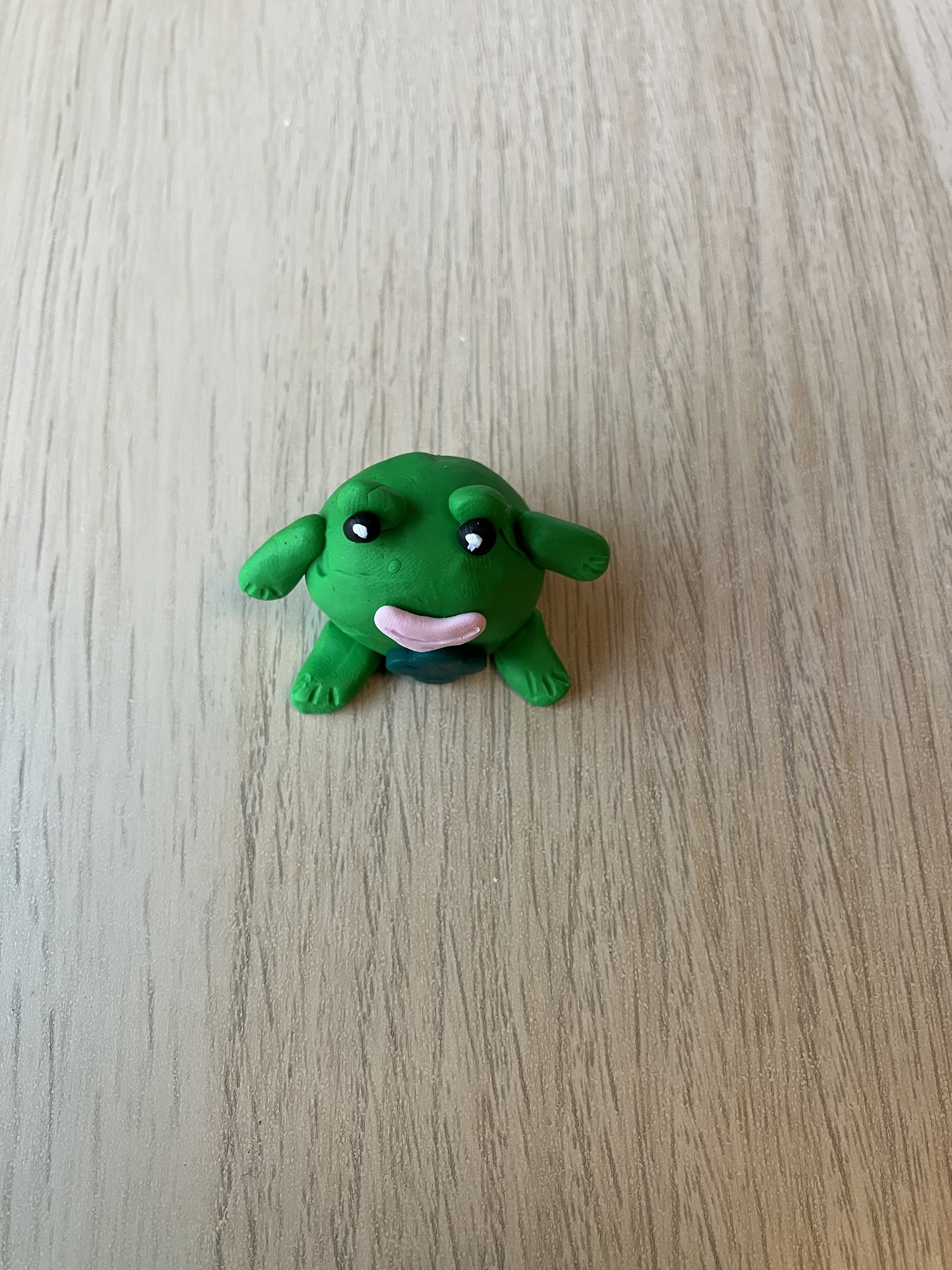
If we were having coffee, next I’d share that I’ve been crafting again. I made several polymer clay frogs for staff members who are recovering from surgery. The frog (Dutch: “kikker”) is sometimes used as a symbol for cheering someone up (“opkikker”). The first one took me over an hour to finish, but the second one was so much easier once I’d figured out how I wanted it. Here’s the second one.

If we were having coffee, then I’d tell you that I have a new assigned staff. One of my two assigned staff is on long-term leave for familial reasons and the other is a student. I had been a bit angry at the student for various reasons, among which her way of communicating the temp worker situation with me. The new one will be my assigned staff together with the student. I can get along with her pretty well.

If we were having coffee, finally I’d make use of the fact that I write my coffee share on Sunday to share that my spouse and I had an important discussion today after our outing to have lunch and shop. We have made up our minds that we’re getting divorced. We will continue to be best friends, but since there’s no sexual or romantic component to our relationship and we’re not living together nor intending on ever doing so again, it makes sense that we officially divorce. We have been having this on our minds for several months already, so the discussion, though hard, wasn’t altogether a surprise to me. We mostly need to work out how much my spouse owes me for my contribution to our mortgage, so that the house can be completely my best friend’s and no longer mine. I guess I will from now on refer to my spouse as my best friend to ease the transition for me.

It may seem like I’m not affected emotionally by this decision, but I am. I mean, I’ve mentioned a few times that my spouse and I will always be soulmates, but the fact is nothing is for certain. When we got married after all, it was to affirm our everlasting love to one another. Though our feelings for each other haven’t changed all that much since we first met in 2007, there’s this voice in me telling me this is the beginning of the end. I tell myself this is attachment anxiety talking. Whether it is or this fear is real, doesn’t really matter in the present moment though, as right now we’re still soulmates.

Positive Psychology: The Science of Optimal Wellbeing #AtoZChallenge

Hi everyone. For my letter P post in the #AtoZChallenge, I want to talk about positive psychology. Positive psychology, first developed by Martin Seligman at the beginning of this century, is focused on optimal wellbeing as opposed to overcoming mental health problems. After all, according to Seligman, curing the negative (such as depression or anxiety) does not produce the positive. As such, though positive psychology also focuses on interventions, its aim is to maximize people’s happiness rather than merely curing mental problems.

What are the main ideas behind positive psychology? First are the three types of happiness. These are hierarchical in order. Lowest on the ladder is the Pleasant Life. This refers to daily pleasures and indulgences. For example, I enjoyed a BBQ yesterday. Next up is the Good Life, which is achieved when people are engaged in their daily activities. This form of happiness is focused more on longer-term goals. For example, engagement might look like being passionate about your work, cultivating healthy relationships or pursuing hobbies. Highest up then is the Meaningful Life, which is achieved when people use their strengths and character traits to serve a cause greater than them.

I for one find myself mostly at the lowest point if even that. Occasionally, I try to work towards longer-term goals, but this easily gets overwhelming.

Next, positive psychology looks at the pillars behind happiness. These are summarized as the acronym PERMA or PERMAH. These stand for:


  • Positive emotions.
  • Engagement in activities: being truly present when doing something.

  • Relationships that are meaningful and intentionally investing in them.

  • Meaning in life: focus on a cause greater than yourself.

  • Accomplishment: achieving goals that are important to you.

  • Health, particularly physical health. This one is the most recent addition to the acronym. For physical health, research shows that three things in particular help: physical activity, healthy eating and sleep.

Like I said, in order to lead a Meaningful Life, people utilize their strengths and virtues. However, it may be hard to discover what your strengths are. To find these, researchers have developed the VIA (Virtues in Action) strengths survey. For some reason, I couldn’t register in order to take the survey.

Gratitude and grit are two more concepts in positive psychology. Grit is a focus on long-term goals. This is what keeps people going when they have temporary setbacks. Gratitude can also help people focus on the things they do have rather than the things they don’t.

Overall, though I know that positive psychology is actually science-based, it does leave me wondering how well people can actually influence their happiness. Positive psychology, though it might help people who aren’t struggling with their mental health in any major way, won’t cure significant mental distress. In this sense, the reverse of what Seligman said about curing the negative not producing the positive, is also true.

Love Languages and Relationship Development #AtoZChallenge

Hi everyone. Today for my letter L post in the #AtoZChallenge, I want to write about love languages.

First of all, what are love languages? Love languages, in general, are the ways we primmarily prefer to receive or give affection.

That being said, the concept that there are different love languages was first populated by Gary Chapman in his 1992 book The Five Love Languages. The five love languages, according to Chapman, are:


  • Physical touch, such as hugging, kissing and holding hands.

  • Gifts: expressing love through giving meaningful gifts that symbolize the relationship. For example, my spouse giving me a stuffed teddy bear holding a heart.

  • Quality time spent together. For example, my partner and I often go to Apeldoorn together.

  • Words of affirmation: compliments or other verbal expressions of appreciation. I think cute nicknames are a part of this too.

  • Acts of service, such as my spouse having put together my Ikea cabinet.

Of course, as you can see above, people in a healthy relationship share all love languages, but Chapman believed each of us has a primary and secondary love language.

Chapman believes that people often naturally express their love in the same love language they would like to receive love in. For example, if one person usually takes other people on outings, their primary love language might be quality time and this then is the way they’d like their partner to show them love. For instance, in this case the person would really like their partner to spend quality time with them.

Then, if the partner’s main love language is physical touch, they will more easily start hugging the other person rather than spending quality time with them. This may lead to awkward situations or even conflict, because maybe the other person doesn’t like to be touched. As such, it is important, according to Chapman, to know your partner’s love language and learn to express your love in that language when interacting with them.

So are the five love languages backed up by science? The short answer is “No”. First of all, there are more ways to express love than just these five. Secondly, though there is some research that shows people lean more towards certain love languages, it isn’t true that people have just one primary (and one secondary) love language. In fact, as you can see above, my spouse and I use all five and more.

Codependency and Emotional Dependence #AtoZChallenge

Hi everyone. For my letter C post in the #AtoZChallenge, I wasn’t really sure what topic to pick. I could go with cognitive functions, but without explaining personality typologies first, this wouldn’t make sense. Since I chose the broad topic of personal growth for my theme, I could however choose a topic that isn’t necessarily related to personality. IN this post, I’m talking about codependency.

What is codependency? In a narrow sense, it refers to certain behaviors exhibited by individuals in a close relationship with an addict. The addict is, in this sense, dependent on a substance (or behavior) and their partner is codependent, as in “second-degree dependent”.

I used to understand codependency as involving just enabling behaviors. For example, a codependent person might be manipulated into giving the addict access to their drug of choice. In this case, a person buying alcohol and giving it to an alcoholic, is codependent.

Actually though, codependency isn’t just the direct enabling of an addiction. It also happens in abusive relationships in which neither of the parties involved is an addict. For example, a person staying with their partner in spite of domestic violence, could also be seen as codependent.

Codependency, as such, is more related to being emotionally dependent on someone else despite them being in some way toxic. It could also be seen as compulsive caregiving.

For clarity’s sake, though their are certain individual traits that make someone more susceptible to becoming codependent, codependency is at least as much an attribute of the relationship as it is of the individual.

How can you heal from codependency? The first step is to set healthy boundaries. This means that boundaries are not so weak that they allow others to use you as a doormat and not so rigid that you end up self-isolating. Of course, what boundaries you set, depends on the person you’re setting boundaries with. For example, you may want to go no-contact with an abuser, but keep a supportive friend close by.

Another step in the healing process is to recognize yourself as a unique individual separate from the addict or abusive person you’re codependent on. And, for that matter, separate from everyone else in the world. This means learning about and validating your own preferences, wants and needs. As you learn to be more aware of your own individuality, you’ll start to develop greater emotional independence.

Healing from codependency will ultimately help you have healthy relationships with the people around you.

I am not currently in an abusive relationship and don’t have any close relatives who are addicts. As such, I am not really codependent on anyone at the moment. However, being that I grew up in a dysfunctional family, I do share some traits of emotional dependency. I was at one point also diagnosed with dependent personality disorder (DPD), even though my psychologist at the time only chose that diagnosis to make it look like I was misusing care. She actually claimed that I was perfectly capable of asserting myself, which people with DPD definitely aren’t.

Like I said, codependency is at least in part defined by the relationship, whereas DPD is a diagnosis meant for an individual. It doesn’t, however, take into account the fact that many adult children of dysfunctional families will end up showing (co)dependent behaviors in other relationships too.

Abandonment Wounds: What Will Happen If I Can No Longer Mask?

I’ve been struggling with attachment issues a lot lately. Not related to a specific person this time. I mean, yes, like I said on Wednesday, four of my “favorites” among the staff are either on leave or will be leaving (be it temporarily or permanetly) soon. That’s not the problem, since I’ve learned the hard way to expand my list of “favorites” when necessary. It’s in my best interest too to avoid a situation like the one with my assigned staff in Raalte, who was leaving and left me with just two other trusted staff.

The issue I’ve been dealing with lately, is much more existential: the knowledge that, if I’m truly myself, I’m unacceptable. Not because I’m some kind of criminal. I’m not. Rather, I’m an outcast. And while I won’t be in the prison system for that, being shoved around care home after care home while not having family to advocate for me, will be equally horrid.

I have been struggling with memories of the circumstances surrounding that assigned staff leaving. A few months before she left, I sent her a rather dramatic E-mail about how no-one will be in my life forever. Well, my spouse says we’ll always be in each other’s life, but truthfully we can’t know that. Besides, when we lived together, there were just a little too many situations in which my spouse (understandably) was disappointed in me that are however things I couldn’t help. For clarity’s sake: I don’t blame my spouse, but maybe with my being multiply-disabled, I’m not suited for “traditional” long-term relationships. Ha, now I’m reminded that my spouse often reminds me that I said when we were choosing to be a couple, that I didn’t want a traditional relationship.

Of course, the reason I’m undesirable by society’s standards isn’t my fault. Like, I can’t help being disabled. But just because it isn’t something I choose, doesn’t make it any less real or hurtful. In fact, it hurts more because I can’t choose not to be me.

I mean, I’ve masked more or less successfully for many years. Mostly less successfully, but my parents prevented me from landing in the care system at a much earlier age than I did by claiming the police and other people who thought I was disturbed, were just stupid. They were masters at manipulating the system. I am not.

Back to my assigned staff in Raalte. She was the first to take my wish to leave seriously. I assume she genuinely felt that the intensive support home could better serve me than the care facility, but I also assume she had a team and a manager to deal with and it remains a fact that some of her coworkers couldn’t cope with my behavior. Which was, for the record, much less challenging than it is now.

It genuinely scares me to think of what will happen if (when?) I can no longer mask at all. There was this news feature sometime in 1997 or 1998 about a girl, aged about sixteen, who was too intelligent for intellectual disability services but who still couldn’t cope in adolescent mental health services and was, as a result, restrained long-term. After her family sought media attention, she was transferred to a treatment center for youth with mild intellectual disability and severe challenging behavior. I don’t know what became of her.

Last week, when I had several severe outbursts related to my most recent frustration, I begged my support coordinator to ask the behavior specialist to involve the Center for Consultation and Expertise (CCE) again. I really want to get the ball rolling on getting them involved before it’s too late and I’m being kicked out again, like the last time they were involved in 2018. In this sense, a consultation might help more this time, because at this point, as far as I know, staff aren’t yet so much at their wit’s end that they see the situation as unresolvable. But I’m scared of what will happen if they do get to this point, like apparently some staff in Raalte were.

10 on the 10th (September 2024): This or That?

Hi everyone. Today I’m participating in 10 on the 10th. This month, it’s a fun this or that. Let’s get into it.

This or that: A long term meaningful relationship with someone you see only once a year (platonic or otherwise) or lots of short term relatively meaningless relationships with people you see regularly.
This is a toughie, as I’m not sure what “relationship” means. Do professional relationships count too? In other words, would I be completely on my own aside from the one time a year I’d see my significant other? That’s impossible for me. However, if it means not having any real connection with anyone else but they could still help me (yet how would we define “connection”?), I’d definitely choose the one meaningful relationship. I, after all, would choose my spouse even for a once-a-year visit over all the meaningless interactions with my staff. I however do need to receive care.

This or that: A bouquet of fresh flowers every week or a flowering bush every year.
A flowering bush every year! I don’t really care for bouquets of flowers and I’d love a flowering bush in my yard-space-thingy at the care home.

This or that: A luxury, all expenses paid cruise to the Antarctic or a week in a beach shack off the beaten path.
A cruise to the Antarctic. I’m not a fan of the cold, but no-one said we had to leave the ship. And I don’t care for beaches.

This or that: Pumpkin spice everything or pumpkin spice nothing.
Pumpkin spice nothing. The only thing with pumpkin spice in it I like a little is coffee, but it isn’t like I don’t enjoy coffee without it.

This or that: Warm, sunny days with high humidity or cold, sunny days with little humidity.
You’ll probably be surprised here, but I’d choose the cold but sunny days with low humidity. Having recently experienced warmer, high-humidity weather, I feel that as much as I loved the heat, I hated the humidity. Last night, in fact, was my first night of not sweating profusely and I am so glad for it.

This or that: A vintage real fur coat or a new faux fur coat.
New faux fur coat. Until I read Marsha’s answer, I didn’t even realize faux fur is bad for the environment, so I thought choosing the new faux fur coat would be a win-win: new coat plus less animal cruelty.

This or that: The car of your dreams wrapped with a logo of some kind or the car you currently drive.
I don’t drive a car, since I’m blind, so I’m going to choose for my spouse and we’re both happy with the “Freezer Fiat”, my nickname for the car my spouse currently drives. My spouse, in fact, only started the lease on it last January and this one is pretty much our ideal car. In this sense, I get it both ways. Although I personally wouldn’t mind a logo, I know my spouse wouldn’t tolerate it.

This or that: Beautiful stilettos crafted specifically for your feet or sneakers you’ve worn and molded to your feet.
I guess the point of this one is to choose between beauty and comfort and, if you’ve read about my shoe saga, you know I’d choose comfort. My orthopedic shoes are quite ugly but they’re comfortable. Same for my walking shoes, which I actually think are sneakers. Besides, I absolutely cannot walk on heels so stilettos would basically mean a life without walking.

This or that: The house of your dreams painted in colors you despise or a small cottage you can paint in colors you love.
I would personally choose the house of my dreams, but since that basically is a small cottage because I’d get lost in anything larger, I get it both ways again. I am blind, but still would love to have my little living space painted in all pastel lilacs and pinks.

This or that: Your favorite food every day for a year or foods you’ve never tried every day for a year.
My favorite food everyday for a year. I don’t like to try out new foods and would hate to have to try new foods each day for a year. Of course, it would get a little boring eating the exact same food everyday, but I’d take that over having to try out something I probably won’t like.

Friendship: What It Means to Be a Friend #AtoZChallenge

Hi everyone. For my letter F post in the #AtoZChallenge, I had a lot of choices and yet this actually overwhelmed me. I am once again doing a post on a topic I think I covered in 2019 too, ie. friendship. What does it mean to be a friend?

My spouse and I are best friends. Since we aren’t in a traditional relationship due to for example not living together, we need to find other ways to make our relationship work. However, we were friends before we were a couple.

As someone who didn’t have any friends beyond elementary school until I met my now spouse, I am not the best possible judge of what makes a friendship tick. I mean, I can look at what psychologists say about the development of friendships from early childhood into adulthood.

For instance, three-year-olds say someone is their friend because they play with them on the see-saw and “doesn’t want to be their friend anymore” as soon as the other child isn’t any longer interested in the same activity. I have this kind of relationship with some of my fellow residents.

As a child gets older, they develop more perspective about the fact that other children aren’t just momentary playmates, but their viewpoint is still very one-sided. For example, a six-year-old might consider someone their friend because they save them a seat at the bus or give them treats. They don’t yet fully comprehend mutual give-and-take though.

This follows at the next stage, which starts at around age six and continues throughout elementary school age. At this point, children are very fairness-conscious and usually have rigid rules for give-and-take.

At my very best, I am stuck at this stage. Usually though, I am at the second stage, hard as I find it to admit this. I, after all, usually only think of giving something in return for the things (material or immaterial) my spouse gives me when I’m in a very healthy place mentally.

At the next stage, which starts at around age eleven, children develop intimate friendships in which they mutually support each other. They help each other solve problems and confide feelings in each other that they don’t share with anyone else. Like I said, I never had friends beyond elementary school before meeting my spouse. Though I did and do confide in my spouse, I am pretty bad at offering my spouse any emotional support in return.

Finally, adolescents and adults have mature friendships in which they emphasize emotional closeness over anything else. They can accept, sometimes even appreciate their friends being significantly different from them. People at this stage emphasize trust, knowing their friendship will be long-lasting even through temporary separations and differences.

Hello Monday (May 8, 2023)

Hi everyone. My weekend was quite good, if a little hectic. I thought I’d share about it. I am linking up with Hello Monday.

On Saturday, I had a temp worker who was here for the first time as my one-on-one staff for most of the morning shift. Thankfully, I got along with him okay. This did mean I didn’t feel comfortable going on a walk, let alone working with clay or other crafty things. I did play a game of Yahtzee with a fellow resident in the morning. My weighted blanket was also finally put in the washing machine. I was a little worried that putting it in the dryer would damage it, but the staff told me he knew what he was doing. Thankfully, once I got back from Lobith on Sunday, I found out it was still intact.

In the afternoon, I got a new temp worker once again, but thankfully my spouse was here almost as soon as the evening shift started, so I didn’t have to deal with the temp worker long. We drove to my spouse’s and my house in Lobith, picking up groceries and Domino’s pizza along the way. I had the hot and spicy pizza with pepperoni, bell peppers, onions and jalapeños.

Because I hadn’t been walking all day on Saturday, I decided to do some dancing in the evening. Otherwise, I wouldn’t have reached my movement goal on my Apple Watch and I didn’t want to cheat by lowering it yet again (and I certainly didn’t want to break my 250-odd day streak).

On Sunday, we visited my in-laws for a bit. My mother-in-law and I went for a 40-minute walk through the village. In the evening, when I once again had a temp worker, but thankfully a somewhat familiar one, I went for two more 40-minute walks. Then, because I could, I danced some more. I finally doubled my movement goal on my Apple Watch for the first time in half a year.

Yesterday evening, I had a bit of an issue with my sister. I invited her to my birthday at the end of June, thinking that if I invited her now she would have plenty of time to make sure she actually could make it on one of the days my spouse and I are available. She got upset, because her and my youngest niece’s birthdays are first (this Saturday and on the 19th, respectively). She tried to ask me whether we would come over for her birthday too, which on the surface seems reasonable. However, being that she has both this weekend and the weekend after that planned pretty full with other family and, besides, we don’t do last-minute planning for trips that are this long (my sister and her family live over two hours away), I decided against it. According to my sister, the way it “works” in our family is everyone knows when our birthdays are and is welcome to come by, so it wasn’t like she should have invited me. Being the people pleaser that I am, I actually almost let her persuade me to allow her to ask her in-laws, whom I barely know, to pick me up when they would be visiting them on the 18th. Thankfully, my spouse intervened and told me that would be really unwise, since what if I have a meltdown either on the trip or when with my sister’s family? Finally, thankfully, it turned out she wasn’t really expecting us, but was just upset that I’d mentioned my birthday this close to hers. I can see her point.

Yesterday, as a side note, was my partner’s and my fifteenth anniversary of being a couple. I really feel pleased that we decided to “call it a relationship”back on May 7, 2008. We’ve overcome quite a few hurdles in those fifteen years, but I’m so happy that we’re stronger than ever together!