Neurodivergence and Emotional Dysregulation

Hi everyone. On Monday, I listened to an episode of the Navigating Adult ADHD podcast. It was on emotional dysregulation and it’s been on my mind ever since.

I don’t have a diagnosis of ADHD, but have wondered for years whether my emotion regulation issues are “just” autistic meltdowns, whether I have borderline personality disorder like my psychologist in the psychiatric hospital used to believe, or whether something else is going on. So far, I haven’t found a satisfactory answer and, with that, I have not found something that helps.

I tried a ton of medications but none truly helped me, except for maybe my antidepressant. That is, obviously my antipsychotic did lessen my emotional outbursts, but it didn’t do so in a pleasant way. In fact, I only felt irritability or I felt nothing. That’s not emotion regulation but being numbed down too much.

I tried dialectical behavior therapy, which I still believe could’ve been helpful if the clinician hadn’t been so horribly invalidating. I mean, there’s quite a world between going along with every single emotion I describe without question (which I realize could be counterproductive) and telling me, albeit implicitly, that my entire way of experiencing things is invalid. I haven’t been involved with DBT for long enough to know whether it in itself is invalidating or whether it was just the clinician being judgmental.

In the podcast, the speaker described six ways in which emotional dysregulation can show up. I related to all of them, though some more than others. For example, my low frustration tolerance is truly debilitating. So is my inability to calm down. I literally still fret over things that happened at the intensive support home and these influence how I react to my current staff. My spouse and I also regularly fight over both of our (but more so my) inability to let go.

The things I relate less to, interestingly, are things I see as relatively “positive”. For example, I do get slightly over-excited at times, but not to an extreme degree. Then again, the fact that I don’t experience it to an extreme degree, is probably why I see it as “positive”: after mulling over negative things for weeks, I’d love something to get overly enthusiastic about. In reality though, finding a new hobby and buying all the “needed” supplies within hours, isn’t actually good for me financially. I just wish I’d experience that rush of excitement. Then again, when, rarely, I do, it often leads to even lower lows afterwards.

I’m joining in with #WWWhimsy.

Variation and Deviation: What Is Typical vs. What Is Desirable

For today’s Friday Faithfuls challenge we’re encouraged to write about what “normal” means to us. I am reminded of the opening phrase to one of the Project 2025 training videos. Mind you, I didn’t see the actual video, but listened to an episode of the podcast, The Ace Couple, walking the listener through it. The goal of the video was to educate Project 2025 supporters about the language leftists (and presumably anyone else not in agreement with their garbage) use and what we (yeah, I’m one of those pesky leftists!) supposedly mean.

The opening phrase was: “I’m just a normal American woman.” The speaker then went on to describe what she supposedly would be called by the Left. The exact wording, I can’t remember but it included “cisgendered” (her words, never mind that it’s “cisgender” without the “-ed” ending), “ethnoimperialist” (a term I’ve never heard of but then again I’m white and assume this is just a parody phrase to say she is too), probably “heterosexual” and “pronouns she/her”.

Now what’s “normal” about all this? Statistically speaking, being straight and cis (which means, for those not aware, that your gender assigned at birth aligns with your gender identity, so the opposite of trans) are indeed “normal”, in that the vast majority of the population falls within this category. White, globally speaking, definitely is not: the majority of the world’s population are BIPOC (Black/Brown, indigenous, or people of color).

I was also reminded of an open discussion I had several months ago with a temp worker who happens to be gay. We were discussing sexual and gender diversity and relating it to neurodiversity. The neurodiversity movement says that autism and other neuropsychiatric conditions are merely a variation of the norm, not a deviation from it. The difference is that variants are statistically less common but not less valuable, whereas deviants carry a connotation of “less than”. Autistic/neurodivergent people are different, not less in a similar way that people under the LGBTQ+ umbrella are different, not less.

Now I would like to say that no-one is “less” as a person. However, some human conditions, traits and behaviors are both abnormal and undesirable.

I do understand that what are considered “deviations” from the norm rather than mere variations, changes over time. Autism, commonly, is still seen as a disorder in need of a cure and there’s hardly any protection against discrimination based on it. Homosexuality, thankfully, not anymore. At least, not in the Netherlands. This doesn’t mean gays don’t face discrimination, but in that case, society sees that it’s the person being homophobic who’s in the wrong, not the gay person.

I am a strong supporter of both neurodivergent and LGBTQ+ rights, and a member of both communities, for clarity’s sake. Though I am white, I try to learn about race issues. I may not statistically speaking be “just a normal woman” and thank goodness in this era I’m not American. However, I am a human being and this means I deserve human rights.

Sunday Ramble: Motivation and Positivity

Hi everyone! I’m feeling full of ideas today, but none make it out of my head and into my hands. I’m talking both crafting and blogging here. Thankfully, with respect to blogging, I can always count on some great bloggers to provide me with prompts. Today, I’m participating once again in E.M.’s Sunday Ramble. This week the topic is positivity. Here goes.

1. What are the greatest attributes about you that make you feel good about yourself?
First up is, of course, my creativity! Many years ago, I would have said my intelligence, but I don’t really value that as much anymore. I do still consider it an asset that I’m a quick learner, but it’s not like I feel particularly good about being intelligent. It does make me feel good that I have many interests and I do consider that both related to my creativity and my intellectual ability.

2. What is/are your biggest motivation/s to get things done?
I find that I’m very much driven by an internal sense of motivation that comes in spurts and then goes away completely again. I’m not really sure what motivates me to do things I’d not otherwise be motivated for, other than maybe a kick in the butt from my staff.

3. Do you have any tips that could help others with their own motivation?
No, not really. I mean, other than getting treatment for obvious mental health problems that stand in the way of motivation, such as depression and anxiety. It may also help, if like me you’re neurodivergent (autistic, ADHD, etc.), to ask for help with step-by-step instructions on daily life tasks. There are groups for this on Facebook, such as Neurodivergent Cleaning Crew (I’m not a member of that one as I don’t do my own cleaning). That still may not help with actual motivation though.

4. As you are sitting there reading this question, look around you. What item in your home/work/car (wherever you are) made you smile when you looked at it?
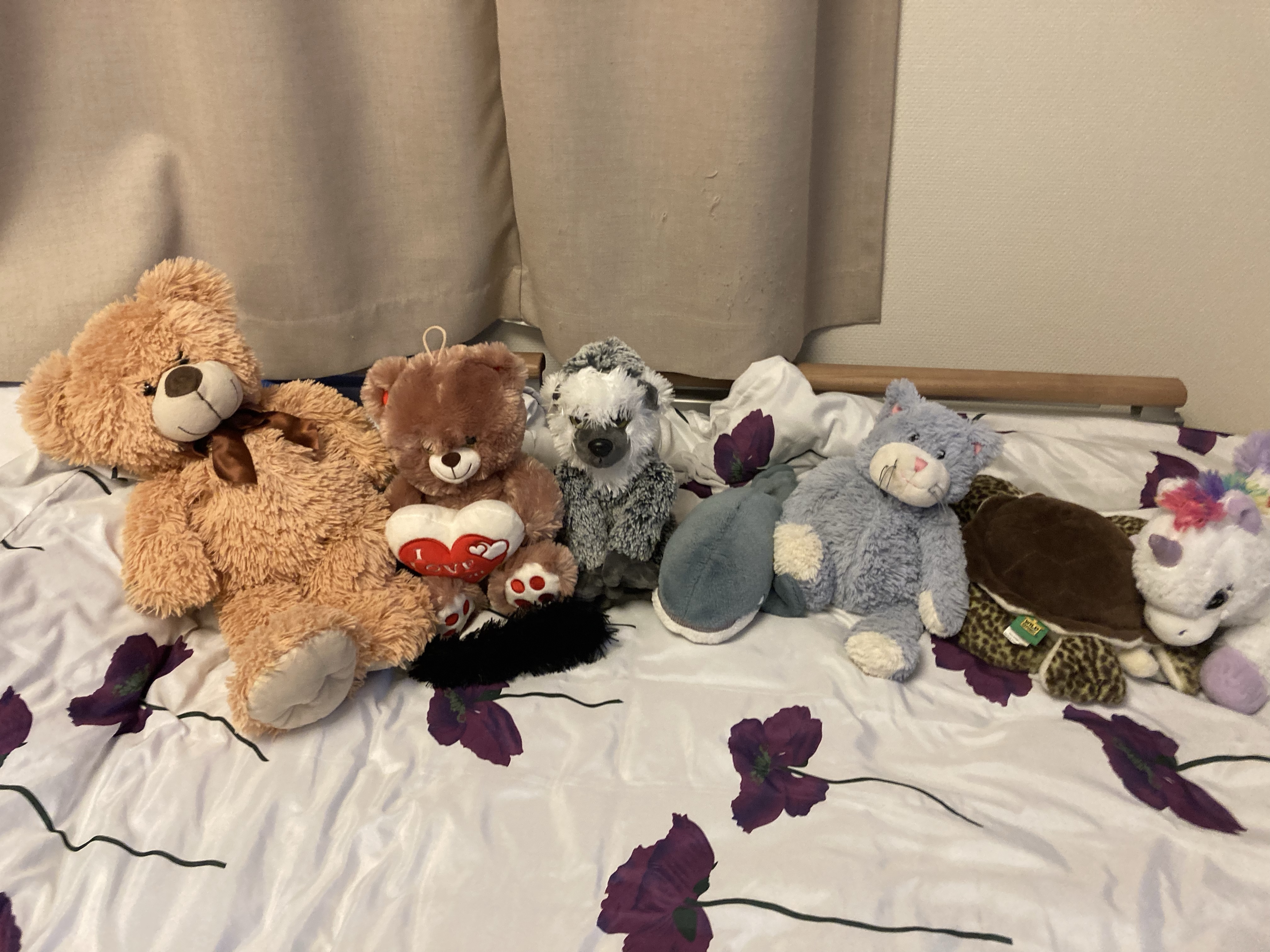
I cannot actually look at it, being that I’m blind, and I cannot touch it from where I’m sitting at my desk, but my bed with all my stuffed animals and the satin duvet cover and pillow case that I got from a staff definitely makes me smile! I just had to leave my desk to take a picture (of course I did arrange the stuffed animals for it!).

5. What always makes you laugh and smile in your life?
My husband’s jokes! He has the funniest sense of humor.

How about you? What always makes you laugh and smile?