April 2025 In My Kitchen

Hi everyone. Phew, I made it to the end of the #AtoZChallenge! It’s 11PM now, but I still badly want to write a post for Sherry’s In My Kitchen linky. I could of course write it tomorrow, as it’s technically a beginning-of-the-month linky in Sherry’s timezone, but that feels off to me. Sadly, though I had planned to do some cooking, I haven’t actually prepared any dinners this past month. However, I did enjoy several other kitchen endeavors.

First, I downloaded several new cookbooks off Bookshare. One of them is Coffee Creations by Celeste Wong. I really want to be able to create my own coffees. That being said, being the scatter-brained person that I am, I didn’t pay attention to the fact that most coffees I felt like creating (lattes) are espresso-based. I did buy a milk frother last Monday, but not an espresso machine. Now I’m either having to be creative by deciding that a regular coffee can be the right base for a latte, or consider the milk frother an impulse buy that isn’t for me. And to be honest, I’m not even sure I like lattes, as I enjoy most specialty coffees more for the syrup and add-ins. I did buy a few bottles of coffee syrup that are probably way too large for me to use up before they’ll go bad.

Other than that, I’ve also been creating smoothies. I created the best cherry chocolate mocha smoothie. When starting the blender, it made a weird noise, so I was worried that some cherry pit had remained in my store-bought packet of frozen cherries. I guess not though, since there were no pit remains in my smoothie as far as I could tell and I didn’t get sick either.

I also made a mango-passion fruit smoothie. Yuck! I used mango, passion fruit, banana and coconut water and I guess I don’t like the taste of passion fruit, as I’ve used all other ingredients before and had no problem with them. My fellow clients did claim they liked this one though.

Lastly, I have one kitchen adventure to share that was a success: flat bread topped with cheddar, sun-dried tomatoes, red onion and bell pepper.
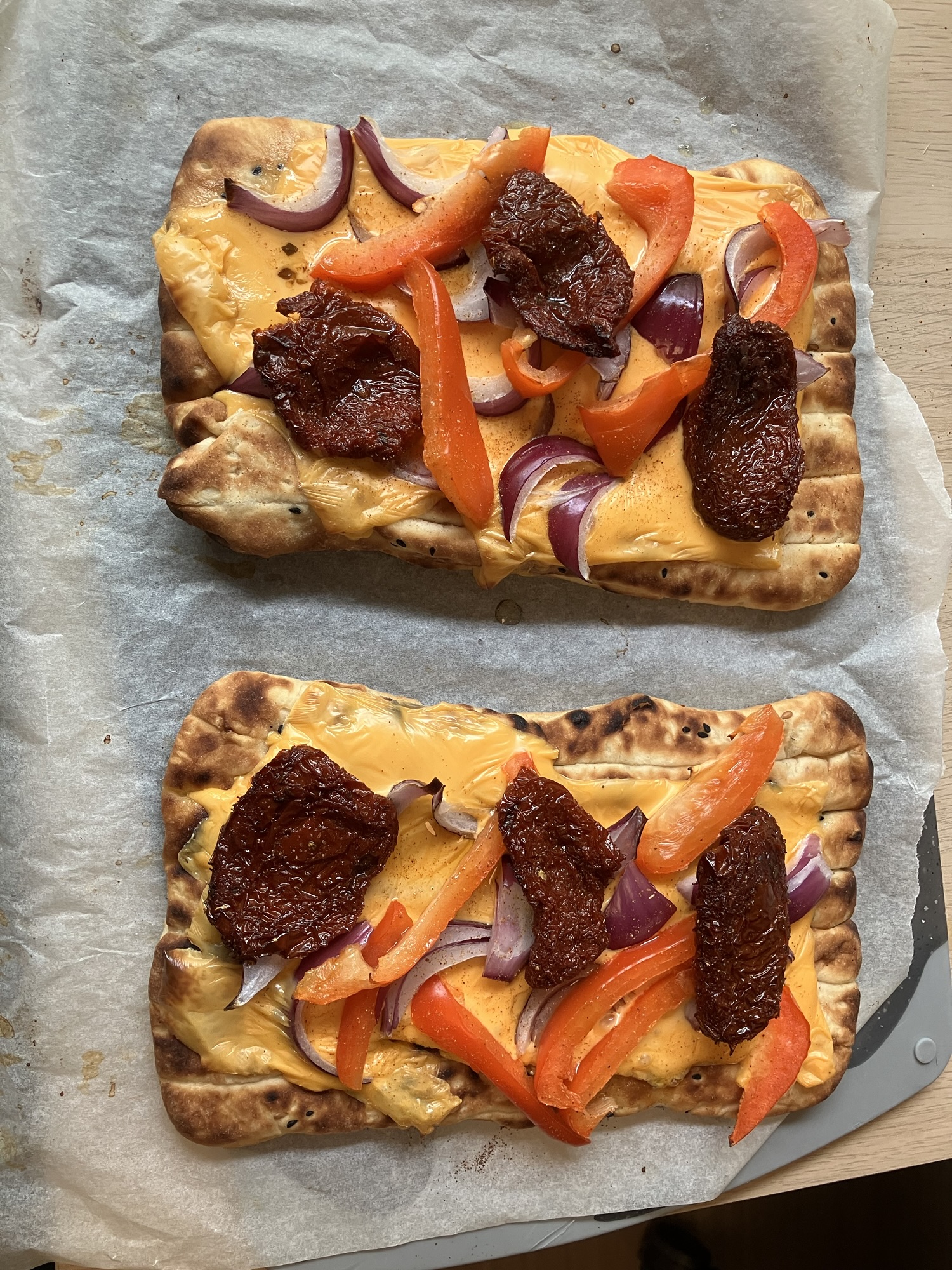
When running the photo through Be My Eyes, an image description app, it identified every ingredient correctly, including correctly naming the flat bread. It however did say the flat bread was topped with “orange cheese”. I was apparently already totally blind by the time I saw cheddar for the first time, as I can’t remember its color. I asked my best friend whether this was the pinch of cayenne I had used or whether cheddar is orange. It turns out in the Netherlands, cheddar is colored with annatto and as a result is a little orangey. Originally, it is a white cheese. Isn’t that interesting?

Zodiac, Etc.: Astrology for Personal Growth #AtoZChallenge

Hi everyone. For my letter Z post in the #AtoZChallenge, I’m writing about astrology. This may be seen as cheating once again, as astrology is about as far removed from science as can be, but then again my topic is personal growth and some people do believe in astrology and use it for self-development. I realize I already wrote a bit about the topic for my letter T post in 2020, which also covered tarot. Like you may’ve noticed during this year’s #AtoZChallenge if not the one in 2020, I believe firmly in picking what works for you and leaving the rest whether it’s science-based or not. Like, I personally do find the Enneagram helpful and I occasionally do visit astrology forums online too. I just wanted to make clear that I’m not claiming there’s any evidence behind it.

So what is astrology? Astrology is the belief that the position of the stars and the celestial bodies they form in space have an influence on people and the natural world. The Zodiac sign, or sun sign, is the celestial body closest to the sun at the time of an event (usually a person’s birth). Mine is Cancer. There are other signs that are important in astrology too, such as the person’s moon sign.

What does someone’s Zodiac sign say about their personality? Honestly, nothing. I mean, I did a quick Google search for personality traits of people with the Zodiac sign Cancer and, though the first two hits (I was too lazy to look any further) included somewhat similar traits, they are incredibly broad and I no doubt would be able to find different descriptions if I weren’t so lazy. For example, Cancers are supposed to be caring, creative and intuitive. They also supposedly value long-lasting relationships. Well, doesn’t everyone? Oh, and we care about traditional values. Not me! But maybe that’s because I was born prematurely and should really have been a Libra. Just kidding.

Youth to Midlife: At What Point is Personality Development Complete? #AtoZChallenge

Hi everyone. I’m cheating a little with my letter Y post in the #AtoZChallenge, because I’m not really talking about any Y topic. That is, my topic for today is personality development from youth to midlife.

Many people believe that someone’s personality development is more or less complete by the age of eighteen. This isn’t true. The last phase in emotional development, which covers people’s individuation from everyone else, isn’t complete until a young adult has reached age 25 or so.

Similarly, cognitive abilities such as executive functioning, which is important for impulse control, haven’t fully developed until a person is in their late twenties.

As such, can we say that someone is well and truly an adult by the age of 30? Not necessarily. After all, life experiences also contribute to adulting. This means that in today’s society, where people leave home later, many don’t start a family until they’re in their mid-thirties, etc., with respect to life choices, someone hasn’t truly faced the most difficult ones until they’re around age 40. Which is midlife whether you want it or not. Yes, Millennials like me might want to pretend to still be youthful, and this makes sense from a personality development standpoint, but we’ve most likely had (nearly) half our life behind us.

What does this mean if you want to work on personal growth? What does it mean when you’re struggling with a personality disorder? Personality disorders are said to start in early adulthood and be stable over time, but are they?

I try to see it as there being hope. People with certain personality disorders, such as borderline personality disorder, do experience improvement of their symptoms as they get older. In fact, when I was in my mid-twenties, my psychiatrist told me my dissociative and emotion regulation problems (which were at the time not diagnosed as BPD, by the way) would likely get better as I got older. So far, they haven’t, but then again I (hopefully) still have half my life ahead of me.

Xennials, Boomers, Gen Z, Etc.: Does Your Generation Determine Your Personality #AtoZChallenge

Hi everyone. Wow, we’ve arrived at the dreaded letter X! Now let me tell you X, by recommendation of one of the founders of the #AtoZChallenge (I don’t remember who) several years ago, was the first letter I decided on a topic for. This topic isn’t necessarily related to personal growth or even psychology, more to sociology. However, it’s fun nonetheless.

My topic for today’s post is generations. The idea that people of one generation have similar traits that differ from those of another generation, is tempting. Like, we all grew up at different times in history, so doesn’t it make sense that the technology available to us, the major world events of our teen years, etc. affect our personality?

The short answer to this though is “No”. Yes, young people (Gen Z currently, those born between 1995 and 2010) have a different attitude to life than older people like Gen X (birth years 1965-1980) or Boomers (1945-1965). They, for example, tend to have a more laid-back work ethic (also known as them being lazy) and a more relaxed view towards the future.

I see this myself in all the temp workers who are self-employed, most of them in their early to mid twenties. They clearly are in there for the quick money (self-employed temp workers get nearly twice as much as regular employees) and have a rather short-sighted attitude, such as not having disability/sick leave insurance.

If you read this, you may wonder why I said generations don’t have different characteristics. The reason I said so is it’s not their generation, but their age. When other generations were in their early twenties, they had a similarly laid-back attitude towards work or school. As an example, I’ll give my father (Boomer): he was in college for ten years free-wheeling through different majors and never finished anything. As he got older though, he did develop a more serious work ethic.

So what generation am I? I was born in 1986 so am none of the generations mentioned in the title. Xennials, after all, are on the cusp between Gen X and Millennials, roughly birth years 1977-1983. Instead, I’m a core Millennial. And it’s definitely the best generation to be in. After all, in our teens, we got a world-shattering terrorist attack to adapt to, in our twenties, we survived the Great Recession, and in our thirties, we survived COVID. If that doesn’t make us resilient, I don’t know what does. Just joking.

#WeekendCoffeeShare (April 27, 2025)

Hi everyone. I really wanted to write a #WeekendCoffeeShare post yesterday, but was dealing with neck and shoulder pain and was quite tired, so I lay in bed by 9:30PM. I originally intended this to be a quick lie-down and planned to write my post after my music pillow had auto-disconnected after thirty minutes. Well, before those thirty minutes were up, I set the pillow to keep playing until I either manually turned it off or its battery was empty. Guess what? I know for a fact that the latter happened sometime during the night, because the pillow was no longer connected when I woke up at 8:30AM, but I swear I didn’t hear its pretty loud sound indicating it needs charging. I slept like a log!

Anyway, all this to say I’m doing my coffee share on Sunday evening. I’ve just had my last cup of coffee for the day, but I can serve you some soda or tea. Let’s have a drink and let’s catch up.

If we were having coffee, first as usual I’d talk about the weather. We’ve had some rain, some sunshine and some clouds. Today, the daytime temp was 19°C. We’re supposed to get almost summerlike temps of 23-24°C this coming week.

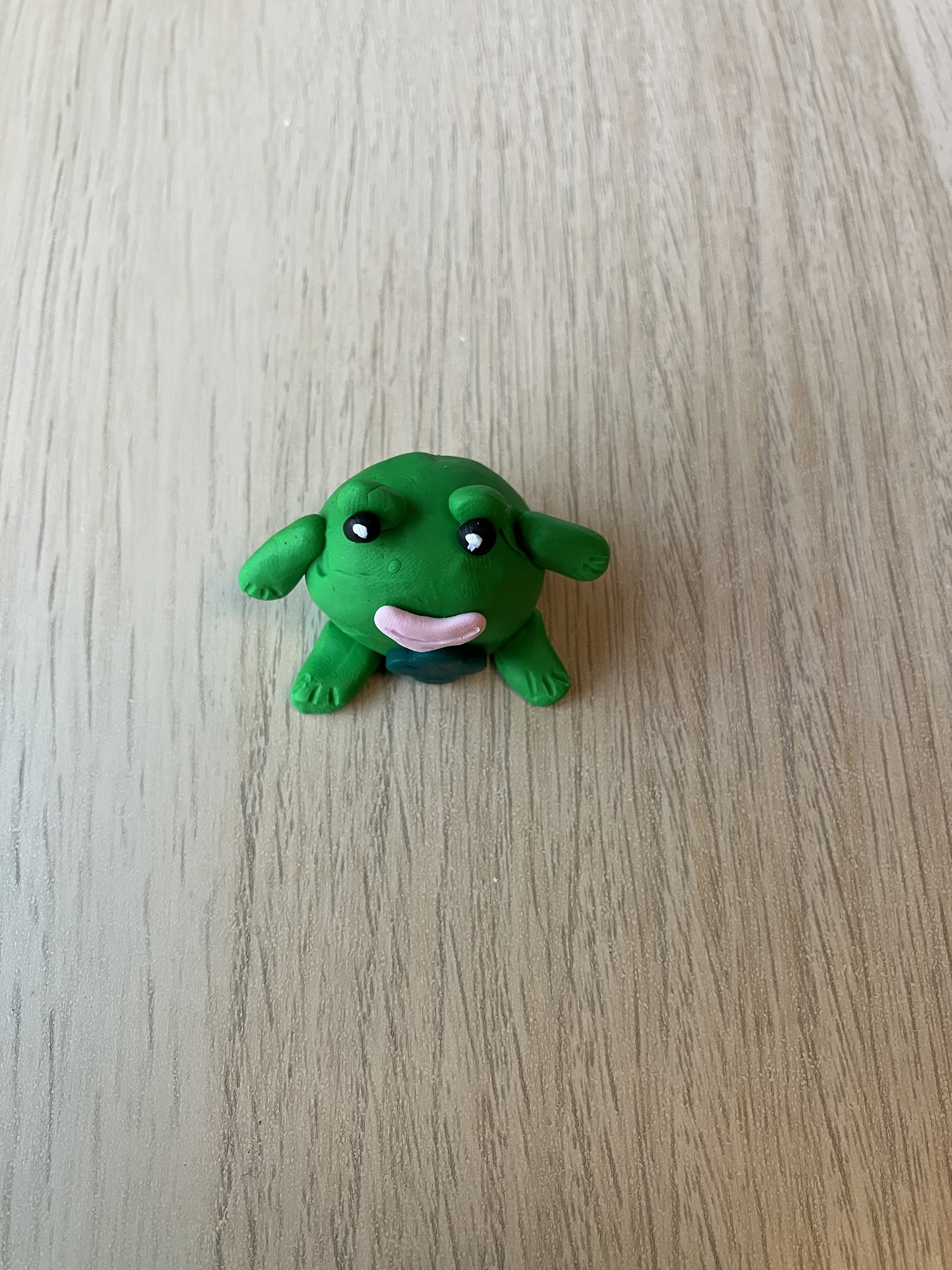
If we were having coffee, next I’d share that I’ve been crafting again. I made several polymer clay frogs for staff members who are recovering from surgery. The frog (Dutch: “kikker”) is sometimes used as a symbol for cheering someone up (“opkikker”). The first one took me over an hour to finish, but the second one was so much easier once I’d figured out how I wanted it. Here’s the second one.

If we were having coffee, then I’d tell you that I have a new assigned staff. One of my two assigned staff is on long-term leave for familial reasons and the other is a student. I had been a bit angry at the student for various reasons, among which her way of communicating the temp worker situation with me. The new one will be my assigned staff together with the student. I can get along with her pretty well.

If we were having coffee, finally I’d make use of the fact that I write my coffee share on Sunday to share that my spouse and I had an important discussion today after our outing to have lunch and shop. We have made up our minds that we’re getting divorced. We will continue to be best friends, but since there’s no sexual or romantic component to our relationship and we’re not living together nor intending on ever doing so again, it makes sense that we officially divorce. We have been having this on our minds for several months already, so the discussion, though hard, wasn’t altogether a surprise to me. We mostly need to work out how much my spouse owes me for my contribution to our mortgage, so that the house can be completely my best friend’s and no longer mine. I guess I will from now on refer to my spouse as my best friend to ease the transition for me.

It may seem like I’m not affected emotionally by this decision, but I am. I mean, I’ve mentioned a few times that my spouse and I will always be soulmates, but the fact is nothing is for certain. When we got married after all, it was to affirm our everlasting love to one another. Though our feelings for each other haven’t changed all that much since we first met in 2007, there’s this voice in me telling me this is the beginning of the end. I tell myself this is attachment anxiety talking. Whether it is or this fear is real, doesn’t really matter in the present moment though, as right now we’re still soulmates.

Wings and Arrows: How the Enneagram Types (and Other Personality Types) are Interconnected #AtoZChallenge

Hi everyone. Today for my letter W post in the #AtoZChallenge, I want to talk about the interconnectedness of various traits that might, if looked at another way, actually distinguish between personality types. I’m starting with the Enneagram wings and arrows, as I know those best, but may also branch out into other typologies.

Like I shared in my general post on the Enneagram, even though you are thought to be one out of nine different Enneagram types, the types are connected via wings and arrows. I will explain this using my own Enneagram type, which is Four, as an example.

First, each Enneagram type has two wings. In the case of Four, these are Three and Five. The wings complement the main type to form a more complete personality. Most people use both wings, though many use one more than the other. For example, I use my Five wing more.

As a Four, I tend to be dramatic and emotional, while my Five wing allows me, type Five being the Investigator, to look at things more intellectually. The Four with a strong Five wing is sometimes called the Bohemian. Had I had a stronger Three wing, I’d be characterized as the Arisstocrat, because type Threes are usually goal-driven.

Then there are the arrows. These connections determine which way each type moves under stress or in exceptional health. Fours move to type One in health and to type Two in stress.

Of course, a stressed type Four is not the same as a regular type Two. A regular Two, being the Helper, will possibly be a bit codependent but not to an extreme degree, whereas a stressed Four will be overly dependent and needy. As such, one Enneagram type is not better than another, but each type will use the positive qualities of one arrow when particularly healthy and the negative traits of another when particularly stressed.

I relate to characteristics of many Enneagram types. This is understandable not just because of the wings and arrows, but also because each type with two others will be in a particular triad and, depending on your perspective, these triads will be different. For example, type Four is with Three and Two in the heart-centered triad )which means that these types make decisions primarily based on their heart). In another respect though, types Four, Five and Nine are in the same triad, which, if I remember correctly, is based on reactivity.

In a similar way, MBTI types are grouped by primary cognitive function, but they can also be grouped by the dichotomous letter combination. What I mean is, in the latter case, INFJ and INFP are similar, while in the former, they couldn’t be different.

Of course, like I’ve said before, everybody is unique and we all could relate to traits of different types.

Values and Vision: Determining What’s Important in Life to You #AtoZChallenge

Hi everyone. I’m still struggling a bit, but I was pretty creative again today. Besides, I’m still going strong with the #AtoZChallenge and that’s an accomplishment in its own right. Today’s letter is V and I want to talk about values and how to have a vision for your life.

Like I shared when discussing positive psychology, living a life in accordance with your values is part of living the Good Life, which is the second step on the ladder to happiness. Having a vision in life, ie. something bigger than yourself to live for, is part of the highest step in happiness, the Meaningful Life. If it’s merely something personal you want to accomplish, a life vision can also help you if you’re “just” on the second step. But how do you decide on your values and create a vision for your life?

Most people live by many different values. When Googling, I actually found long lists of possible values. For example, one started with achievement, authenticity, autonomy, beauty and I’m pretty sure I forgot some starting with A and B. However, the key to living your life with intention is to narrow them down and decide which five or so are the most important to you. You may then even be able to choose two or three that are your absolute top priority. These are your core values and these will most likely be fairly stable throughout adulthood. Deciding whether your decisions align with these values, will guide you on your path towards a more meaningful life.

A way to figure out your core values is to have an honest conversation with your inner wise person, ie. yourself as a person nearing the end of their life. How would you like to be able to look back at your life?

You will, when you’ve figured out your core values, also be able to set a vision for your life. Put simply, this is what you ideally want to see when you reflect on your life near the end of it.

So are core values actually science-based? In general, yes, but it depends on how you use them. If you merely write down a few values and never actively work on living by them, you will not gain anything from them. Yes, that includes my choosing a word for the year and only thinking about it once a month when it was time to do my monthly reflection. However, if you hold all your important decisions up against your core values, they will certainly be helping you live a more meaningful life.

Unique: Using Your Individual Qualities for Personal Growth #AtoZChallenge

Hi everyone. I’m currently quite triggered and feeling unsafe, so this is going to be a bit of a ramble. For my letter U post in the #AtoZChallenge, I’d like to talk about how each person is different and how to use your own unique qualities for personal growth.

Some people like to categorize or label themselves or others, for example using the MBTI, Enneagram or another personality test. There is nothing wrong with this in itself, but if you take your labels too seriously, you run the risk of not seeing the person you yourself are.

For example, I’m an Enneagram 4. For the longest time, I thought that because I identify most with this type, I also had to identify with similarly-described types in other categories. If you’ve seen my post on the MBTI, you’ve seen that for a long while, I identified as INFJ. I still am not sure whether I’m an INFJ or INTJ and basing my identity solely on a meme, isn’t quite wise. That being said, the reason I forever thought I must be an INFJ, is in part that I identify most with Enneagram type 4. However, the Enneagram is based on core motivations, whereas the MBTI is based on cognitive preferences, so why would an Enneagram 4 need to be a Feeling type?

Personality tests, like I’ve said, can definitely help understand yourself. However, they are not the be all and end all of self-understanding. Neither is any other method of identifying yourself as one particular type or another. Not even deep introspection. Yes, it will lead you to a deeper understanding of yourself, but if then you decide to narrow your identity down to a type or even a rating on the Big Five, you’re not doing yourself justice. You are unique, after all. And yes, so is everybody else.

Therapy, Counseling and Coaching for Mental Health and Personal Growth #AtoZChallenge

Hi everyone. Today for my letter T post in the #AtoZChallenge, I want to talk about therapy and other forms of support when you’re dealing with mental health problems and/or when you want to grow as a person.

Generally speaking, therapy isn’t for personal growth, although as a person you may grow when overcoming mental health problems. What I mean by this, is that your therapist isn’t just a sounding board and they aren’t your friend. If you’re feeling pretty good overall, formal therapy at least here in the Netherlands isn’t what you should be looking for. After all, therapy is aimed at helping you, in as little time as possible, to overcome your mental health problems. Here in the Netherlands, in fact, there’s a limit on the number of psychotherapy sessions you can get covered by health insurance. Of course, you could pay out of pocket for more, but if you’re reasonably well-adjusted, why should you?

Coaching and counseling are much more affordable and accessible because anyone can call themselves a counselor or coach. This also means that you’ll find coaches or counselors who align with almost any spiritual or psychological teaching. There are Enneagram coaches, for example, even though the Enneagram is actually nonsense. Did I, a person who frequently writes about herself as an Enneagram type 4, just say that? Yes, I did.

There are, of course, also coaches or counselors who do work within the framework of science-based psychology and education. For example, many people call themselves ADHD coaches and they do (I assume) have some knowledge of the current ideas surrounding ADHD.

Psychotherapy is, here in the Netherlands, often heavily protocol-based depending on your diagnosis or main problem. This is also what I’ve often found frustrating. Like, when I was diagnosed with borderline personality disorder, my psychologist wanted to do schema-focused therapy, but the modes and all that didn’t fit in with my experience of being plural.

At other times, therapy didn’t suit me because, while I sort of understood the theory, I wasn’t able to apply it in practice. This is why I eventually stopped doing dialectical behavior therapy.

I personally don’t do well with therapies that are merely focused on skill-building or that are primarily verbal (talk therapy). I have had the most success with art and movement therapies. I currently do movement therapy based on the Sherborne method. This is a sensory and attachment-based therapy approach. For example, today my therapist brought a multisensory tool called CRDL. When both of us touched the tool with one hand and touched each other’s hands or arms, the CRDL made different calming sounds. This is helping me regulate far better than any DBT skill helped me.

Shame and Guilt: How to Deal With Difficult Emotions #AtoZChallenge

Hi everyone. Today for my letter S post in the #AtoZChallenge, I want to talk about how to cope with hard-to-deal-with emotions such as shame and guilt.

First, what are shame and guilt? Shame is a complex emotion that usually arises when you think you’ve failed. Shame is not really focused on the specific action that causes you to feel bad about yourself, but rather it is focused on your identity. As a result, shame can cause you to feel inadequate or worthless.

Guilt, on the other hand, is an emotional response to thinking you’ve done something wrong. It, unlike shame, is linked to the specific mistake you made and it as a result often prompts you to try to rectify it.

Put simply, shame is an emotion that prompts people to hide, whereas guilt prompts people towards justice.

How do you deal with shame and guilt? First, identify what shame feels like for you. For instance, where do you feel it in your body?

Then, identify your shame triggers. Shame and guilt are both triggered by specific events. However, shame often leads us to feel like we as people are flawed, rather than us having simply made a mistake. As such, we often lose sight of the specific situations that trigger us to feel shame. Try to identify these.

Then, identify and challenge the specific thoughts that cause you to feel like you’re altogether bad. Shame can be helpful in pointing out ways in which you’ve failed, but these mistakes do not make you a failure as a person.

Finally, right the wrong. Do what it takes to rectify the mistake you made that caused you to feel shame. For example, if you’ve damaged another person’s stuff, buy new stuff or give them money or whatever. At the very least, apologize. And do the work necessary to prevent you making the same mistake again. Going into hiding out of shame doesn’t do any good. Admitting your guilt and making amends does.

There are other difficult emotions I could’ve mentioned here, such as bitterness and anger (except that these don’t start with the letter S). These are in a similar way related to each other that shame and guilt are: while bitterness leads people to inaction, anger leads people to fight for what they believe in. Anger, of course, can turn to the extreme of rage and then be inappropriate, but in general it’s healthier to be angry rather than bitter. In every situation, it is recommended to watch for all-or-nothing thinking that can lead you towards hopelessness and self-defeat.